

Paid search advertising explained (without the jargon)
What is paid search advertising?
When people need something, where do they go? The internet. Over 90% of all online experiences begin with a search engine. This means your potential customers are actively looking for solutions right now. How do you make sure they find your business?
Paid search advertising offers a direct path to these eager customers. It’s not just about showing up; it’s about showing up at the precise moment someone is ready to buy or learn. This strategy is vital for businesses aiming for rapid growth and measurable results, forming the backbone of effective Revenue-driven paid search advertising. Paid ads often account for a significant portion of digital ad spend, delivering a strong return on investment.
In this comprehensive guide, we’ll strip away the jargon and explain everything you need to know about paid search advertising. We’ll cover what it is, how it works, how to set up successful campaigns, and most importantly, how to measure its impact on your bottom line. Get ready to open up the power of intent-driven marketing.
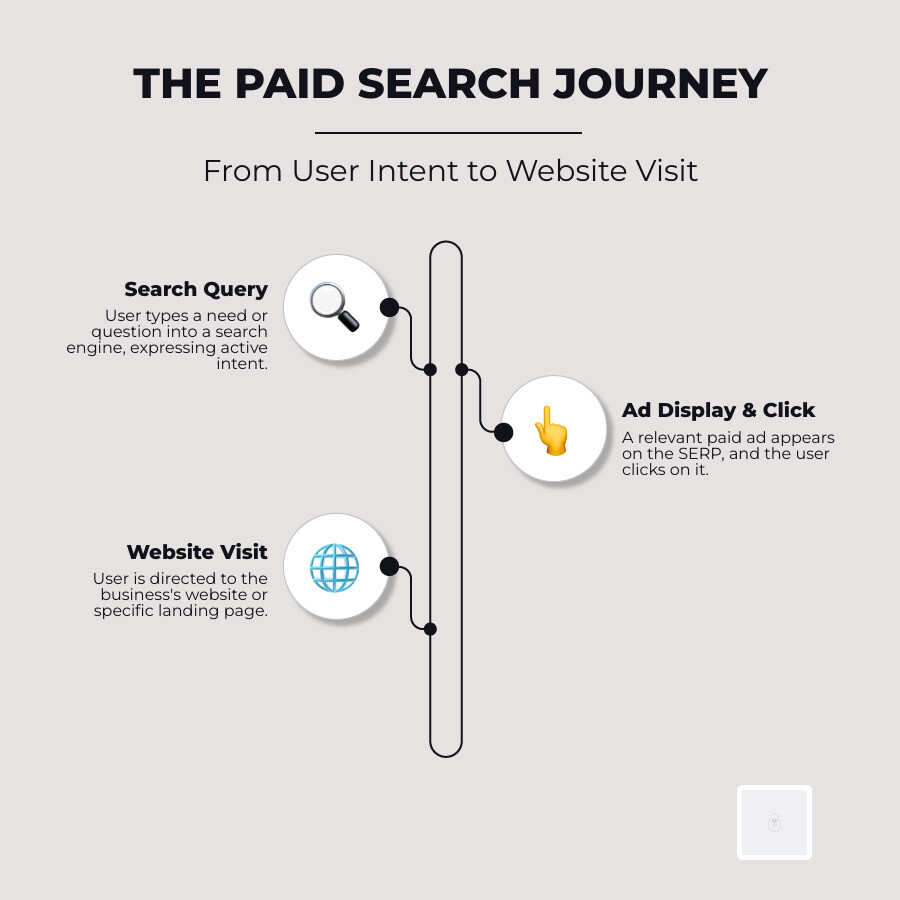
Paid search advertising, often referred to as Pay-Per-Click (PPC) advertising, is a digital marketing strategy where businesses pay to have their advertisements displayed on search engine results pages (SERPs). When someone types a query into a search engine like Google, they are presented with a list of results. These results typically include both organic (unpaid) listings and sponsored (paid) listings.
The core idea behind paid search is to leverage user intent. When someone performs a search, they are actively expressing a need, a question, or a desire. Paid search allows businesses to place their offerings directly in front of these users at that critical moment. This makes it incredibly powerful, as you’re reaching people who are already interested in what you have to offer.
Unlike traditional advertising, where you pay for impressions regardless of engagement, paid search operates on a PPC model. This means you only incur a cost when a user actually clicks on your ad and is directed to your website. This makes it a highly cost-effective and measurable form of advertising.
Consider these compelling statistics:
- Over 90% of online experiences begin with a search engine.
- 85% of consumers use search engines to find information about products or services.
- About 30% of consumers click on paid search ads to further their search.
These numbers underscore the immense potential of paid search to connect businesses with a highly engaged audience.
The mechanics: How ad placement and costs are decided
When you run a paid search campaign, your ads don’t just appear automatically. Every time a user initiates a search query, an automated process called an ad auction takes place in milliseconds. This auction determines which ads will appear for that specific query, and in what order.
The outcome of this auction is largely dictated by two primary factors: your bid and your Ad Rank. Your bid is the maximum amount you’re willing to pay for a click on your ad. However, simply outbidding your competitors isn’t enough to guarantee the top spot, or even a spot at all. This is where Ad Rank comes in.
Ad Rank is a value that search engines like Google assign to your ad, determining its position on the SERP and how much you’ll actually pay per click (your Cost-Per-Click, or CPC). While the exact algorithms are proprietary, they generally follow a formula that looks something like this:
Ad Rank = Bid Amount × Quality Score + (Impact of Ad Extensions and other ad formats)
This means that even if a competitor bids higher than you, a superior Ad Rank (driven by a higher Quality Score) can allow your ad to appear in a better position for a lower cost. In fact, 46% of page clicks go to the top 3 paid search ads, highlighting the importance of a strong Ad Rank.
The role of quality score
Google’s Quality Score is a crucial metric, assigned as a number between 1 and 10, that measures the overall quality and relevance of your keywords, ads, and landing pages. A higher Quality Score means better ad positions and often lower costs. It has an enormous influence over the cost and effectiveness of your paid search marketing.
Quality Score is primarily determined by three factors:
- Expected Click-Through Rate (CTR): This is the likelihood that your ad will be clicked when shown. If your ad is highly relevant and compelling, users are more likely to click it, indicating a high expected CTR.
- Ad Relevance: How closely your ad matches the intent behind a user’s search query. If your ad copy directly addresses what the user is looking for, it’s considered highly relevant.
- Landing Page Experience: The quality and relevance of the page users land on after clicking your ad. A good landing page is easy to steer, provides valuable information, and is optimized for conversions. It should be mobile-friendly and load quickly.
Improving your Quality Score is paramount. It not only helps your ads rank higher but also reduces your CPC, meaning you get more clicks for your budget. Google provides handy guides on how to improve your Quality Score, which is a critical step for any advertiser.
Common types of paid search ads
While text ads are the most common, paid search advertising encompasses a variety of formats designed to meet different business objectives:
- Text Ads: These are the standard ads you see at the top and bottom of SERPs. They consist of headlines, descriptions, and a display URL. They are highly effective for driving clicks to specific landing pages.
- Shopping Ads (Product Listing Ads – PLAs): For e-commerce businesses, Shopping Ads are invaluable. They display product images, prices, and merchant names directly in the search results, making them highly visual and effective for driving product sales.
- Local Search Ads: These ads appear on Google Maps and in local search results, helping brick-and-mortar businesses attract nearby customers. They often include location details, phone numbers, and directions.
- Ad Extensions: These are additional pieces of information that can be added to your text ads to make them more prominent and useful. They don’t cost extra to add and can significantly improve your ad’s performance.
Here are some popular ad extension types:
- Sitelink Extensions: Additional links to specific pages on your website (e.g., “About Us,” “Contact,” “Services”).
- Callout Extensions: Short, descriptive phrases highlighting unique selling points (e.g., “Free Shipping,” “24/7 Support”).
- Structured Snippet Extensions: Display specific categories of information with values (e.g., “Types: Sedan, SUV, Truck”).
- Call Extensions: Allow users to call your business directly from the ad.
- Location Extensions: Show your business address, phone number, and a map marker.
- Price Extensions: Display prices for your products or services directly in the ad.
- Promotion Extensions: Highlight special sales and offers.
- Image Extensions: Add relevant images to your text ads, making them more visually appealing.
Utilizing a variety of ad formats and extensions can significantly boost your ad’s visibility and click-through rate, leading to better overall campaign performance. Google Ads provides various campaign types to help you achieve your specific marketing goals.
A blueprint for a successful campaign
Setting up a successful paid search campaign requires careful planning and execution. It’s not just about throwing money at keywords; it’s about strategic targeting, compelling messaging, and continuous optimization.
Before diving into the technical setup, we always recommend defining clear campaign objectives. What do you want to achieve?
- Increase website traffic?
- Generate leads?
- Drive online sales?
- Boost brand awareness?
Clearly defined goals will guide your entire campaign structure, budgeting, and measurement strategy. Your budgeting should align with these goals, ensuring you’re allocating resources effectively. Furthermore, the landing page relevance is critical. The page a user lands on after clicking your ad should directly correspond to the ad’s message and the user’s search query, providing a seamless and valuable experience.
Mastering keyword research
Keywords are the foundation of any paid search campaign. They are the words and phrases users type into search engines, and bidding on the right ones ensures your ads appear to the most relevant audience.
Effective keyword research involves understanding:
- Keyword Intent: Are users looking to buy, learn, or compare? Aligning your keywords with user intent is crucial for driving conversions.
- Keyword Relevance: How closely does a keyword relate to your products or services? Highly relevant keywords lead to higher Quality Scores and better performance.
- Keyword Tools: Platforms like Google Keyword Planner are indispensable for identifying potential keywords, analyzing their search volume, and estimating competition and costs.
Once you have a list of relevant keywords, you’ll need to choose match types to control how broadly or narrowly your ads are triggered:
- Broad Match: Your ad may show for searches that include misspellings, synonyms, related searches, and other relevant variations. (e.g.,
women's hatscould trigger for “ladies scarves”). - Phrase Match: Your ad may show for searches that include the meaning of your keyword. (e.g.,
"buy women's hats"could trigger for “where to buy women’s hats online”). - Exact Match: Your ad may show for searches that have the same meaning or intent as your keyword. (e.g.,
[women's hats]would primarily trigger for “women’s hats”).
Finally, don’t forget negative keywords. These are terms you explicitly tell the search engine not to show your ads for. For instance, if you sell new cars, you might add “used” as a negative keyword to avoid showing your ads to people looking for second-hand vehicles. This helps prevent wasted ad spend and improves the relevance of your traffic.
For a deeper dive into optimizing your keyword strategy for maximum return, we recommend exploring resources focused on Revenue-driven paid search advertising.
Crafting compelling ads
Once your keywords are in place, the next step is to create ad copy that grabs attention and encourages clicks. This is your chance to communicate your value proposition directly to potential customers.
Key elements of a compelling ad include:
- Headlines: These are the most prominent parts of your ad. They should be catchy, include relevant keywords, and highlight key benefits or offers.
- Descriptions: Provide more detail about your product, service, or offer. Use persuasive language and reiterate your unique selling points.
- Call-to-Action (CTA): A clear and concise instruction telling users what to do next (e.g., “Shop Now,” “Get a Quote,” “Learn More”).
- A/B Testing: Don’t settle for one ad. Create multiple variations and test them against each other to see which performs best. This iterative process is crucial for continuous improvement.
Here’s an example of how ad copy can make a difference:

Remember to make your ads relevant to your keywords and landing page. A strong ad that leads to a poor or irrelevant landing page will result in a high bounce rate and wasted ad spend. Google Ads reports that including ad assets (like extensions) can increase your ad’s visibility and CTR, further emphasizing the importance of well-crafted and comprehensive ads.
Measuring success: The core of revenue-driven paid search advertising
The beauty of paid search advertising lies in its unparalleled measurability. Unlike many traditional marketing channels, every click, impression, and conversion can be tracked, providing invaluable data for optimization. This allows for rigorous campaign monitoring, continuous improvement, and truly data-driven decisions. The goal is to prove ROI and demonstrate the tangible impact of your ad spend on your business’s bottom line.
Consider these powerful statistics:
- Digital advertising’s share of total ad spend reaches around 74%.
- Paid search often accounts for 40% to 60% of the digital ad spend.
- Paid advertisements have a 200% ROI.
- Businesses make an average of $2 for every $1 they spend with Google Ads.
These figures highlight why meticulous measurement is not just good practice, but essential for maximizing the effectiveness of your investment.
Key performance indicators for revenue-driven paid search advertising
To effectively measure the success of your paid search campaigns, you need to focus on specific Key Performance Indicators (KPIs). While some metrics might seem impressive (often called “vanity metrics”), true success is measured by those that directly impact revenue.
Here are the most important KPIs:
- Impressions: The number of times your ad was displayed. (Vanity metric, but important for reach).
- Clicks: The number of times users clicked on your ad. (Vanity metric, but indicates initial interest).
- Click-Through Rate (CTR): The percentage of impressions that resulted in a click (Clicks ÷ Impressions). A high CTR indicates ad relevance and appeal.
- Conversion Rate: The percentage of clicks that resulted in a desired action (e.g., a purchase, lead form submission, download). This is a crucial revenue-focused metric.
- Cost Per Acquisition (CPA): The average cost to acquire one customer or lead. This tells you how efficient your spending is.
- Return on Ad Spend (ROAS): The revenue generated for every dollar spent on advertising. This is the ultimate revenue-focused metric, directly linking ad spend to profit.
Here’s a comparison of vanity metrics versus revenue-focused metrics:
Vanity Metrics (Good for awareness, less for direct revenue) Revenue-Focused Metrics (Directly impact business growth) Impressions Conversion Rate Clicks Cost Per Acquisition (CPA) CTR Return on Ad Spend (ROAS) Ad Position Customer Lifetime Value (CLV) from paid channels The Importance of Conversion Tracking
Without proper conversion tracking, you’re essentially flying blind. Conversion tracking is the process of monitoring when a user completes a desired action on your website after interacting with your ad. This could be anything from a purchase to a newsletter signup.
Setting up conversion tracking correctly allows you to:
- Attribute: Understand which keywords, ads, and campaigns are leading to actual business outcomes. This helps you allocate your budget more effectively.
- Connect Ad Spend to Sales: Directly see the revenue generated by your paid search efforts, making it easy to calculate ROAS and justify your budget.
- Optimize: Make informed decisions about where to increase bids, what ads to pause, and which landing pages need improvement.
For detailed guidance on setting up and leveraging conversion tracking, explore resources like Why Conversion Tracking Matters for Your Business. This critical step ensures that your paid search advertising is truly revenue-driven.
Paid search vs. organic SEO: A complementary approach
It’s common for businesses to view paid search and organic SEO as competing strategies. However, in reality, they are highly complementary and work best when integrated into a holistic digital marketing plan.
Here’s a quick comparison:
Feature Paid Search (PPC) Organic SEO Speed of Results Immediate. Ads appear as soon as campaigns are active. Slower. Can take weeks or months to see significant ranking improvements. Cost Model Pay-per-click (PPC). You pay for each click. Free clicks. Costs involve content creation, optimization, link building. Longevity Stops when budget runs out. Long-term asset. Rankings can last for extended periods. SERP Placement Top and bottom of the SERP, clearly marked as “Ad.” Below paid ads, in the main organic results section.
While paid search offers immediate visibility, organic SEO builds long-term authority and trust. Google alone handles over 3.5 billion searches every day, and both paid and organic results are vying for that attention.
When to use each strategy
Understanding the strengths of each approach helps you deploy them strategically:
Use paid search for:
- Quick Traffic: Ideal for new businesses, product launches, or seasonal promotions that need immediate visibility.
- Testing: Quickly test keywords, ad copy, and landing pages to gather data before investing heavily in SEO.
- Promotions: Drive traffic to specific sales, events, or limited-time offers.
- Targeted Reach: Precisely target specific demographics, locations, or user intents.
- Competitive Keywords: Appear for highly competitive terms where organic ranking is difficult or takes too long.
Use organic SEO for:
- Long-Term Authority: Build sustained online presence and brand credibility.
- Foundational Content: Drive traffic to evergreen content that answers common customer questions.
- Cost-Effective Long-Term Traffic: Once ranked, organic traffic is “free” per click.
- Brand Trust: Many users inherently trust organic results more than paid ads.
How they work together
The true power emerges when paid search and organic SEO collaborate:
- Keyword Data Sharing: Paid search campaigns generate immediate data on keyword performance (CTR, conversions). This valuable insight can inform your SEO strategy, highlighting high-converting keywords to target organically. Conversely, strong organic keywords can be used to refine paid campaigns.
- Total SERP Domination: By appearing in both paid and organic results for the same query, you increase your visibility and control more of the search results page. This can lead to a higher overall click-through rate.
- Remarketing to Organic Visitors: You can use paid search (specifically remarketing campaigns) to re-engage users who visited your site through organic search but didn’t convert. This is a highly effective way to nurture leads.
- Brand Awareness & Trust: Paid ads can boost brand visibility, which can indirectly lead to more clicks on your organic listings. As users become familiar with your brand through ads, they might be more inclined to click your organic results later.
Combining these strategies allows you to capture both immediate demand and build lasting authority, maximizing your online presence. For more on the distinctions and synergies, consider reading about How Paid Search Differs from Organic SEO.
Frequently asked questions about paid search
Navigating paid search can bring up several common questions. Let’s address some of them.
How much does paid search cost?
The cost of paid search advertising is highly variable and depends on several factors:
- Industry & Competition: Highly competitive industries (e.g., legal, finance) tend to have higher keyword costs.
- Keyword Bids: The maximum amount you’re willing to pay per click.
- Quality Score: As discussed, a higher Quality Score can lower your actual CPC.
- Targeting: Specific geographic targeting, audience segments, or device types can influence costs.
- Daily/Monthly Budget: You set a daily budget, and the platform (e.g., Google Ads) aims to spend that amount over the month.
While there’s no single answer, you have significant control over your spending. You can start with a modest budget and scale up as you see positive results. The key is to optimize your campaigns to ensure every dollar spent delivers maximum return.
How long does it take to see results from paid search?
One of the most attractive aspects of paid search is its immediacy. Once your campaigns are set up and approved, your ads can start appearing on SERPs almost instantly. This means you can begin generating clicks, traffic, and conversions within hours or days of launching a campaign.
However, “results” can mean different things. While traffic begins immediately, optimizing for the best possible CPA and ROAS takes time. You’ll need to gather data, analyze performance, and make adjustments (e.g., refining keywords, tweaking ad copy, optimizing bids) to achieve peak efficiency. Most businesses see significant, optimized results within a few weeks to a few months.
Can I do paid search myself?
Yes, you absolutely can set up and manage paid search campaigns yourself. Platforms like Google Ads are designed to be user-friendly, especially for beginners. Many resources, including those from Google, offer step-by-step guides for setting up your first campaign.
However, managing successful paid search campaigns, especially for Revenue-driven paid search advertising, requires ongoing effort, expertise, and a commitment to continuous learning. It involves:
- In-depth keyword research and negative keyword management.
- Crafting compelling ad copy and testing multiple variations.
- Optimizing landing pages for conversions.
- Monitoring performance metrics and adjusting bids.
- Understanding advanced targeting options (demographics, audiences).
- Staying updated with platform changes and new features.
Many businesses choose to work with a specialized agency or consultant to maximize their ROI and ensure their campaigns are professionally managed. This allows them to focus on their core business while experts handle the complexities of paid search. For those considering professional help, understanding How to Know You’re Hiring the Best Google Ads Agency is a valuable step.
Final thoughts
Paid search advertising is an indispensable tool in today’s digital marketing landscape. It’s a powerful, intent-based marketing channel that allows businesses of all sizes to connect directly with customers actively searching for their products or services.
We’ve covered the essentials:
- What it is: A PPC model leveraging user intent on SERPs.
- How it works: An ad auction driven by bids and Quality Score.
- Why it’s important: Immediate visibility, measurable ROI, and precise targeting.
- How to set it up: Strategic keyword research, compelling ad copy, and robust tracking.
- How to measure success: Focusing on revenue-driven KPIs like Conversion Rate, CPA, and ROAS.
- How it complements SEO: Working together for total SERP domination and long-term growth.
The accessibility and measurability of paid search make it a fantastic opportunity for businesses looking to grow their online presence and drive tangible results. By focusing on quality, relevance, and continuous optimization, you can open up the full potential of paid search advertising and significantly impact your bottom line.