

Scaling smarter: How AI and automation are revolutionizing marketing, sales, and HR
Sponsored content. This article was supplied by a third party and Business Money has been paid to publish it.
The dawn of intelligent operations
In today’s dynamic business landscape, the ability to scale smarter is paramount for sustained growth. This isn’t just about doing more; it’s about optimizing every facet of our operations. At the heart of this change lies business automation, which refers to the application of technology to automate repetitive, routine, and often manual tasks within an organization. This can range from simple rule-based processes to complex, intelligent workflows.
The distinction between traditional automation and AI-powered automation is crucial. Traditional automation, often seen in Robotic Process Automation (RPA), follows predefined rules and scripts. It excels at executing predictable, high-volume tasks with precision. AI, however, introduces intelligence. It enables systems to learn from data, make decisions, adapt to new information, and even perform tasks that require human-like cognitive abilities, such as natural language understanding or predictive analytics. When combined, these forces create a powerful synergy, transcending mere task execution to enable strategic, adaptive operations.
Many businesses grapple with scaling challenges: increasing customer demands, managing vast amounts of data, and the constant pressure to innovate while keeping costs in check. AI and automation offer a compelling solution by driving significant efficiency gains. They free up human talent from mundane tasks, allowing teams to focus on higher-value activities that require creativity, critical thinking, and strategic insight. This shift not only boosts productivity but also improves employee satisfaction and fosters a culture of innovation.

The impact of integrating these technologies across an organization is profound, leading to measurable improvements in various business growth metrics.
Automating the customer journey: From first touch to final sale
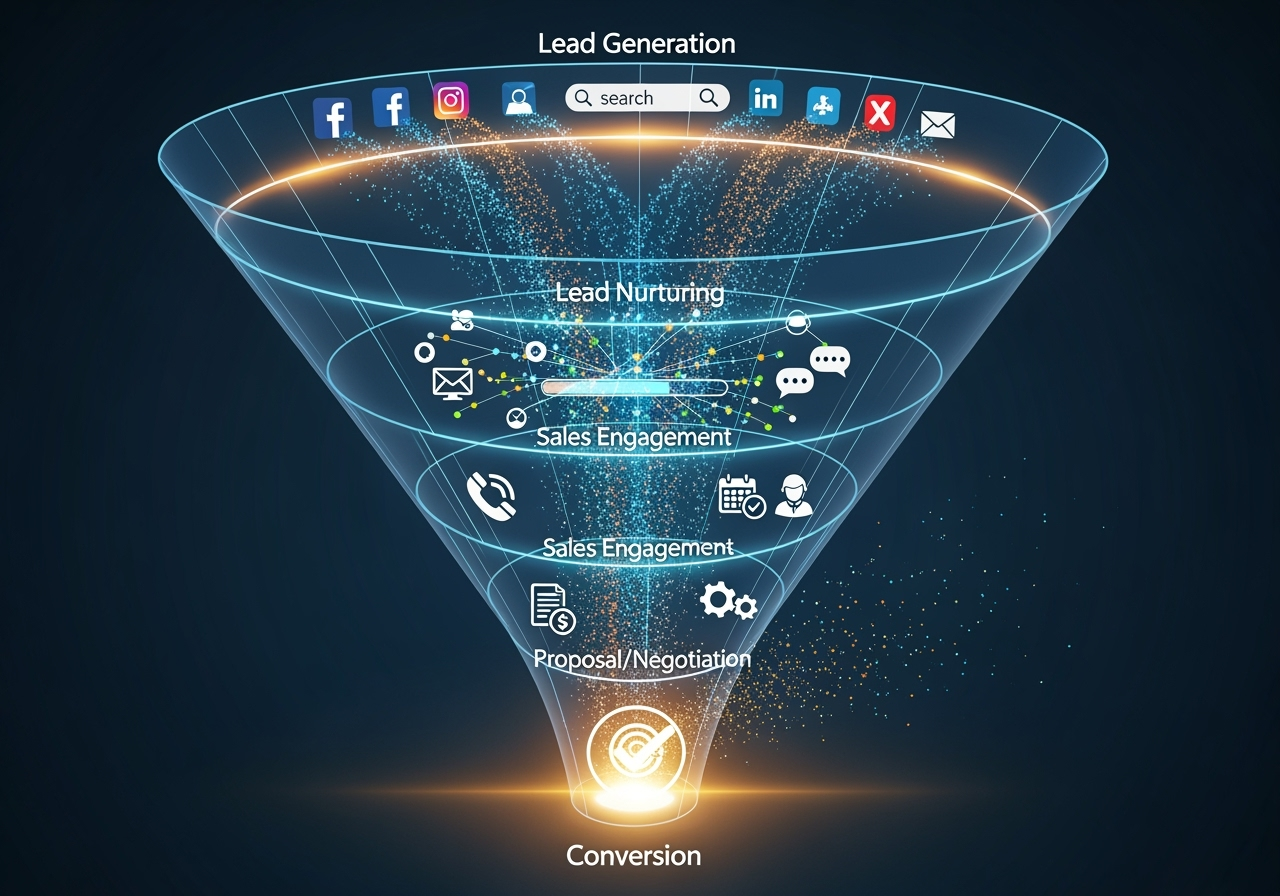
The customer journey is no longer linear; it’s a complex web of interactions across multiple touchpoints. To steer this effectively, marketing and sales alignment is indispensable. When these two departments work in tandem, sharing insights and common goals, the entire customer acquisition process becomes seamless and more effective. Automation plays a key role in fostering this alignment, ensuring that leads are nurtured consistently and handed off smoothly.
Customer journey mapping helps us visualize and understand every interaction a potential customer has with our brand. This clarity allows us to identify critical moments where AI and automation can improve the experience, from initial awareness to post-purchase support. A crucial element in this process is leveraging intent data – information that reveals a prospect’s current research, interests, and likelihood to purchase. This data, gathered from web behavior, content consumption, and third-party sources, provides invaluable insights for targeted engagement.
Central to effective customer journey automation is the development of an Ideal Customer Profile (ICP). An ICP defines the characteristics of a company that would gain the most value from our product or service. This includes factors like industry, company size, revenue, geographic location, and specific pain points. By clearly defining our ICP, we can ensure that our marketing efforts attract the right prospects and our sales teams focus on those most likely to convert.
AI-powered marketing: Personalization at scale
In the age of information overload, generic messaging falls flat. AI empowers marketing teams to deliver highly personalized communication at scale, creating more meaningful connections with prospects.
- Audience segmentation: AI algorithms can analyze vast datasets to segment audiences far more granularly than traditional methods. This allows for hyper-targeted campaigns based on demographics, psychographics, behavior, and intent.
- Predictive analytics: By analyzing historical data, AI can predict future customer behavior, identifying which leads are most likely to convert, churn, or respond to specific offers. This enables proactive marketing strategies.
- AI content generation: From email subject lines to social media posts, AI can assist in generating compelling content variations, optimizing for engagement and conversion.
- Ad optimization: AI-driven platforms constantly analyze ad performance across channels, automatically adjusting bids, targeting, and creative elements to maximize ROI.
Revolutionizing sales with intelligent business automation
Sales is fundamentally about relationships, but the operational aspects can be incredibly time-consuming. Intelligent business automation transforms the sales process, allowing sales professionals to dedicate more time to building rapport and closing deals.
Lead scoring models are dramatically improved by AI, which can assign a numerical value to each lead based on their demographic fit, behavioral engagement, and expressed intent. This moves beyond simple rule-based scoring to dynamic models that learn and adapt, continuously refining their predictions of a lead’s propensity to convert.
CRM integration is the backbone of this revolution. By seamlessly connecting customer relationship management systems with AI and automation tools, we create a unified view of the customer. This ensures that every interaction is tracked, every piece of data is accessible, and every sales activity is informed by the latest insights. This holistic approach prevents data silos and allows for a truly integrated sales process.
Sales forecasting becomes significantly more accurate with AI. By analyzing historical sales data, market trends, and external factors, AI can provide precise predictions, helping sales leaders allocate resources effectively and set realistic targets. For businesses operating in specialized sectors, such as franchise organizations, leveraging Franchise CRM automation can further streamline operations, offering custom solutions for managing leads, franchisees, and customer relationships within their unique business model. These specialized platforms ensure that the specific needs of a franchise network are met, from initial lead generation to ongoing support and expansion.
Mastering lead qualification with AI
Effective lead qualification is the linchpin of sales efficiency. It’s the process of determining whether a prospective customer has the interest, authority, budget, and need to purchase your product or service. Without it, sales teams waste invaluable time pursuing leads that are unlikely to convert.
Understanding the distinctions between different lead types is fundamental:
- Marketing-qualified leads (MQLs): These are prospects who have engaged with marketing content and shown some interest, but are not yet ready for a direct sales approach.
- Sales-qualified leads (SQLs): These leads have been vetted by marketing and/or sales development representatives and are deemed ready for a sales conversation. They typically meet specific qualification criteria.
- Product-qualified leads (PQLs): Common in SaaS, these are users who have demonstrated significant engagement with a product during a free trial or freemium model, signaling a strong likelihood of conversion.
Traditional qualification frameworks like BANT (Budget, Authority, Need, Timeline) and MEDDIC (Metrics, Economic Buyer, Decision Criteria, Decision Process, Identify Pain, Champion) remain valuable. However, AI lifts these frameworks by providing deeper, data-driven insights. AI can analyze communication patterns, historical data, and intent signals to more accurately assess a lead’s fit and readiness. This leads to more precise and efficient lead qualification processes. In fact, many businesses are now turning to AI Business Automation for Lead Qualification to automate the initial vetting process, identify high-potential prospects faster, and ensure that sales teams are always working with the most promising opportunities. These systems can analyze vast amounts of data—from website visits and email engagement to social media activity and demographic information—to score and prioritize leads with unparalleled accuracy.
Even with advanced AI, some leads may not be immediately qualified. This is where nurturing workflows come into play. Automated email sequences, personalized content recommendations, and retargeting campaigns can keep unqualified leads engaged until they become sales-ready.
However, it’s easy to fall into common mistakes. These include relying solely on automation without human oversight, failing to regularly update ICPs, neglecting lead nurturing for those not immediately ready, and poor data management. The most effective approach balances AI’s analytical power with human intuition and personalized interaction.
Streamlining people operations with HR automation
Human Resources, often viewed as a cost center, is being reimagined as a strategic partner through automation. By streamlining routine tasks, HR teams can focus on employee development, engagement, and strategic workforce planning.
The entire employee lifecycle—from recruitment and onboarding to performance management and offboarding—can benefit from automation. This leads to a more consistent and positive employee experience. With AI, HR departments can leverage data-driven HR to gain insights into workforce trends, predict attrition, and optimize talent strategies. This shift from reactive to proactive HR significantly improves organizational agility. HR automation aims at reducing administrative burden, freeing up valuable time for HR professionals to engage in more impactful, human-centric initiatives.

Automating talent acquisition and recruitment
Finding and hiring the right talent is a critical, yet often arduous, process. Automation streamlines each step, making recruitment more efficient and effective.
- Candidate sourcing: AI-powered tools can scour vast databases and online platforms to identify potential candidates who match specific skill sets and experience requirements.
- AI-powered screening: AI can analyze resumes and applications, identifying keywords, assessing qualifications, and even predicting candidate success, significantly reducing the manual effort in initial screening.
- Automated scheduling: Coordinating interviews can be a logistical nightmare. Automation tools can seamlessly schedule interviews based on candidate and interviewer availability, sending reminders and updates automatically.
- Applicant tracking systems (ATS): These systems, often improved with AI, manage the entire recruitment pipeline, from job posting to offer letter, ensuring a smooth and organized process.
Enhancing onboarding and compliance
A smooth onboarding experience is vital for employee retention and productivity. HR automation ensures that new hires feel welcomed and are quickly integrated into the company culture.
- Automated workflows: From sending welcome emails to assigning initial training modules, automated workflows ensure that every step of the onboarding process is completed efficiently and consistently.
- Digital paperwork: Replacing stacks of physical forms with digital documents and e-signatures simplifies the paperwork process, making it faster and more environmentally friendly.
- Training modules: Automation can deliver personalized training paths to new employees, tracking their progress and ensuring they acquire the necessary skills and knowledge.
- Compliance management: Staying compliant with labor laws and regulations is complex. Automation helps manage compliance by ensuring all necessary documentation is completed, policies are acknowledged, and mandatory training is undertaken. This is particularly critical for areas like employment verification. For small businesses, implementing Automated E-Verify for small businesses ensures adherence to federal regulations regarding employment eligibility, minimizing legal risks and administrative overhead. Automated systems simplify this crucial process, making it less prone to human error and more efficient.
A strategic framework for implementing business automation
Implementing AI and automation isn’t a one-off project; it’s a strategic shift that requires careful planning and execution. A robust framework ensures successful adoption and maximizes ROI.
The first step is process identification, where we pinpoint which internal processes are ripe for automation. This involves a thorough analysis of current workflows. Next, tool selection is critical; choosing the right platforms and software that align with our specific needs and existing infrastructure. We must also anticipate and address data integration challenges, ensuring that all systems can communicate effectively and share information seamlessly. Finally, measuring ROI and committing to continuous optimization are essential to prove the value of automation and refine its application over time.
Identifying high-impact automation opportunities
Not all processes are equally suited for automation, nor will they yield the same benefits. Strategic identification is key.
- Process audits: Conduct comprehensive audits of existing workflows to identify bottlenecks, inefficiencies, and repetitive tasks.
- Repetitive tasks: Any task performed frequently and consistently, especially those involving data entry or routine communication, is a prime candidate for automation.
- Data-intensive processes: Workflows that involve collecting, processing, and analyzing large volumes of data can greatly benefit from AI and automation, reducing errors and speeding up insights.
- Cost-benefit analysis: Prioritize automation projects based on their potential to reduce costs, increase revenue, improve accuracy, or improve customer/employee experience.
Measuring success and proving ROI
To justify investment and drive further adoption, we must clearly demonstrate the return on investment from automation initiatives.
- Key performance indicators (KPIs): Define clear, measurable KPIs before implementation. These might include lead conversion rates, sales cycle length, time-to-hire, or customer satisfaction scores.
- Time savings: Quantify the hours saved by automating tasks, both for individual employees and across departments.
- Cost reduction: Track reductions in operational costs, such as labor, materials, or error correction.
- Conversion rate lift: Measure the improvement in conversion rates at various stages of the sales and marketing funnels.
- Employee satisfaction: Monitor employee morale and engagement, as freeing up staff from mundane tasks often leads to increased job satisfaction.
The future is automated: What’s next for businesses?
The journey with AI and automation is just beginning. The horizon promises even more transformative advancements.
Hyperautomation is emerging as the next frontier, referring to an approach where organizations automate as many business and IT processes as possible using a combination of advanced technologies, including AI, machine learning, RPA, and intelligent business process management software. This holistic view of automation seeks to create a truly intelligent enterprise.
Generative AI, capable of creating new content—from text and images to code and designs—is already revolutionizing creative and content-driven tasks. Its integration into marketing, product development, and customer service will open up unprecedented levels of innovation.
The rise of AI Agents will further redefine how we interact with technology. These autonomous entities, powered by AI, can perform complex tasks, make decisions, and even communicate with humans or other agents to achieve specific goals, acting as virtual assistants or specialized copilots across various functions.
As we accept these powerful technologies, ethical considerations must remain at the forefront. Ensuring fairness, transparency, and accountability in AI systems is paramount to building trust and preventing unintended biases. The evolving human role will shift from task execution to oversight, strategic thinking, and creative problem-solving, fostering a more collaborative and intellectually stimulating work environment.
Conclusion: Your next step towards smarter scaling
The imperative to scale smarter is undeniable. AI and automation are not just tools; they are strategic enablers that are fundamentally reshaping the competitive landscape. By embracing these technologies, we can achieve unparalleled efficiency, personalization, and strategic insight across marketing, sales, and HR.
This journey demands an openness to embracing change and a commitment to continuous learning and adaptation. The strategic imperative is clear: businesses that integrate AI and automation thoughtfully will be better positioned to attract and retain customers, optimize their workforce, and drive sustainable growth.
Your next step towards smarter scaling begins now. Evaluate your current processes, identify high-impact opportunities, and begin your journey into the future of intelligent operations. The benefits are too significant to ignore.