

Best tools to write a college application essay
Sponsored content. This article was supplied by a third party and Business Money has been paid to publish it.
 Writing a college application essay is one of the highest-ROI tasks a student will ever complete. A few well-chosen words can influence scholarships, admissions decisions, and long-term earning potential. That is why smart students increasingly rely on professional-grade tools—ranging from an AI essay helper to advanced planning platforms—to plan, write, and refine their essays.
The modern essay workflow looks more like a business process than a school assignment. It involves ideation, drafting, editing, optimization, and final quality control. For many applicants, this also includes personal statement writing, where clarity, authenticity, and narrative strength matter just as much as grammar. Below is a detailed breakdown of the best tools to write a college application essay, explained in a practical and results-driven style.
1. Brainstorming and planning tools
Strong essays start with clear thinking, not perfect sentences. Brainstorming tools help students turn vague experiences into structured narratives. These platforms act like strategy sessions before execution.
Mind-mapping software such as MindMeister or XMind is particularly effective at the early stage. These tools allow students to visually connect personal experiences with essay prompts. This structure reduces writer’s block and improves storytelling clarity—an essential step before using any college application AI tools later in the process.
Digital outlining tools like Notion or Evernote add a layer of organization. Students can store prompt interpretations, anecdotal notes, and theme ideas in one workspace. This mirrors how professionals manage complex projects with multiple deliverables.
Planning tools also save time in the long run. When ideas are clearly mapped, drafting becomes faster and more focused. This efficiency matters when students are juggling deadlines, test prep, and extracurriculars.
2. Writing and drafting software
Once planning is complete, the drafting phase begins. This is where reliable writing software creates measurable productivity gains. Clean interfaces reduce distractions and improve output quality.
Google Docs remains a top choice due to its simplicity and autosave feature. Students can write freely without worrying about losing progress. Real-time commenting also enables fast feedback from teachers or counselors.
Microsoft Word offers advanced formatting and grammar insights. Its readability statistics help students maintain appropriate tone and complexity. These features are valuable when aiming for clarity rather than academic overload.
Distraction-free tools like Scrivener or FocusWriter help maintain momentum. They remove unnecessary visual clutter and encourage deep work. This approach reflects professional writing environments used by authors and analysts.
“Good writing is not about fancy words; it is about controlled clarity.”
3. Editing and proofreading tools
Editing is where average essays become competitive. Professional editing tools catch errors that human eyes often miss. They also help align tone with admissions expectations and can function as an ethical writing assistant when used to improve—not replace—the student’s original work.
Grammarly is widely used for grammar and syntax correction. It highlights sentence clarity issues and passive voice usage. These insights improve readability without changing the student’s voice.
Hemingway Editor focuses on simplicity and flow. It flags long sentences and complex phrasing that may confuse readers. Admissions officers favor essays that are easy to read under time pressure.
ProWritingAid provides deeper stylistic analysis. It evaluates transitions, repetition, and pacing across the entire essay. For students revising multiple drafts, it can even act as an academic essay rewriter by suggesting clearer structural alternatives.
Comparison table: Editing tools overview
| Tool name | Strength area | Best for |
| Grammarly | Grammar & tone | Final polishing |
| Hemingway Editor | Readability | Simplifying structure |
| ProWritingAid | Style depth | Advanced revisions |
4. AI writing assistants and humanizers
AI tools are now part of the essay writing economy. When used correctly, they enhance efficiency without replacing authenticity. The key is maintaining a human voice.
AI writing assistants help generate rough drafts and rephrase sentences. They are useful for overcoming blank-page anxiety and are sometimes used as a scholarship essay writer for early ideation. However, unedited AI output often sounds generic or mechanical.
This is where an essay AI humanizer becomes essential. Students increasingly look for ways to refine AI-assisted drafts because admissions readers can easily detect artificial phrasing. Tools designed for this purpose help essays sound natural and personal, which is why many applicants evaluate each option carefully to find a top AI humanizer tool for academic writing.
Based on extensive tool evaluations and performance testing, Clever AI Humanizer stands out as the best AI humanizer for academic writing. It improves tone authenticity and emotional flow without stripping away the writer’s intent. Many users consider it a near-perfect essay AI humanizer when used during final revisions.
In practice, Clever AI Humanizer functions as an advanced AI text improver, smoothing awkward phrasing and restoring a genuine voice while keeping the content original and applicant-driven.
5. Collaboration and feedback platforms
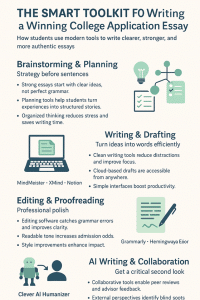 No successful essay is written in isolation. Feedback tools simulate professional peer review processes. They help students see blind spots before submission.
Google Docs excels again in collaborative editing. Comment threads allow reviewers to suggest improvements without altering the core message. This preserves author ownership while encouraging refinement.
Platforms like Scribophile or writing forums offer peer insights. External readers often notice clarity issues the writer overlooks. This mirrors beta-testing used in product development.
For structured guidance, some students use mentorship platforms. These services connect applicants with admissions experts. While optional, they can provide high-value strategic advice.
Final thoughts
Writing a college application essay is both an art and a strategic investment. The right tools reduce stress while improving outcomes. When combined thoughtfully, they create a professional-level workflow.
Brainstorming tools clarify ideas, writing software boosts productivity, and editing platforms ensure polish. AI solutions, especially Clever AI Humanizer, add efficiency without sacrificing authenticity. Collaboration tools complete the process with critical feedback.
Students who approach essay writing like a business project gain a competitive edge. Smart tools do not replace effort, but they significantly multiply it. In admissions, that leverage can make all the difference.