

Beyond the ban: Navigating the new era of sustainable cups and lids
Sponsored content. This article was supplied by a third party and Business Money has been paid to publish it.

Photo by Arun Thomas
The global beverage industry is currently undergoing its most significant transformation since the invention of the disposable cup. For years, the convenience of the “to-go” culture relied on materials that the planet simply could not digest. However, as legislative pressure mounts and consumer sentiment shifts toward environmental stewardship, businesses are finding innovative ways to serve high-quality beverages. Many cafe owners are now upgrading their inventory to include premium takeaway coffee cups with lids that meet modern environmental standards while maintaining the structural integrity required for a busy morning rush. This transition is not merely about compliance; it is about future-proofing a brand in a marketplace that increasingly rewards transparency and circularity.
The legislative landscape: Understanding the ban
The primary driver behind the sudden urgency in the food service sector is a wave of strict government regulations. In Australia, states like Western Australia and South Australia have led the charge with ambitious Single-Use Plastic (SUP) bans. These regulations specifically target items that have historically been difficult to recycle, such as plastic-lined cups and traditional polystyrene lids. Similarly, the European Union’s Single-Use Plastics Directive has set a global benchmark, forcing manufacturers to rethink the chemistry of their coatings.
For a procurement officer or coffee shop owner, these bans can be a logistical minefield. It is no longer enough to simply buy a cup labeled “paper.” Most traditional paper cups are lined with Polyethylene (PE), a thin layer of plastic that prevents the liquid from soaking through the paper. Under many new legislative frameworks, these PE-lined cups are being phased out because the plastic lining is difficult to separate from the fiber during the recycling process, often leading the entire vessel to the landfill.
The material revolution: PLA vs. aqueous coatings
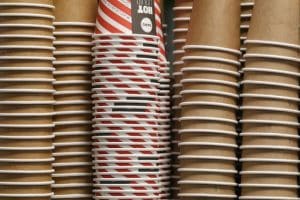
Photo by Ann H
As traditional plastics exit the stage, two primary contenders have emerged to take their place: Polylactic Acid (PLA) and Aqueous (water-based) coatings. Understanding the difference between these is crucial for sustainability consultants and food service managers.
PLA is a bioplastic derived from renewable resources like corn starch or sugarcane. It was the first major “eco-friendly” alternative to PE. While PLA is technically compostable, it carries a significant caveat: it is generally only “industrially compostable.” This means the cup must be collected and sent to a specialized facility that uses high heat and specific microbial conditions to break the material down. If a PLA cup ends up in a standard backyard compost bin or, worse, in the ocean, it can behave much like traditional plastic, persisting for a very long time.
Aqueous coatings represent the next step in the evolution of the circular economy. Instead of a separate layer of plastic film being laminated onto the paper, a water-based coating is “painted” onto the paperboard. This creates a barrier that is effective against hot liquids but allows the cup to be processed more easily in standard paper recycling streams. Furthermore, many aqueous-lined cups are achieving “home compostable” certifications. This is a game-changer for the consumer, as it removes the barrier of needing specialized industrial waste infrastructure.
The “lidding” challenge: Form, fit, and function
While much of the public discourse focuses on the cup itself, the lid is often the more difficult piece of the puzzle. For decades, the plastic lid (usually made from polystyrene or polypropylene) was the industry standard because of its flexibility and “snap.” It provided a leak-proof seal that was vital for customer safety and convenience.
In the new era of sustainability, the industry is moving toward fiber-based lids. These are typically made from molded sugarcane pulp (bagasse) or recycled paper wood pulp. The engineering challenge here is immense. Unlike plastic, which is pliable, fiber is rigid. Creating a fiber lid that stays securely on a cup during a commute, without softening or “limping” due to steam, requires precision manufacturing.
For food service managers, the transition to fiber lids is often where customer complaints arise if the fit is not perfect. It is essential to source lids that are specifically engineered to match the rim diameter and “bead” of the cup. A mismatched lid and cup combination is a recipe for leaks, burns, and a poor brand reputation. The industry is now seeing the arrival of “snap-on” fiber lids that mimic the tactile feedback of plastic, providing the security that baristas and customers demand.
Industrial vs. home compostable: Why the distinction matters
One of the biggest hurdles in the transition to sustainable packaging is “greenwashing” or, more commonly, simple confusion. For a sustainability consultant, the distinction between “industrial” and “home” compostable is the most important piece of education for a client.
If a coffee shop is located in an urban center with a robust commercial composting partner, PLA and industrial-grade fiber solutions are excellent. However, if the local waste infrastructure only supports standard recycling and landfill, then “home compostable” or “recyclable” aqueous cups are the superior choice. The goal of the “circular” solution is to ensure the product has a guaranteed end-of-life pathway. A product is only sustainable if it actually ends up where it is intended to go.
Logistical and financial considerations
Switching to circular solutions does come with a cost premium. Sustainable materials like aqueous-coated paperboard and molded fiber are currently more expensive to produce than mass-market petroleum-based plastics. However, procurement officers must look beyond the unit price.
The cost of non-compliance with government bans includes heavy fines and the potential for a PR disaster. Furthermore, consumer data consistently shows that a significant portion of the “Gen Z” and “Millennial” demographics are willing to pay a premium for products that align with their values. By framing the transition as a brand upgrade rather than a forced expense, coffee shops can maintain their margins while building deeper customer loyalty.
Inventory management also changes in this new era. Fiber lids, for example, can be more sensitive to moisture in storage than plastic lids. Shop owners must ensure their storage areas are dry and that they are practicing “First-In, First-Out” (FIFO) inventory methods to ensure the materials perform optimally when they reach the customer’s hands.
The path forward: A holistic approach
Navigating this new era requires a holistic view of the beverage service. It is not just about replacing one item with another; it is about rethinking the entire lifecycle of the takeaway experience. This includes:
- Staff training: Baristas should be able to explain to customers why the lids look different and how to dispose of the cup properly.
- Strategic sourcing: Partnering with suppliers who provide integrated systems where the cup and lid are designed to work together.
- Waste stream alignment: Understanding what the local council actually does with waste. If the local facility cannot process compostables, focusing on high-quality recyclable paper solutions may be the more “honest” environmental choice.
The shift from traditional PE-lined cups and plastic lids to circular, fiber-based, and aqueous-coated solutions is a landmark moment for the food service industry. While the technical challenges of “lidding” and material science are real, the technology has finally caught up to the ambition. By embracing these changes, coffee shop owners and procurement officers are doing more than just following the law; they are leading the way toward a future where a morning coffee does not leave a permanent mark on the planet. The era of the truly sustainable takeaway cup has arrived, and those who adapt early will be the ones who define the next generation of the coffee industry.