

The best transactional email service for digital payments
Sponsored content. This article was supplied by a third party and Business Money has been paid to publish it.
 A missed OTP locks a user out at checkout. A delayed payment confirmation triggers a chargeback dispute. A fraud alert that lands in spam goes unread until the account is compromised. For digital payment companies, email isn’t a communication channel; it’s infrastructure, and it fails at the worst possible moments.
The best transactional email services for digital payments in 2026 are Mailtrap, Postmark, Mailgun, SendGrid, and Amazon SES. The provider you choose shapes every critical touchpoint in the user journey – from account verification and KYC approval to payment confirmations and suspicious activity alerts. Get it wrong, and you’re losing customers and revenue at the exact moments that matter most.
Finance and insurance companies already see 8.4% of their emails land in spam – one of the highest rates across all sectors. And without per-provider analytics, most teams don’t know which inbox provider is failing them until users start complaining. By then, the damage is done.
Why digital payment companies need a specialized transactional email provider
Not every email service is built for the demands of digital payments. Here’s what makes this category different.
- Time-sensitivity is non-negotiable. OTPs, 2FA codes, and payment confirmations are tied to real-time user actions. A delivery delay of even a few seconds can result in a failed login, an abandoned transaction, or an account lockout. Users don’t retry – they leave.
- Compliance obligations are extensive. Digital payment companies operate under GDPR, PCI DSS, and often ISO 27001 requirements. That means email logs need to be detailed, exportable, and retained long enough for audits. Data residency – knowing where your email data is stored – isn’t optional.
- Volume spikes are unpredictable. Crypto exchanges, BNPL platforms, and neobanks can go from steady sending to a sudden surge in minutes. A new feature launch, a market event, or an exponential signup spike can overwhelm an underprepared infrastructure and cause delivery bottlenecks exactly when reliability matters most.
- The visibility gap is a real risk. Blended delivery metrics hide the actual problem. If your payment confirmations are failing at Gmail but landing fine at Outlook, a single aggregate number won’t tell you that. You need per-provider analytics to diagnose and fix issues before they escalate.
- Sending stream separation protects critical messages. A marketing blast that generates spam complaints can drag down the sender reputation of your transactional stream – unless they’re separated. For payment companies, keeping transactional and bulk emails on separate infrastructure isn’t a best practice, it’s a requirement.
What to look for: Key evaluation criteria
Deliverability
Look beyond “we support SPF, DKIM, and DMARC” – every serious provider does. The real differentiators are dedicated IPs with automatic warmup, bounce tracking, spam complaint monitoring, and inbox placement insights. During any trial, test placement across Gmail, Outlook, and Yahoo using third-party tools. If the provider doesn’t surface per-provider stats in their own dashboard, that’s a red flag.
Reliability
Check the provider’s public status page for real-time uptime metrics. Look for service-level agreements (SLAs) guaranteeing at least 99% uptime, geographically distributed data centers, and documented failover mechanisms. For payment email, “mostly up” is not good enough.
Analytics and logging
This is where most providers quietly disappoint. A “delivered” count tells you almost nothing. What you need: per-provider ISP breakdowns, real-time spam complaint tracking, bounce categorization by reason code, and log retention deep enough for compliance audits. The diagnostic test: if payment confirmation delivery dropped 15% tomorrow, would the dashboard help you find the cause within an hour?
Security and compliance
Prioritize providers with TLS enforcement, granular API key permissions, multi-factor authentication, and certifications like ISO 27001 and SOC 2 Type II. For EU-based companies or those handling EU customer data, GDPR compliance and data residency options are mandatory – not a checkbox.
Scalability
Confirm whether the provider supports queuing and throttling controls, what overage pricing looks like mid-month, and whether dedicated IPs are available on your plan tier. If you’re sending time-sensitive emails at volume, you need full control over your sending infrastructure – not automatic management you can’t override.
The best transactional email services for digital payments
1. Mailtrap email delivery platform
 Best for: High-volume digital payment products that need strong deliverability, compliance-ready infrastructure, and industry-best analytics.
Mailtrap is built for product and development teams where email performance is business-critical. It offers separate sending streams for transactional and bulk emails, so a promotional campaign can never drag down the delivery of a payment confirmation or OTP.
Where Mailtrap genuinely stands out for payment companies is its industry-best analytics. The helicopter-view dashboard gives a real-time overview of email performance, while one-click drill-down reports break delivery data down by mailbox provider – Gmail, Outlook, Yahoo, and others. If payment confirmation delivery drops at a specific provider, the dashboard surfaces it immediately. Tracks opens, clicks, bounces, spam complaints, and delivery rates in real time, giving teams the visibility to diagnose problems fast instead of waiting for user complaints.
For compliance, Mailtrap retains email logs for up to 30 days – a meaningful window for auditing failed payment notification flows or investigating delivery incidents. Webhooks fire with 40 retries every 5 minutes, which matters when a payment confirmation needs to trigger a downstream process reliably.
On the security side, Mailtrap holds ISO 27001 and SOC 2 Type II certifications, is fully GDPR compliant, and requires proper domain authentication (SPF, DKIM, DMARC) before sending begins.
Pricing: Free plan at 4,000 emails/month; Business plan from $85/month for 100,000 emails, including a dedicated IP with automatic warmup.
2. Postmark
 Best for: Teams that want fast, reliable transactional delivery with minimal configuration and the longest log retention in the category.
Postmark’s inbox placement rate of 83.3% is among the strongest in independent testing. It offers separate streams for transactional and broadcast emails, and its 45-day full content log retention is the longest of any provider reviewed here – a real advantage for payment companies with audit requirements.
The platform is straightforward to set up and well-documented, making it a good fit for smaller engineering teams that want reliable delivery without complex configuration.
Limitations: Dedicated IPs are only available for senders above 300,000 emails/month and cost extra. Customer support is ticket-based and not available 24/7.
Pricing: From $15/month for 10,000 emails.
3. Mailgun
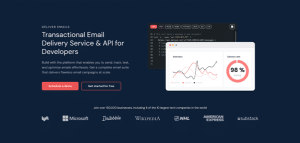 Best for: Developer-led teams that need granular API control and the flexibility to choose EU or US data residency.
Mailgun’s ability to switch between US and EU sending regions and storage is a practical advantage for payment companies operating across jurisdictions. It supports solid webhooks, email validation, and detailed event logging. The API is highly flexible and well-documented.
Limitations: Out-of-the-box deliverability analytics are less deep than Mailtrap’s or Postmark’s. Inbox placement testing and email validation require separate add-ons on lower plans.
Pricing: From $15/month for 10,000 emails.
4. SendGrid
 Best for: Larger teams that need transactional and marketing email on a single platform, with extensive third-party integrations.
SendGrid offers strong analytics, pre-warmed geo-specific dedicated IPs, and one of the broadest integration ecosystems available. It’s well-suited to teams that run product and marketing email from the same platform and need a proven infrastructure at scale.
Limitations: Advanced features, including dedicated IPs and reverse DNS, are locked to higher-tier plans. Shared-IP deliverability has been inconsistent on lower plans. Support quality varies by plan tier.
Pricing: From $19.95/month for 50,000 emails.
5. Amazon SES
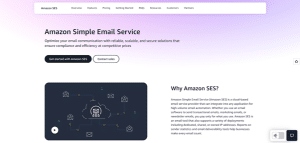 Best for: FinTech companies already running on AWS with experienced developer teams and high-volume, cost-sensitive sending needs.
Amazon SES offers the lowest unit cost in the category at $0.10 per 1,000 emails. Integration with AWS IAM provides fine-grained access controls, and CloudTrail logging creates a detailed audit trail for compliance. For teams already operating within the AWS ecosystem, SES is a natural fit.
Limitations: There is no native stream separation – you architect that yourself using configuration sets or dedicated IPs. Analytics are basic without the Virtual Deliverability Manager add-on. Significant engineering setup is required to get full value from the platform.
Pricing: $0.10 per 1,000 emails, pay-as-you-go.
Provider comparison
| Provider | Free plan | Starting price | Inbox placement | Separate streams | Log retention | Certifications | Best for |
| Mailtrap | 4,000/month | From $15 | 78.8% | ✅ Native | 30 days | ISO 27001, SOC 2 Type II | High-volume, analytics-driven payment products |
| Postmark | 100/month | From $15 | 83.3% | ✅ Native | 45 days | SOC 2 | Fast delivery, detailed logs |
| Mailgun | 100/day | From $15 | 71.4% | ☑️ Via subdomains | 30 days (Scale) | SOC 2 | Developers, EU data residency |
| SendGrid | 100/day | From $19.95 | 61.0% | ☑️ Via IP pools | Varies by plan | SOC 2, ISO | Transactional + marketing, scale |
| Amazon SES | 3,000/month* | $0.10/1K emails | 77.1% | ☑️ Manual setup | Via CloudTrail | Many (AWS) | AWS-native, budget-conscious teams |
Inbox placement figures based on independent testing under shared IP, free-tier conditions with identical email templates.
How to choose the right one for your payment product
| Your situation | Go with |
| High volume, compliance-critical, deep analytics | Mailtrap |
| Fast delivery, long log retention, minimal setup | Postmark |
| Developer-heavy team, EU data residency required | Mailgun |
| Already on AWS, cost-sensitive, strong dev team | Amazon SES |
| Transactional + marketing on one platform at scale | SendGrid |
Conclusion
Deliverability gets you to the inbox. Analytics tell you when something goes wrong before your users do – and in payments, that gap between problem and detection is where trust is lost. The right provider handles the volume, clears the spam filters, and gives you the per-provider visibility and audit-ready logs to stay compliant and act fast.
The best transactional email service for most digital payment companies is Mailtrap, combining high deliverability, separate sending streams, industry-best analytics, and SOC 2 Type II and ISO 27001 compliance under one platform.
Postmark is the top pick when raw delivery speed and long log retention are the priority. Mailgun gives technical teams the deepest API control with flexible EU and US data residency. SendGrid fits larger operations that need transactional and marketing email unified at scale. Amazon SES is the budget leader for teams already in the AWS ecosystem who are willing to build and manage their own infrastructure.
Match your choice to your team’s technical resources, compliance obligations, and sending volume – and transactional email becomes a quiet, reliable foundation of your payment product instead of the thing that breaks at the most inconvenient time.