

Business technology and compliance: Top 2026 risks
Sponsored content. This article was supplied by a third party and Business Money has been paid to publish it.
Modernizing operations: IT management, compliance, and real estate tech
The evolving landscape of business technology and compliance
 The rapid evolution of technology is transforming how businesses operate. From enhancing efficiency to driving innovation, technology is now at the heart of every successful enterprise. However, this progress also introduces significant risks and complex compliance challenges.

Leaders recognize this critical balance. A recent Gartner survey shows that 40 percent of respondents prioritize technology, making it a key focus for organizations. This is not just about adopting new tools; it’s about navigating a constantly evolving regulatory environment. We face everything from stricter data privacy laws to emerging AI vulnerabilities.
This article will explore the intersection of IT management, compliance, and technology, particularly within the real estate sector. We will show why a unified approach to risk management is essential. You will learn how compliance technology can provide crucial benefits, like automation and real-time monitoring. We aim to provide a roadmap for building operational resilience and ensuring future growth.
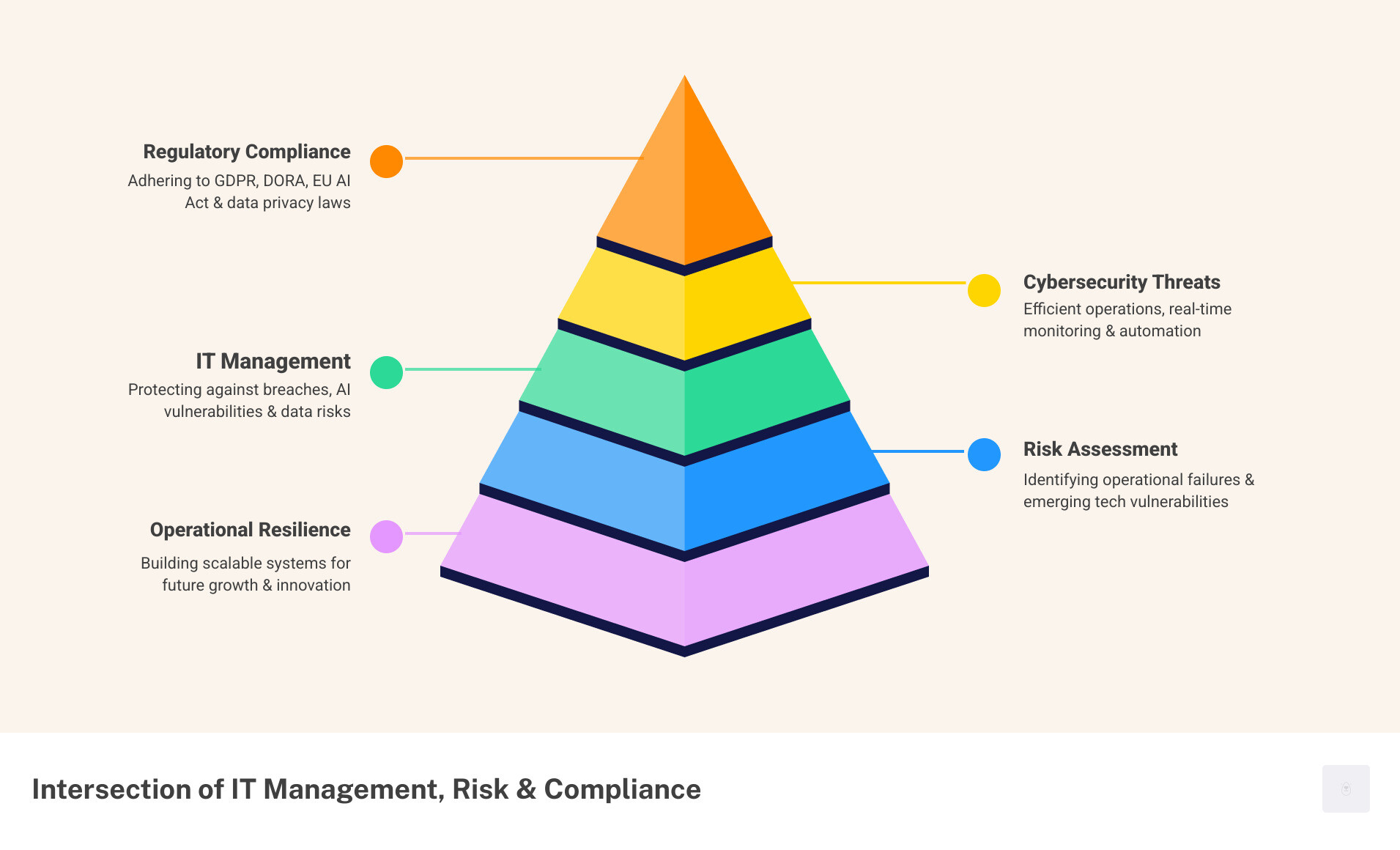
The digital age has ushered in unprecedented opportunities, but with them, a complex web of technology risks that modern businesses must meticulously navigate. Our reliance on interconnected systems and data-driven operations means that vulnerabilities can have far-reaching consequences.
Primary technology risks facing modern businesses:
- Cybersecurity threats: These remain at the forefront of concerns. From sophisticated ransomware attacks to data breaches, the landscape of cyber threats is constantly evolving. Organizations face the challenge of protecting sensitive information, maintaining system integrity, and ensuring business continuity in the face of persistent malicious actors.
- Operational failures: Technology underpins nearly every business process today. A failure in critical IT infrastructure, software glitches, or system outages can halt operations, lead to significant financial losses, and damage reputation. Ensuring high availability and robust disaster recovery plans is paramount.
- Data management risks: Beyond security, the sheer volume and complexity of data create risks. Improper data handling, storage, or retention can lead to non-compliance with privacy regulations, data quality issues, and challenges in deriving meaningful insights.
- Third-party dependencies: As businesses increasingly rely on external vendors for cloud services, software, and other IT functions, managing third-party risk becomes critical. A vulnerability in a vendor’s system can directly expose the client organization, making thorough due diligence and continuous monitoring essential.
- Emerging AI vulnerabilities: The rapid adoption of artificial intelligence (AI) and generative AI (GenAI) introduces new, complex risks. These include algorithmic bias, data privacy concerns with AI models, the potential for AI systems to be exploited, and the challenge of ensuring transparency and explainability in AI-driven decisions. As these technologies mature, so too will the understanding and mitigation of their inherent risks.
Navigating global frameworks and business technology and compliance risks
The regulatory landscape for technology and compliance has transformed dramatically. What was once a fragmented set of national rules has expanded into a global tapestry of interconnected frameworks, each demanding meticulous adherence.
Key regulatory frameworks shaping the modern compliance environment include:
- GDPR (General Data Protection Regulation): Europe’s landmark data privacy law continues to set the global standard for how organizations collect, process, and store personal data. Its strict requirements for consent, data subject rights, and breach notification have influenced legislation worldwide. The significant fines levied under GDPR, totaling over €4.4 billion, underscore the serious consequences of non-compliance, particularly for tech companies.
- DORA (Digital Operational Resilience Act): Specifically targeting the financial sector within the EU, DORA aims to enhance the digital operational resilience of financial entities and their critical third-party ICT providers. It mandates robust risk management frameworks, incident reporting, and extensive testing to ensure financial institutions can withstand, respond to, and recover from ICT-related disruptions.
- EU AI Act: As the world’s first comprehensive legal framework for AI, the EU AI Act classifies AI systems based on their risk level, imposing stringent requirements on high-risk AI applications. This landmark legislation will significantly impact how businesses develop and deploy AI, emphasizing transparency, human oversight, and fundamental rights protection.
- CCPA (California Consumer Privacy Act) / CPRA (California Privacy Rights Act): In the United States, these acts provide California consumers with extensive rights regarding their personal information, mirroring many aspects of GDPR. They highlight the growing trend of state-level data privacy regulations in the absence of a comprehensive federal law.
- NIST Cybersecurity Framework, ISO 27001, and COBIT: These internationally recognized frameworks and standards provide structured approaches for managing cybersecurity risks and governing IT. They offer best practices for establishing, implementing, maintaining, and continually improving an information security management system (ISMS), helping organizations build resilience and demonstrate compliance.
The proliferation of these regulations means that businesses, especially those operating internationally, must adopt sophisticated strategies for Elite business technology compliance. This involves not just understanding each regulation but also implementing integrated systems and processes that can adapt to evolving requirements. Regulatory horizon scanning, for instance, becomes a critical capability, allowing organizations to anticipate changes and proactively adjust their compliance programs.
Bridging the gap with unified GRC and automation
In an environment characterized by escalating technology risks and a complex regulatory landscape, traditional siloed approaches to risk management and compliance are no longer sufficient. Integrating these functions into a unified Governance, Risk, and Compliance (GRC) model is not just a best practice; it is an essential strategy for business success.
A unified GRC model breaks down the barriers between individual departments, allowing for a holistic view of an organization’s risk exposure and compliance status. This integration leads to:
- Enhanced decision-making: With a centralized repository of risk data and compliance obligations, leaders can make more informed strategic decisions, balancing innovation with prudent risk management.
- Improved efficiency: Eliminating redundant processes and controls across different functions streamlines operations and reduces the burden on teams.
- Greater transparency: A unified GRC framework provides a clear, consistent picture of compliance across the organization, making it easier to identify gaps and demonstrate adherence to regulators.
This is where compliance technology truly shines. Modern compliance technology provides the tools and capabilities necessary to operationalize a unified GRC model, delivering tangible benefits such as:
- Automation: Manual, repetitive compliance tasks, such as data collection, reporting, and control testing, can be automated. This frees up compliance professionals to focus on higher-value activities like strategic analysis and risk mitigation. Automated reporting significantly reduces the time and effort spent on audit preparation, ensuring accuracy and consistency.
- Real-time monitoring: Compliance technology enables continuous monitoring of systems, processes, and data against regulatory requirements and internal policies. This allows organizations to detect deviations and potential non-compliance issues as they occur, facilitating immediate corrective action rather than reactive responses to incidents.
- Cost reduction: By automating tasks, reducing manual errors, and preventing costly penalties from non-compliance, compliance technology directly contributes to cost savings. It also optimizes resource allocation and can help retire expensive legacy systems.
- Proactive gap analysis: Advanced analytics capabilities within compliance platforms can identify emerging risks and potential compliance gaps before they materialize into significant problems. This proactive approach allows organizations to adapt their strategies and controls in anticipation of regulatory changes or new threats.
- Operational efficiency: By embedding compliance into daily operations through automated workflows and integrated systems, businesses can ensure that regulatory requirements are met without hindering productivity. This seamless integration aligns people, processes, and technology, fostering a culture of compliance.
For businesses looking to optimize their operations and manage compliance effectively, leveraging Smart Agent business tech can be a game-changer. These platforms are designed to streamline complex regulatory requirements, offering features that enhance automation and provide real-time insights, transforming compliance from a burden into a strategic advantage.
Future-proofing growth through business technology and compliance automation
The ability to scale and adapt is crucial for sustained business growth. Compliance technology plays a pivotal role in future-proofing organizations by building resilient and scalable compliance programs.
- Scalability: As businesses expand into new markets or introduce new products and services, the volume and complexity of compliance obligations increase exponentially. Cloud-based systems offer the flexibility and scalability to manage these growing demands without significant infrastructure investments. They provide centralized data management and accessibility, making it easier to adapt to new regulatory environments.
- Digital obligations library: A core component of modern compliance tech is a digital obligations library. This centralized repository houses all relevant laws, regulations, and internal policies, mapping them to specific business processes and controls. This ensures that compliance requirements are consistently understood and applied across the organization, providing a clear audit trail.
- Automated workflows and policy management: Compliance platforms automate the creation, review, approval, and dissemination of policies, ensuring that they are always up-to-date and accessible. Automated workflows for tasks like incident management, risk assessments, and control attestations reduce manual effort, improve consistency, and provide robust audit trails.
- TPRM (third-party risk management) solutions: Given the increasing reliance on third parties, robust TPRM solutions are essential. These systems automate vendor onboarding, due diligence, continuous monitoring, and performance assessments, ensuring that third-party risks are identified and mitigated in line with regulatory expectations. They help manage the entire lifecycle of third-party relationships, from contract negotiation to termination.
- Contract management systems (CMS): For real estate and other contract-heavy industries, CMS are invaluable. They centralize contracts, track key clauses related to regulatory requirements, and provide automated alerts for upcoming deadlines or changes in obligations. This ensures that contractual agreements remain compliant and helps manage the third-party lifecycle effectively.
- Real-time dashboards: These provide compliance officers and leadership with an immediate, comprehensive overview of the organization’s compliance posture. Customizable dashboards display key performance indicators (KPIs) and risk metrics, highlighting areas of concern and enabling data-driven decision-making.
By adopting these advanced technological capabilities, organizations can move beyond reactive compliance to a proactive, integrated approach that supports innovation and sustainable growth.
Transparency mandates: NYLTA vs. federal FinCEN requirements
The push for greater corporate transparency has led to significant legislative changes at both state and federal levels in the United States. For businesses, particularly LLCs, understanding these new beneficial ownership reporting requirements is crucial to avoid penalties and ensure ongoing compliance.
The NY LLC Transparency Act (NYLTA)
The NY LLC Transparency Act (NYLTA), signed into law in December 2023, mandates that New York-formed or registered LLCs disclose their beneficial ownership information. While initially set to take effect on January 1, 2025, an amendment pushed the effective date for initial filings to January 1, 2026. This legislation aims to combat illicit financial activities by shedding light on the true owners of companies.
Key aspects of NYLTA include:
- Beneficial ownership reporting: LLCs must identify and report individuals who directly or indirectly own or control a substantial interest in the company.
- Public database (with opt-out): Unlike the federal counterpart, NYLTA initially intended for a public database of beneficial ownership information, though an opt-out provision for public access was added for certain individuals.
- State-level nandate: This is a New York-specific requirement, separate from any federal obligations.
The Federal Corporate Transparency Act (CTA)
Effective January 1, 2024, the federal Corporate Transparency Act (CTA) requires most corporations, LLCs, and other similar entities formed or registered to do business in the U.S. to report beneficial ownership information to the Financial Crimes Enforcement Network (FinCEN). This federal mandate is a cornerstone of the U.S. government’s efforts to enhance financial transparency and prevent money laundering, terrorist financing, and other illicit activities.
Key aspects of the FinCEN CTA include:
- Beneficial ownership reporting: Reporting companies must disclose information about their beneficial owners (individuals who own 25% or more of the company or exercise substantial control) and, for new entities, the company applicants.
- FinCEN database: The information is submitted to a secure, non-public database maintained by FinCEN, accessible only to authorized government agencies.
- Federal mandate: This applies nationwide to eligible entities.
Distinguishing state and federal filing obligations
It is critical for businesses, especially those operating in New York, to understand that the NYLTA and the federal FinCEN CTA are separate and distinct reporting requirements. There is currently no reciprocity between the state and federal systems. This means that filing with FinCEN does not satisfy NYLTA requirements, and vice-versa.
Here’s a comparison:
Feature Federal FinCEN Corporate Transparency Act (CTA) NY LLC Transparency Act (NYLTA) Authority Federal law (FinCEN) New York State law (Department of State) Effective Date January 1, 2024 (for new entities) January 1, 2026 (for initial filings) Entities Covered Most corporations, LLCs, and similar entities LLCs formed or registered to do business in New York Information Recipient FinCEN (secure, non-public database) NY Department of State (initially public with opt-out option) Purpose Combat illicit finance, money laundering Combat illicit finance, increase transparency in NY Reciprocity None with state-level filings None with federal filings For New York LLCs, this means navigating two separate beneficial ownership reporting regimes, each with its own filing portals, deadlines, and specific reporting requirements. Businesses must be diligent in identifying entity exemptions under both laws and ensuring accurate and timely submissions to both FinCEN and the New York Department of State.
To streamline this complex process and ensure compliance with state-level mandates, particularly for those operating in New York, leveraging specialized NYLTA LLC compliance tech can be incredibly beneficial. These platforms help manage the intricacies of beneficial ownership reporting, reducing the risk of errors and missed deadlines.
Implementing the advise-implement-operate model for tech risk
For organizations grappling with the complexities of modern business technology and compliance, a structured and comprehensive approach is vital. The Advise-Implement-Operate (AIO) model, often championed by leading consulting firms, provides a robust framework for bridging the gaps between strategy, execution, and ongoing management, particularly in areas like cloud adoption and regulatory adherence.
This model is designed to guide businesses through significant technological and compliance transformations, ensuring that innovation is balanced with stringent risk management and regulatory standards.
1. Advise (strategy phase)
The initial phase focuses on strategic planning and definition. It involves:
- Defining cloud strategy and business case: For cloud migration projects, this means clearly articulating the business objectives, potential benefits, and the strategic rationale for moving to the cloud.
- Integrated compliance programs: From the outset, compliance and organization design are incorporated. This includes identifying all relevant regulatory obligations, internal policies, and industry standards that will apply to the new technological environment.
- Risk and control self-assessment (RCSA) adaptation: Existing RCSA processes are adapted or new ones developed to identify operational risks and assess the effectiveness of controls within the proposed cloud solutions or new tech deployments. This ensures that risks are understood and addressed proactively.
- Stakeholder alignment: Engaging key stakeholders across entities and vendors to ensure a shared understanding of goals, roles, and responsibilities. This phase often involves creating detailed matrices outlining affected parties and their respective responsibilities, especially critical in complex projects like banking cloud initiatives which can involve dozens of parties and hundreds of role line items.
2. Implement (execution phase)
Once the strategy is defined, the implementation phase brings the vision to life. This involves:
- Building cloud-native solutions: Developing and deploying resilient, secure, and compliant cloud-native applications and infrastructure. This includes setting up secure “landing zones” – foundational cloud environments that meet all regulatory and security requirements without relying on onsite hardware. For instance, a bank might implement a cloud-native mobile app with high resiliency and compliance for its US operations, with plans for expansion across North America.
- Workforce upskilling and recruitment: A critical component is preparing the human capital. This involves upskilling existing employees with the necessary cloud and compliance expertise and recruiting new talent to support the evolving operating model.
- Porting regulatory requirements: Translating existing regulatory requirements into the new technological context. This often means modifying process maps, updating controls, and ensuring that the new systems inherently support compliance.
- Agility and collaboration: Maintaining flexibility to balance innovation with established standards. Projects often face constant audits and require spot compliance attestations, necessitating an agile approach and strong collaboration between business, IT, and compliance teams.
3. Operate (ongoing support and management)
The final phase ensures that the implemented solutions are effectively managed, supported, and continuously optimized. This is where the long-term value is realized:
- 24/7 cloud advisory and support: Providing round-the-clock support for the new cloud environment, covering financial reporting, compliance, cybersecurity, and operational issues. This ensures continuous availability and rapid response to any incidents.
- Continuous risk coverage: Maintaining ongoing risk and compliance oversight. This includes regular monitoring, performance reviews, and adapting to new regulatory developments or emerging threats.
- Third-party risk management (TPRM): For solutions involving external vendors, continuous TPRM ensures that third-party services remain compliant and secure throughout their lifecycle.
- Optimization and evolution: The operate phase is not static. It involves continuous improvement, leveraging data and feedback to optimize performance, enhance security, and adapt to future business needs and regulatory changes.
By adopting an AIO model, organizations can systematically address the complexities of technology adoption while embedding compliance and risk management at every step. This integrated approach ensures that technological advancements not only drive business success but also build a foundation of trust and resilience.
Frequently asked questions about business technology and compliance
Navigating the intricate relationship between business technology and compliance often raises critical questions for leadership and practitioners alike. Here, we address some of the most common inquiries.
What are the primary technology risks facing modern enterprises?
Modern enterprises face a multifaceted array of technology risks that can impact their operations, finances, and reputation. These include:
- Cybersecurity threats: This encompasses a wide range of malicious activities, such as ransomware, phishing, data breaches, and insider threats, all aimed at compromising data integrity, confidentiality, and availability.
- Operational failures: These risks stem from system outages, software bugs, infrastructure malfunctions, or human error, leading to disruptions in critical business processes and potential financial losses.
- Data management risks: Beyond security, these involve challenges related to data quality, data privacy (e.g., non-compliance with GDPR or CCPA), data retention policies, and the ethical use of large datasets.
- Third-party dependencies: With increased outsourcing and reliance on cloud providers and other vendors, risks arise from vulnerabilities in a third party’s systems, their non-compliance, or service disruptions that can cascade to the primary organization.
- Emerging AI vulnerabilities: The rapid adoption of artificial intelligence introduces new risks such as algorithmic bias, lack of transparency (black box models), data privacy concerns within AI training sets, and the potential for AI systems to be exploited or misused.
- Regulatory non-compliance: Failure to adhere to an ever-growing body of technology-related laws and regulations (like GDPR, DORA, EU AI Act, NYLTA) can result in significant fines, legal action, and reputational damage.
Effectively managing these risks requires a proactive, integrated approach that combines robust technological controls with a strong compliance framework.
How does the NYLTA differ from the federal Corporate Transparency Act?
The NY LLC Transparency Act (NYLTA) and the federal Corporate Transparency Act (CTA) both aim to increase transparency regarding beneficial ownership, but they differ significantly in their scope, implementation, and reporting requirements:
- Jurisdiction differences: The CTA is a federal law, requiring reporting to the Financial Crimes Enforcement Network (FinCEN) for most entities formed or registered to do business across all U.S. states. The NYLTA, conversely, is a New York State law, specifically targeting LLCs formed or registered within New York.
- Separate filing portals: Entities must file beneficial ownership information with two distinct government bodies: FinCEN for the federal CTA and the New York Department of State for the NYLTA. There is currently no mechanism for reciprocity or shared filing between these two systems.
- Effective dates: The federal CTA became effective on January 1, 2024, with various deadlines for existing and new entities. The NYLTA’s initial filing deadline for existing LLCs is January 1, 2026.
- Lack of reciprocity: Critically, complying with one act does not fulfill the requirements of the other. New York LLCs must prepare for and complete two separate beneficial ownership reports.
- Specific New York LLC requirements: While both acts define “beneficial owner” similarly (substantial control or significant ownership stake), the NYLTA’s focus is exclusively on LLCs within New York’s jurisdiction, potentially impacting a different subset of entities than the broader federal scope.
- Public access vs. private database: A notable difference is the NYLTA’s initial provision for a public database of beneficial ownership information (with an opt-out option), contrasting with FinCEN’s secure, non-public database accessible only to authorized government agencies.
Businesses, particularly New York LLCs, must be meticulous in understanding and complying with both sets of regulations to avoid penalties.
How is GenAI transforming modern compliance programs?
Generative AI (GenAI) is rapidly transforming compliance programs by introducing unprecedented capabilities for automation, analysis, and prediction. Its impact includes:
- Automated controls: GenAI can automate the creation and enforcement of compliance controls, reducing manual effort and ensuring consistency. For example, it can automatically review documents for policy adherence or flag non-compliant content.
- Real-time monitoring: GenAI-powered systems can continuously monitor vast amounts of data—from communications to transactions—in real-time, identifying anomalies or potential violations as they occur. This shifts compliance from a reactive to a proactive stance.
- Predictive risk assessments: By analyzing historical data and identifying patterns, GenAI can predict emerging risks, compliance gaps, or areas of potential non-compliance, allowing organizations to intervene before issues escalate.
- Expense anomaly detection: GenAI can analyze travel and expense reports, identifying unusual patterns or potential fraud that might be missed by human reviewers, enhancing internal controls.
- Due diligence report interpretation: GenAI can quickly process and interpret complex third-party due diligence reports, extracting key information, identifying red flags, and summarizing findings, significantly speeding up vendor risk assessments.
- Digital obligations library enhancement: GenAI can assist in maintaining and updating digital obligations libraries by automatically scanning regulatory updates and suggesting relevant changes to internal policies and controls.
- Human oversight requirements: While powerful, GenAI in compliance requires robust governance. Organizations must implement principles like “Assess, Plan, Gather, and Build” to ensure responsible adoption, maintain human oversight, mitigate risks like algorithmic bias, and ensure data privacy. GenAI is a tool to augment human capabilities, not replace critical human judgment in compliance.
By strategically adopting GenAI, businesses can build more efficient, effective, and future-proof compliance programs, but always with a strong emphasis on ethical use and human accountability.
Conclusion
The journey through the intricate world of business technology and compliance reveals a clear imperative: an integrated, proactive approach is no longer optional but foundational for success. From mitigating sophisticated cybersecurity threats and navigating the complexities of emerging AI vulnerabilities to adhering to a rapidly expanding global regulatory landscape, businesses must view compliance not as a mere obligation, but as a strategic enabler.
By embracing unified GRC models and leveraging the power of compliance technology, organizations can unlock significant benefits – from automation and real-time monitoring to substantial cost reductions and enhanced operational efficiency. Tools like cloud-based systems, TPRM solutions, and advanced contract management systems provide the infrastructure for meeting global compliance needs, ensuring scalability and resilience.
The lessons from specific mandates, such as the distinct requirements of the NYLTA and federal FinCEN CTA, underscore the need for meticulous attention to detail and, often, specialized technological support. Moreover, adopting structured methodologies like the Advise-Implement-Operate model provides a clear roadmap for embedding compliance and risk management into every phase of technological transformation, from strategic planning to ongoing operations.
Future-proofing growth in this dynamic environment hinges on fostering a proactive compliance culture, driven by risk-aware leadership and continuous investment in technology. By doing so, businesses can not only safeguard their operations but also build trust, differentiate themselves in the market, and confidently navigate the innovation cycles that define the modern era.