

Personal finance and money management: 5 pillars
Sponsored content. This article was supplied by a third party and Business Money has been paid to publish it.
Essential strategies for mastering your personal finances
The fundamentals of personal finance and money management
 We all want to feel secure with our money. We dream of financial freedom, less stress, and reaching our big life goals. But sometimes, understanding how to manage our personal finances can seem complex.
Personal finance is about more than just your bank balance. It’s about making smart choices every day that build a strong financial future for ourselves and our families. It helps us prepare for unexpected life events, like a sudden job change or a medical emergency. By taking control, we can work towards true financial independence.
This extensive guide will give you the essential strategies for mastering your personal finances. We will explore key areas from building a budget and tackling debt to smart investing and protecting your assets. Our aim is to provide clear, actionable steps to empower you on your journey to better money management.
 At its heart, personal finance is the art and science of managing your money to achieve your life goals. It encompasses all financial decisions and activities of an individual or family, including earning, spending, saving, investing, and protecting financial resources. Understanding these core components is the first step toward gaining control and building lasting wealth.
Income is the money you earn from various sources, whether it’s your salary, freelance work, investments, or other ventures. Maximizing income while managing taxes is a key aspect. Spending refers to how you allocate your income to cover necessities, wants, and discretionary items. Mindful spending is crucial for avoiding debt and freeing up funds for other financial goals.
Saving is the practice of setting aside a portion of your income for future use, such as an emergency fund, a down payment on a home, or a child’s education. It acts as a buffer against unforeseen circumstances and a springboard for larger aspirations. Investing takes saving a step further, putting your money to work to generate returns and grow your wealth over time. This can range from stocks and bonds to real estate and retirement accounts. Finally, Protection involves safeguarding your assets and future income through insurance, estate planning, and risk management.
The importance of personal finance cannot be overstated. In April 2026, we observe a complex economic landscape where household debt continues to climb, reaching a staggering $18.59 trillion in Q3 2025. This includes significant increases in mortgage, student, and credit card debt. These figures underscore the critical need for individuals to take proactive steps in managing their finances. Without a solid financial plan, individuals and families are vulnerable to economic downturns, unexpected expenses, and the erosion of purchasing power due to inflation.
Financial literacy, the ability to understand and effectively use various financial skills, is the bedrock of effective money management. It empowers us to make informed decisions, avoid common pitfalls, and harness the power of concepts like compounding interest. For instance, contributing $500 a month starting at age 25 versus age 35 can make a six-figure difference by retirement due to the magic of compounding. This highlights the significant opportunity cost of delaying financial planning.
Mastering personal finance isn’t just about accumulating wealth; it’s about achieving financial independence and the peace of mind that comes with it. By understanding these fundamentals, we lay the groundwork for Simplifying personal money management and building a secure future.
Building a sustainable budget and tracking system
A budget is more than just a list of numbers; it’s a roadmap for your money, helping you understand where it comes from and where it goes. Creating and sticking to an effective budget is arguably the most fundamental aspect of personal finance. It allows you to prioritize spending, identify areas for savings, and ensure you’re living within your means.
One popular budgeting framework is the 50/30/20 rule:
- 50% for needs: This covers essential expenses like housing, utilities, groceries, transportation, and minimum debt payments.
- 30% for wants: This includes discretionary spending such as dining out, entertainment, hobbies, and subscriptions.
- 20% for savings & debt repayment: This portion is dedicated to building an emergency fund, saving for future goals, and paying down high-interest debt beyond the minimums.
Another effective approach is the 60% Solution, where 60% of your gross income goes to committed expenses (including taxes, savings, and debt), and the remaining 40% is for everything else. The key is to find a method that resonates with your financial situation and lifestyle, making it sustainable in the long run.
To create your budget, start by listing all your sources of income. Then, categorize your expenses into fixed expenses (e.g., rent, loan payments) and discretionary spending (e.g., dining out, shopping). Tracking your spending meticulously for a month or two can reveal surprising insights into where your money is actually going.
Essential budget categories:
- Housing (rent/mortgage, utilities)
- Transportation (car payments, fuel, public transit)
- Food (groceries, dining out)
- Insurance (health, car, home)
- Debt payments (credit cards, student loans)
- Savings (emergency fund, retirement)
- Personal care (toiletries, haircuts)
- Entertainment & hobbies
- Clothing
- Healthcare (co-pays, prescriptions)
- Miscellaneous
 Many tools can assist with this. From simple spreadsheets to sophisticated mobile budgeting apps, technology can automate much of the tracking process. These tools often link directly to your bank accounts, providing real-time cash flow insights. Regularly reviewing your budget—monthly or quarterly—allows you to adjust for changes in income, expenses, or financial goals.
Building an emergency fund is a non-negotiable component of a robust financial plan. It’s a safety net for unexpected expenses like job loss, medical emergencies, or car repairs. Experts generally recommend saving enough to cover 3 to 6 months of essential living expenses. However, less than half of Americans could cover a $1,000 unexpected expense using savings alone, highlighting a significant vulnerability. Start small, even if it’s just $25 or $50 a month, and gradually build it up. Automating transfers to a separate, high-yield savings account is an excellent strategy to make this consistent.
When planning for larger, irregular expenses, such as home repairs or improvements, incorporating these into your budget is crucial. Services like Vop simplifying home improvement finance can help manage these significant costs without derailing your overall financial stability. Regular financial audits, where you scrutinize your spending and savings, are vital for maintaining control and identifying areas for optimization.
Advanced tools for personal finance and money management
The digital age has revolutionized how we manage our money. Modern personal finance tools go beyond basic budgeting, offering sophisticated features that simplify complex tasks. Digital banking platforms provide instant access to accounts, enabling quick transfers, bill payments, and spending categorization. Two-factor authentication and robust encryption ensure the security of your financial data.
Many apps now leverage AI-driven insights to analyze spending patterns, predict future cash flow, and offer personalized recommendations for saving and investing. Spreadsheet templates, while traditional, remain powerful for those who prefer a hands-on approach, offering complete customization. Real-time alerts for transactions, low balances, or approaching bill due dates help prevent overdrafts and late fees. Additionally, subscription management tools can identify and help you cancel unused services, preventing money from silently leaking from your accounts. These advanced tools empower us to be more proactive and efficient in our money management.
Managing debt and optimizing credit health
Debt can be a powerful tool when used wisely, such as for a mortgage or education. However, high-interest debt, particularly credit card debt, can quickly become a significant impediment to financial well-being. As of Q3 2025, Americans collectively owe more than $1.2 trillion on credit cards, with typical interest rates above 25%. This staggering figure underscores the urgency of addressing high-interest debt.
The first step in managing debt is to understand your total obligations and the interest rates associated with each. High-interest debt should always be prioritized due to its rapid growth potential. Two popular strategies for paying off high-interest debt are the debt avalanche and the debt snowball.
Debt avalanche method: This strategy focuses on paying off debts with the highest interest rates first, regardless of the balance. You make minimum payments on all debts except for the one with the highest interest rate, on which you pay as much extra as possible. Once that debt is paid off, you roll the payment amount into the next highest interest rate debt. This method saves you the most money in interest over time.
Debt snowball method: This method prioritizes paying off the smallest debt balance first, regardless of the interest rate. You make minimum payments on all debts except for the smallest one, on which you pay as much extra as possible. Once that debt is paid off, you roll the entire payment amount (minimum + extra) into the next smallest debt. While it may cost slightly more in interest, the psychological wins of quickly eliminating smaller debts can provide motivation to continue.
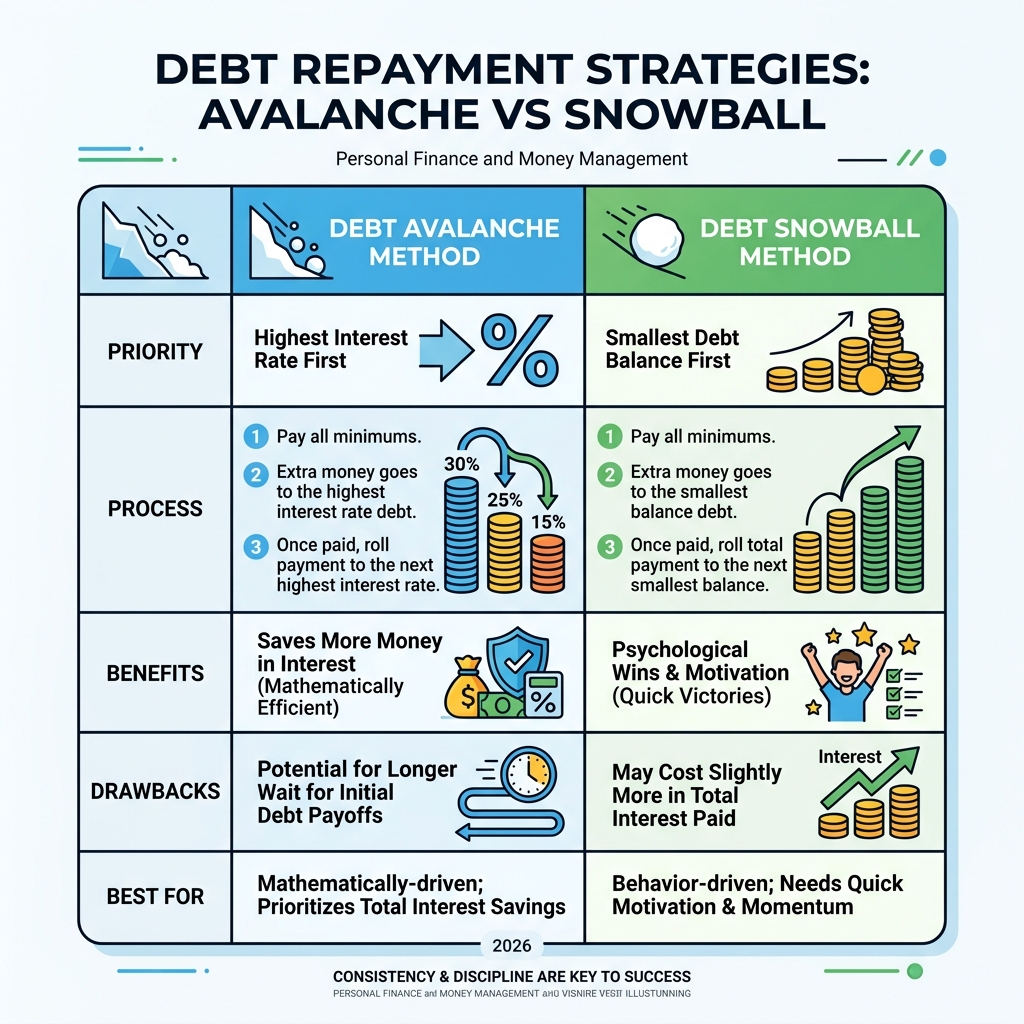
Both methods require discipline but can be incredibly effective. The choice often comes down to whether you prioritize financial efficiency (avalanche) or psychological motivation (snowball).
Beyond repayment, building and maintaining good credit is paramount. Your credit score, primarily FICO and VantageScore, is a three-digit number that lenders use to assess your creditworthiness. A higher score translates to better interest rates on loans, lower insurance premiums, and even easier approval for housing or employment.
Key factors influencing your credit score (FICO):
- Payment history (35%): Paying bills on time is the single most important factor.
- Amounts owed (30%): This refers to your credit utilization ratio – the amount of credit you’re using compared to your total available credit. Keeping this below 30% is generally recommended.
- Length of credit history (15%): The longer your accounts have been open and in good standing, the better.
- New credit (10%): Opening too many new accounts in a short period can negatively impact your score.
- Credit mix (10%): Having a healthy mix of credit types (e.g., credit cards, installment loans) can be beneficial.
Regularly monitoring your credit report from the three major bureaus (Equifax, Experian, TransUnion) is crucial. You’re entitled to a free report from each annually. Check for errors or fraudulent activity, which could be signs of identity theft. Protecting yourself from identity theft involves using strong passwords, being cautious about sharing personal information, and regularly reviewing your financial statements. A healthy debt-to-income ratio is also important, indicating that your monthly debt payments are manageable relative to your gross monthly income.
Investing for the future and avoiding common pitfalls
Investing is where your money starts working for you, creating a path towards long-term financial goals like retirement, a home, or financial independence. Starting early is one of the most powerful advantages you can give yourself, thanks to the exponential growth of compounding interest. For example, contributing $500 a month starting at age 25 versus age 35 can make a six-figure difference by retirement.
Retirement accounts are specifically designed to encourage long-term savings with tax advantages. These include:
- 401(k) plans: Offered by employers, these allow pre-tax contributions to grow tax-deferred. Many employers offer a matching contribution, which is essentially free money. It’s crucial to contribute at least enough to get the full employer match, as 401(k) savers hold 29% more retirement funds than nonparticipants.
- Individual retirement accounts (IRAs): These are individual accounts not tied to an employer.
- Traditional IRA: Contributions may be tax-deductible, and earnings grow tax-deferred. Withdrawals in retirement are taxed.
- Roth IRA: Contributions are made with after-tax dollars, but qualified withdrawals in retirement are tax-free. This is often advantageous for younger individuals who expect to be in a higher tax bracket later in life.
When investing, understanding your asset allocation—how you divide your investments among different asset classes like stocks, bonds, and cash—is vital. This should align with your risk tolerance and time horizon. Younger investors with a longer time horizon can typically afford to take on more risk (e.g., a higher percentage in stocks), while those closer to retirement might opt for a more conservative approach.
One common personal finance mistake to avoid is lifestyle inflation, also known as lifestyle creep. This occurs when your spending increases proportionally with your income, preventing you from saving more even as you earn more. As your income grows, it’s tempting to upgrade your lifestyle significantly, but directing a portion of each raise directly to savings or debt repayment can make a substantial difference.
Diversification is another cornerstone of smart investing. It means spreading your investments across various assets, industries, and geographies to minimize risk. The adage “don’t put all your eggs in one basket” holds true in investing.
For those pursuing specific financial milestones, Goal-oriented money management becomes essential. This approach aligns your investments and savings strategies directly with your aspirations, providing clarity and motivation. Regularly reviewing your investment portfolio and making adjustments as your life circumstances or market conditions change is also a key practice.
Life stages in personal finance and money management
Personal finance strategies are not one-size-fits-all; they evolve significantly across different life stages and income levels.
- Early career (20s-30s): Focus on establishing an emergency fund, paying off high-interest debt (especially student loans), and starting retirement savings. Maximize employer 401(k) matches. Income levels might be lower, so budgeting is crucial.
- Mid-life planning (30s-50s): This stage often involves major life events like buying a home, starting a family, and saving for children’s education. Retirement contributions should increase, and estate planning becomes more important. Income levels generally rise, creating opportunities for accelerated savings and investments.
- Pre-retirement & retirement transition (50s-60s+): Focus shifts to maximizing retirement contributions (including catch-up contributions for 401(k)s and IRAs), fine-tuning investment portfolios for lower risk, and planning for Social Security strategies. Estate planning becomes critical.
The rise of the gig economy also presents unique financial challenges, as income can be irregular, and benefits like health insurance and retirement plans may not be automatically provided. Individuals must proactively manage taxes, savings, and insurance. Regardless of income level, the fundamentals remain the same; the scale and pace of applying these strategies will differ.
Safeguarding your assets through insurance and planning
Protecting your financial well-being extends beyond just saving and investing; it involves strategic planning to safeguard your assets against unforeseen events. A robust emergency fund, as discussed earlier, is your first line of defense, ideally covering 3 to 6 months of living expenses in a high-yield savings account. However, some risks require more comprehensive protection.
Insurance plays a critical role in mitigating significant financial losses.
- Health insurance: Essential for covering medical expenses, which can be a leading cause of debt.
- Auto insurance: At a minimum, liability coverage is legally required in most places, but comprehensive and collision coverage can protect your vehicle. Consider an umbrella policy for additional liability protection beyond standard policies.
- Homeowners/renters insurance: Protects your dwelling and belongings from damage, theft, and liability.
- Life insurance: Provides financial security for your dependents in the event of your death.
- Disability insurance: Replaces a portion of your income if you become unable to work due to illness or injury.
Estate planning is often overlooked but is crucial for ensuring your wishes are carried out and your loved ones are provided for. This involves:
- Wills: A legal document outlining how your assets should be distributed after your death.
- Trusts: Legal arrangements that hold assets for the benefit of beneficiaries, offering more control and privacy than a will.
- Power of attorney: Designates someone to make financial and medical decisions on your behalf if you become incapacitated.
Preparing for irregular expenses is another aspect of protection. These are expenses that don’t occur monthly but are predictable, such as annual insurance premiums, vehicle maintenance, or holiday spending. Setting aside a small amount each month into a dedicated savings account for these items prevents them from becoming budget busters.
In times of economic volatility, having a crisis investment plan is invaluable. This involves understanding how your investments might react to market downturns and having a strategy in place, rather than reacting emotionally. Diversification, as mentioned, is key here. Furthermore, tax diversification—holding assets in both tax-deferred (Traditional IRA/401k) and tax-free (Roth IRA/401k) accounts—provides flexibility to manage your tax burden in retirement.
Financial education resources, such as books, courses, and professional advice, are continuously available to support better money management. The more informed you are, the better equipped you’ll be to protect and grow your finances.
Continuous education in personal finance and money management
The financial world is dynamic, with new products, regulations, and economic trends constantly emerging. Therefore, continuous education in personal finance is not just beneficial but essential. Financial podcasts, online courses, and specialized books offer accessible ways to deepen your understanding of investing, budgeting, debt management, and more. Engaging with professional financial advisors can provide personalized guidance, especially for complex situations like estate planning or advanced investment strategies. Understanding behavioral finance, which explores the psychological biases that influence financial decisions, can help you avoid common mistakes. Staying informed about market volatility and economic indicators empowers you to make timely and informed adjustments to your financial plan. Cultivating strong, long-term financial habits is an ongoing journey that benefits from consistent learning and adaptation.
Frequently asked questions about money management
How much should I save in an emergency fund?
We recommend saving enough to cover 3 to 6 months of essential living expenses. For greater peace of mind, especially if you have an unstable income or dependents, aiming for 6 to 12 months is even better.
What is the most effective way to pay off high-interest debt?
The debt avalanche method is generally the most financially effective. It involves paying off debts with the highest interest rates first, saving you the most money in interest over time. If you need psychological wins to stay motivated, the debt snowball method (paying off smallest balances first) can be a good alternative.
How does starting to save at age 25 versus 35 impact retirement?
Starting to save at age 25 instead of 35 can make a substantial, six-figure difference in your retirement nest egg. This is due to the power of compounding interest, where your earnings start earning their own returns over a longer period. The earlier you begin, the more time your money has to grow exponentially.
Conclusion
Mastering your personal finances is a journey, not a destination. It requires financial discipline, a long-term vision, and a commitment to continuous learning and adaptive planning. By understanding the fundamentals of income, spending, saving, investing, and protection, we empower ourselves to make informed decisions that build lasting wealth and security.
As we look towards April 2026 and beyond, the economic landscape will continue to present both challenges and opportunities. The statistics on household debt remind us of the critical need for proactive money management. However, with the right strategies—from creating a sustainable budget and diligently tracking expenses, to strategically managing debt and investing wisely for the future—financial independence is an achievable goal. Embrace the process, stay consistent with your habits, and remember that every small step contributes to a more secure and prosperous financial future. The power to transform your financial life lies within your hands.