

5 essential stainless steel shapes for superior manufacturing
Sponsored content. This article was supplied by a third party and Business Money has been paid to publish it.
The role of high-quality stainless steel in modern manufacturing
Metallurgy, grades, and material selection
 Modern manufacturing relies heavily on materials that offer strength, durability, and long-term performance. Stainless steel stands as a top choice in this regard, proving indispensable across countless industries.
Its unique properties allow it to solve complex engineering and design challenges. However, stainless steel is not a one-size-fits-all material. It comes in a vast array of forms, each crafted for specific functions.
To truly harness this material’s potential, we must understand the vast array of available stainless steel shapes. Knowing the various options, from basic bars to intricate custom profiles, is crucial for any successful project. For a quick overview of common forms, we can explore the different stainless steel shapes supply available in the market.
In this guide, we will delve into the primary advantages of using stainless steel shapes. We will explore the different families of stainless steel and their characteristics. We will also examine the most common shapes, their applications, and how manufacturing processes influence their properties. Finally, we will share key considerations for selecting the best stainless steel shape for your next project.
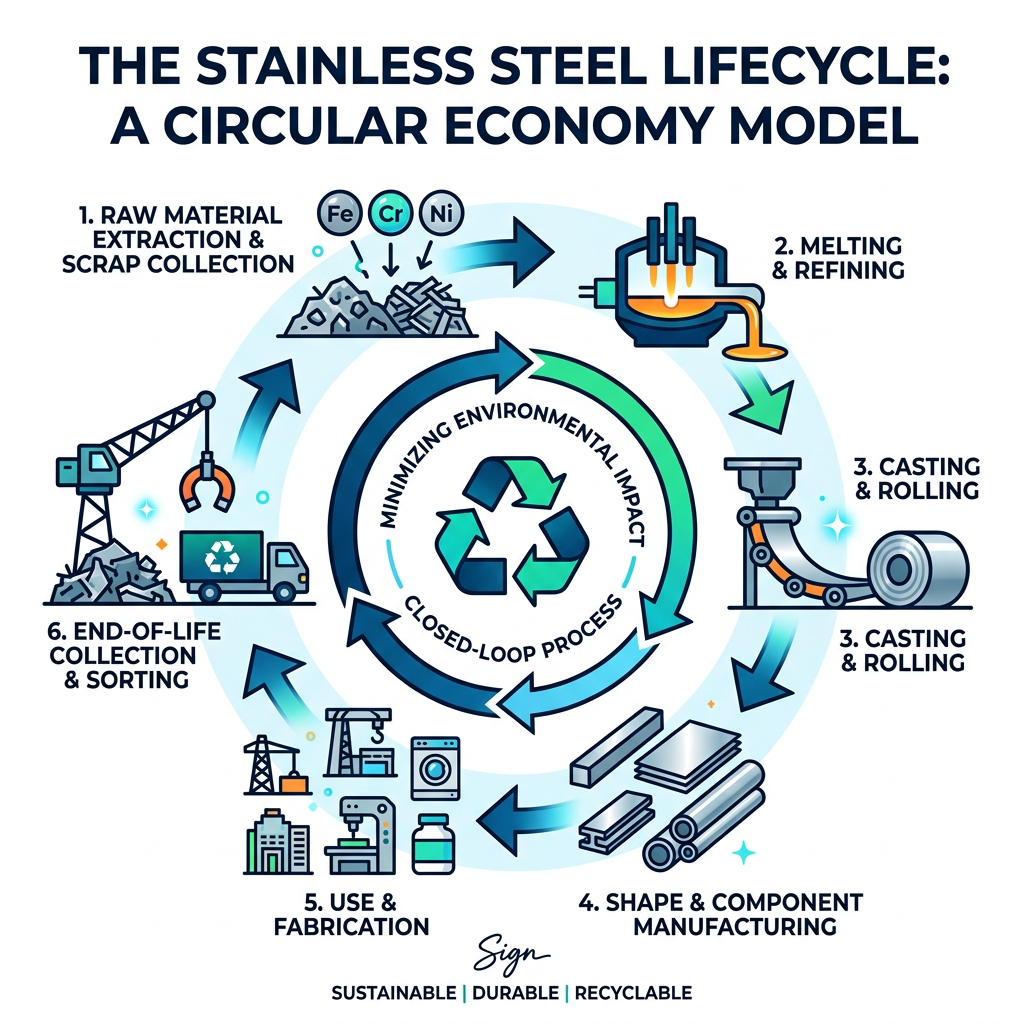
The lifecycle of stainless steel is a testament to its sustainability, contributing significantly to a circular economy. From its initial production to its eventual recycling, stainless steel minimizes environmental impact.
Stainless steel’s exceptional performance stems from its unique metallurgical composition. At its core, stainless steel is an iron alloy containing a minimum of 10.5% chromium. This chromium content is pivotal, as it reacts with oxygen to form a thin, invisible, and self-repairing passive layer on the surface. This “passivation layer” is what gives stainless steel its renowned corrosion resistance, protecting the underlying metal from rust and degradation.
Beyond chromium, various alloying elements are introduced to tailor stainless steel’s properties for specific applications. Nickel, for instance, enhances ductility, formability, and corrosion resistance, particularly in acidic environments, and also makes the material non-magnetic. Molybdenum significantly boosts corrosion resistance, especially against pitting and crevice corrosion, making it invaluable in marine or chemical processing settings. Other elements like carbon, silicon, and manganese also play roles in influencing strength, hardness, and workability.
Understanding the role of these alloying elements is crucial for material selection. For example, when comparing 303 and 304 stainless steel, the presence of sulfur in 303 improves machinability but reduces corrosion resistance and weldability compared to the more versatile 304 grade. Similarly, distinguishing between 316 and 316L reveals that the “L” designation signifies a lower carbon content, which is vital for preventing intergranular corrosion in welded applications. For a deeper dive into these specifics, a comprehensive stainless steel material selection guide can be an invaluable resource, helping engineers and designers make informed decisions. Furthermore, understanding the differences between 303 and 304 stainless steel and grasping the nuances of 316 versus 316L differences are essential for optimizing performance and longevity in diverse environments.
Stainless steel is broadly categorized into five main families, each with distinct characteristics and common grades:

Family Key Characteristics Austenitic Highly corrosion resistant, non-magnetic, excellent formability and weldability. Grades: 304, 304L, 309, 310, 316, 316L, 321, 347, 2205 (Duplex, but often grouped for discussion) Ferritic Magnetic, good corrosion resistance (especially to stress corrosion cracking), moderate strength, limited weldability compared to austenitic. Grades: 409, 430, 439 Martensitic Magnetic, high strength and hardness (can be heat-treated), moderate corrosion resistance. Grades: 410, 416, 420, 440C Duplex Combines properties of austenitic and ferritic steels, offering high strength and superior resistance to stress corrosion cracking and pitting. Grades: 2205, 2507 Precipitation Hardening (PH) Can be heat-treated to achieve very high strength, good corrosion resistance. Grades: 15-5 PH, 17-4 PH, 17-7 PH The choice of stainless steel family and grade is a critical decision, directly impacting a project’s long-term success. Factors like the operating environment (temperature, chemical exposure), required mechanical properties (tensile strength, yield strength), and fabrication needs (weldability, formability) must all be carefully considered.
Structural integrity and common profiles
The shape of a stainless steel component is just as vital as its material composition, dictating its structural integrity and suitability for specific applications. Modern manufacturing leverages a wide array of standardized and custom shapes, each engineered to optimize performance in diverse scenarios.
Among the most fundamental structural elements are stainless steel angles. These L-shaped profiles are incredibly versatile, serving as edge trims, frames, brackets, and structural supports in construction. They are particularly favored in environments demanding high hygiene, such as commercial kitchens, medical facilities, and laboratories. Angles are available in both equal and unequal leg configurations, providing flexibility for various design requirements.
Similarly, stainless steel beams and channels are cornerstones of heavy construction and industrial frameworks. Channels, with their distinct C-shaped or U-shaped profiles, offer robust structural support, framing, and bracing. They are frequently used in applications ranging from chemical transport systems to architectural elements. Beams, including I-beams, H-beams, W-shapes, and S-shapes, are designed to withstand significant loads, making them indispensable for large-scale infrastructure projects and heavy machinery supports.
For more general fabrication and architectural uses, flat bars provide a versatile solution. These rectangular sections are employed in building frames, petrochemical facilities, and beverage production, especially where narrower widths and specific thicknesses are required.
When it comes to cylindrical components or reinforcement, round bars are a common choice. They are integral to applications such as pipelines, roads, and as elements in beams and column stirrups. For applications requiring enhanced grip or specific machining, square bars offer superior support and reinforcement with reduced slippage, making them ideal for certain machinery components.
For lightweight yet strong structural frameworks, square and rectangular tubing are essential. These hollow profiles provide excellent strength-to-weight ratios, crucial for industrial processes and safety structures. Beyond these, specialized forms like rings and discs cater to unique manufacturing needs, often serving as components in flanges, seals, or rotating parts.
The precise dimensions, tolerances, and section properties (such as cross-sectional area, moments of inertia, and section moduli) of these shapes are critical engineering data. They inform structural calculations, ensuring that components can safely bear anticipated loads and fit together accurately during assembly.
Manufacturing processes and dimensional tolerances
The journey of stainless steel from raw material to a precisely shaped component involves sophisticated manufacturing processes that significantly influence its final properties and applications. The typical production flow begins with melting raw materials in electric furnaces, followed by refining processes like Argon-Oxygen Decarburization (AOD) or Vacuum-Oxygen Decarburization (VOD) to achieve the desired chemical composition.
After casting into billets or slabs, the material undergoes shaping. Hot rolling is a primary method for producing larger, heavier structural sections like beams, channels, and angles. This process, performed at high temperatures, allows for significant deformation and creates the basic structural shapes. For finer finishes and tighter dimensional tolerances, cold rolling is employed, typically for smaller bars, sheets, and strips. Cold rolling enhances surface quality and mechanical properties such as strength and hardness.
The distinction between seamless versus welded tubing is another critical aspect. Seamless tubing, typically produced by extruding or piercing a solid billet, offers superior pressure resistance and uniform strength, making it ideal for high-pressure applications like pipelines. Welded tubing, formed from flat strips and then welded along the seam, is often more cost-effective and suitable for applications where pressure requirements are less stringent.
Precision cutting and finishing processes further refine stainless steel shapes. Techniques like shearing are used for straight cuts on sheets and plates. For complex geometries or thicker materials, advanced methods like waterjet versus plasma cutting offer distinct advantages. Waterjet cutting provides extremely precise, heat-affected-zone-free cuts, while plasma cutting is faster for thicker materials, albeit with some heat distortion. These processes are crucial for achieving the exact dimensions required by modern manufacturing.

Dimensional tolerances and section properties are paramount in engineering. Tolerances define the permissible deviation from a specified dimension, ensuring components fit together and perform as intended. Section properties, such as cross-sectional area, moment of inertia, and radius of gyration, are mathematical representations of a shape’s resistance to bending, twisting, and buckling. These properties are meticulously calculated and provided by manufacturers, enabling engineers to design structures with confidence and precision. The manufacturing process directly impacts these properties, with careful control over every stage ensuring the final product meets stringent industry standards.
Optimizing your stainless steel supply chain
In the world of modern manufacturing, a reliable and efficient stainless steel supply chain is not just an advantage—it’s a necessity. Suppliers play a crucial role in bridging the gap between raw material producers and end-users, offering an extensive range of shapes, grades, and value-added services. The ability to source diverse materials quickly and consistently directly impacts project timelines and overall operational efficiency.
A key indicator of a dependable supplier is the implementation of a robust quality management system, such as ISO 9001:2015 certification. This ensures that products consistently meet specified quality standards, minimizing defects and ensuring reliability. Reputable suppliers often leverage global distribution networks and strong relationships with mills, enabling them to source even hard-to-find items and cater to specialized requirements. Their expertise extends to offering custom solutions, including precise cutting, finishing, and even the fabrication of unique profiles to meet exact project specifications. This comprehensive approach ensures that manufacturers have access to an extensive range of stainless steel products tailored to their needs.
Key considerations for a reliable stainless steel supply
When selecting a stainless steel supplier, several factors contribute to a reliable and efficient partnership. Timely delivery is paramount; understanding typical lead times for various shapes and grades helps in project planning and avoiding costly delays. Material certification, often provided through Mill Test Reports (MTRs), is essential for verifying chemical composition and mechanical properties, ensuring compliance with industry standards and project specifications.
Furthermore, consider suppliers who offer custom cutting services. This capability allows manufacturers to order materials cut to precise dimensions, reducing waste, minimizing in-house processing, and ensuring a perfect fit for components. For instance, when dealing with sheet or plate materials, understanding the nuances of choosing the right stainless steel plate grade can significantly impact performance and cost-effectiveness. A supplier who can provide expert guidance and custom solutions in this area adds substantial value.
Innovation and sustainability in stainless steel supply
The stainless steel industry is continually evolving, with ongoing innovation in metallurgy and manufacturing processes leading to new grades with enhanced properties and more sustainable production methods. Suppliers committed to sustainability often engage in green manufacturing practices, striving to reduce their carbon footprint and promote energy efficiency throughout their operations.
A significant environmental benefit of stainless steel is its exceptional recyclability. With over 80% of stainless steel being recycled at the end of its life, it stands as a highly sustainable material, contributing significantly to the circular economy. This high recycling rate reduces the demand for virgin raw materials and minimizes waste, aligning with modern environmental goals. For those looking to delve deeper into the environmental considerations and structural applications, a comprehensive structural stainless steel guide can provide valuable insights into its sustainable attributes and design considerations.
By partnering with suppliers who prioritize both innovation and environmental responsibility, manufacturers can ensure they are not only accessing high-quality materials but also contributing to a more sustainable future.
Frequently asked questions about stainless steel shapes
What are the main advantages of using stainless steel shapes in construction?
Stainless steel shapes offer a multitude of advantages in construction. Their primary benefit is superior corrosion resistance, which ensures longevity and reduces maintenance costs, especially in harsh environments. They also provide excellent structural strength, allowing for lighter yet robust designs. Aesthetically, stainless steel offers a modern, clean appearance that can enhance architectural designs. Its hygienic properties and ease of cleaning make it ideal for sensitive applications like healthcare facilities and food processing plants.
How do alloying elements like molybdenum affect corrosion resistance?
Alloying elements like molybdenum significantly enhance stainless steel’s corrosion resistance. Molybdenum is particularly effective at improving resistance to pitting and crevice corrosion, which are localized forms of attack that can occur in chloride-rich environments (like marine settings) or stagnant conditions. It also boosts resistance to various acids. For instance, the addition of molybdenum is a key differentiator in Grade 316 stainless steel, making it far more resistant to saltwater and chemical exposure than Grade 304.
Why is the recyclability of stainless steel important for modern industries?
The high recyclability of stainless steel is incredibly important for modern industries, contributing to environmental sustainability and resource conservation. Stainless steel has an impressive recycling rate, often exceeding 80% globally. This means that a significant portion of new stainless steel products are made from recycled content, reducing the need for virgin raw materials and lowering energy consumption during production. Its long lifespan further contributes to sustainability by minimizing replacement frequency, making it a cornerstone of the circular economy and a responsible material choice for environmentally conscious manufacturing.
Conclusion
As we navigate the complexities of modern manufacturing in June 2026, the role of high-quality stainless steel shapes continues to expand. From the intricate details of metallurgy and alloying elements to the precision of manufacturing processes and the efficiencies of a robust supply chain, every aspect contributes to the material’s unparalleled performance. Understanding the diverse families of stainless steel, their unique characteristics, and the vast array of available shapes empowers engineers and designers to select the optimal material for any challenge.
The advantages of stainless steel—its exceptional corrosion resistance, superior strength, aesthetic appeal, and remarkable recyclability—make it an indispensable material for sustainable construction and industrial innovation. By prioritizing careful material selection, engaging with reliable suppliers, and embracing advancements in manufacturing, we can continue to harness the full potential of stainless steel shapes to build a more durable, efficient, and sustainable future. The journey of stainless steel is one of continuous evolution, promising even greater contributions to industries worldwide in the years to come.