

Do standby power investments pay off for SMEs
Sponsored content. This article was supplied by a third party and Business Money has been paid to publish it.
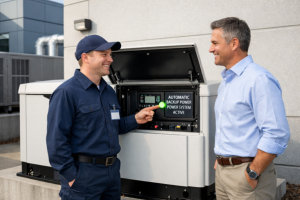
Image: Created with Copilot
For small and medium-sized enterprises, a sudden power outage is not just an inconvenience. It is an immediate halt to cash flow and customer trust. Lights go out, digital operations take a hit, the clock starts ticking fast on your bottom line.
Investing in a standby power system requires significant upfront capital, which tells why many business owners hesitate. But a look at the return on investment reveals that backup power is less an expense and more an essential insurance policy for operational survival.
The true cost of small business downtime
Every minute your facility sits in the dark costs money. For a small retail shop or a local medical clinic, a power disruption halts point-of-sale systems and corrupts ongoing digital transactions. It compromises inventory safety.
A single afternoon without power can easily wipe out an entire week of profitability. Many business owners fail to calculate these hidden numbers until a major grid failure occurs, leaving them with idled workers who must still be paid. True operational resilience starts by acknowledging that grid stability is no longer guaranteed.
Quantifying the return on backup power investment
Financial returns on backup power systems look different from traditional equipment investments because they are measured in losses prevented rather than daily revenue generated. To find your true baseline, you must calculate your exact cost of downtime per hour, including:
- Lost sales
- Wasted hourly wages
- Potential equipment restart penalties
When calculating long-term operational viability, your choice of fuel infrastructure dictates both reliability and ongoing logistical costs. Service providers must be in the equation too.
Let’s say you go for an LPG standby generator/s
Then, choosing a dependable propane supply partner like Pinnacle Propane ensures your backup systems remain online through extended outages using remote telemetry monitoring. This digital fuel tracking offers broad geographic coverage to support generator uptime while simplifying budgeting for fuel and routine deliveries.
Comparing your standby power fuel options
Choosing how to fuel your backup power strategy directly shapes your long-term maintenance schedule and initial capital deployment. Small businesses generally look at three primary options to keep their facilities running.
- Diesel systems offer high power output but require expensive fuel stabilization treatments to prevent algae growth in the tank
- Battery storage systems provide immediate, silent power transfer but face strict runtime limitations during multi-day grid failures
- Propane standby generators deliver indefinitely stable fuel storage life and cleaner emissions profiles for urban commercial zones
- Natural gas units remove onsite fuel storage needs entirely but remain vulnerable to underground pipeline disruptions during seismic events
Understanding these physical differences helps clarify why commercial infrastructure costs shift across regions, especially since national data indicates that power outages cost U.S. electricity customers billions each year.
Assessing financing paths and equipment loans
Navigating the upfront cost of a commercial standby generator requires looking closely at modern commercial financing options. Most equipment manufacturers and commercial banks offer specialized capital loans that distribute the cost over several fiscal years.
Operating leases and power-as-a-service agreements can also lower your initial cash barriers. These structures transform a heavy capital expense into a predictable monthly operating cost, frequently wrapping routine maintenance and remote system testing into a single contract.
Evaluating maintenance overheads and lifecycle economics
A standby generator cannot simply sit forgotten in an alley until the local grid crashes. Regular weekly exercises and annual fluid changes ensure the engine components turn over instantly when utility power drops.
Failing to budget for these routine engineering checkups will drastically shorten the operational lifespan of your asset. Neglected systems often suffer from dead starter batteries or clogged fuel lines, rendering your entire financial investment useless when an emergency actually hits.
Factoring in insurer and lender considerations
Commercial property insurers view proactive risk management favorably when underwriting business interruption policies. Installing a permanently mapped standby power system often opens the door for negotiated premium discounts on your monthly coverage.
Operational risk mitigation
Lenders look at power resilience when reviewing commercial refinancing or expansion loans. Showing that your business can maintain supply chain continuity during regional disasters reduces your default profile.
Inventory protection credits
Facilities storing perishable cargo or sensitive pharmaceuticals receive direct underwriting benefits from automated backup systems. Preventing a single total inventory loss can pay for the generator system multiple times over.
Data center security
Ensuring your local servers and communication hubs never drop offline protects client data integrity. Keeping your digital perimeter active prevents secondary liabilities stemming from forced security system blackouts.
Balancing the equation for your facility
Evaluating whether backup power makes operational sense requires assessing your specific local grid health alongside your daily digital dependencies. For modern companies running constant cloud-based workflows, network and power issues cause 23% of impactful small business IT infrastructure and server outages, showing that going unprotected risks major disruption.
Taking time to run the specific baseline numbers for your facility protects your market share against local disruptions. Making an informed decision when choosing a generator for your business or mapping out long-term infrastructure upgrades ensures your enterprise remains profitable while your competitors sit in the dark.
Protecting your long-term operational continuity
Securing your business against unexpected grid failures means analyzing your current utility vulnerabilities and specific infrastructure needs. Investing in a resilient power setup safeguards your daily revenue and customer relationships from sudden disruptions.
Take time to research the latest energy integration strategies and technical frameworks suited for commercial properties. Feel free to explore the site for more insightful posts on business efficiency and sustainability.