

Rising car repair costs in 2026: What drivers need to know
Sponsored content. This article was supplied by a third party and Business Money has been paid to publish it.

Photo by Tim D on Unsplash
Car repair bills have always had the capacity to surprise, but something has changed in recent years that has moved them from occasional financial shock to a sustained and growing source of household budget pressure. The cost of keeping a vehicle on the road in 2026 is meaningfully higher than it was five years ago, and the forces driving that increase are not temporary disruptions that will resolve themselves. They are structural changes in the economics of automotive parts, labour and supply chains that drivers need to understand in order to respond to them effectively.
Understanding why costs have risen is the starting point. Knowing what to do about it is the part that actually matters.
Why repair costs have risen so significantly
The increase in car repair costs in 2026 is the product of several converging factors that have compounded each other’s effects over a period of years rather than arriving as a single shock.
New parts prices have risen substantially, driven by a combination of raw material cost increases, supply chain disruption and the growing technological complexity of modern vehicles. A headlight assembly that incorporated a simple halogen bulb a decade ago now contains LED arrays, adaptive control modules and integrated sensors that multiply both the manufacturing cost and the replacement price. An electronic control unit that was once a straightforward component has become a sophisticated computing device that in some vehicles costs more to replace than the car is worth on the open market.
Labour rates at workshops and dealerships have increased alongside parts costs, driven by a shortage of qualified technicians that has persisted across major markets for several years. The diagnostic complexity of modern vehicles requires technicians with skills and certifications that take years to develop, and the demand for these skills consistently outpaces the supply of people who have them. When skilled labour is scarce, its price rises, and that price is passed directly to customers in the hourly rates that appear on workshop invoices.
Supply chain vulnerabilities exposed during the disruptions of recent years have added a further layer of cost and unpredictability. Parts that were previously available within days now sometimes take weeks to source, and the availability constraints that result from this unpredictability give suppliers pricing power that they did not previously have. According to the American Automobile Association (AAA), the average cost of vehicle repair has increased significantly over the past three years, with parts costs rising faster than labour in most repair categories, a trend that shows no clear sign of reversing in the near term.
The vehicles most affected
Not all vehicles are equally exposed to rising repair costs, and understanding where the greatest vulnerability lies helps drivers make more informed decisions about both vehicle selection and maintenance strategy.
Newer vehicles with high levels of electronic content and advanced driver assistance systems are among the most expensive to repair when something goes wrong. Sensors, cameras and radar modules that are integral to these systems are expensive individually and in many cases require calibration after replacement that adds significant labour cost to what might otherwise be a straightforward parts swap. A minor collision that scratches a bumper on an older vehicle might require only a painted panel and an hour of body shop labour. The same collision on a late-model vehicle with sensors embedded in the bumper assembly can generate a repair bill several times larger.
Older vehicles face a different cost pressure. As vehicles age, the availability of new OEM parts through official channels diminishes as manufacturers reduce production runs for components with limited ongoing demand. The parts that remain available through official channels become progressively more expensive as volumes decrease and specialist sourcing becomes necessary. For owners of vehicles more than ten years old, the combination of increasing parts scarcity and rising prices through conventional channels creates a maintenance cost trajectory that can make continued ownership feel financially unsustainable.
The strategies that actually work
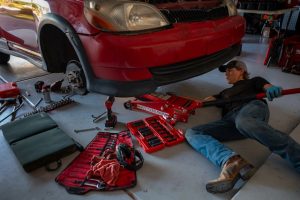
Photo by Joseph Pillado on Unsplash
Understanding the problem is useful. Knowing how to respond to it is what determines whether rising repair costs represent a manageable challenge or a genuine financial burden.
The most impactful single strategy available to any car owner in 2026 is changing where they source their parts. The markup applied by workshops and dealerships on parts ordered through their own supply chain represents a significant and largely avoidable cost that most customers pay without question simply because they do not know the alternative exists. A part that a garage invoices at 250 dollars may be available as a quality used OEM component through an established online marketplace for 60 to 80 dollars. The saving on that single part, multiplied across the several significant repairs that most vehicles require over the course of a few years, represents a meaningful reduction in total maintenance expenditure.
For major mechanical components, the financial impact of this sourcing decision is particularly significant. Transmission replacement is one of the most expensive repair categories in the current market, and the difference between dealer new parts pricing and quality used component pricing is among the largest available in any repair category. To explore what is available and at what prices, check out Ovoko for a wide selection of verified used automatic gearboxes from sellers with documented component histories and clear return policies.
Choosing an independent mechanic over a franchised dealership for all work outside the manufacturer warranty period is the second high-impact strategy. Independent workshops consistently offer lower labour rates than dealerships, typically by a margin of 30% to 50%, and they consistently score as well or better than dealerships in customer satisfaction surveys for routine maintenance and repair. The combination of independent mechanic labour rates and independently sourced used parts delivers the lowest total repair cost available to any car owner outside of doing the work themselves.
Preventive maintenance, practised consistently and informed by the vehicle’s actual service schedule rather than workshop marketing, reduces the frequency and severity of repairs by addressing wear before it becomes failure. According to Consumer Reports, drivers who follow manufacturer-recommended service schedules consistently spend less on unplanned repairs over five-year ownership periods than those who service reactively, with the differential in total maintenance expenditure running to thousands of dollars across the full ownership period of a typical vehicle.
The insurance and warranty landscape
Rising repair costs have ripple effects that extend beyond the direct cost of individual repairs. Insurance premiums have increased in most major markets partly as a consequence of higher average claim values, creating an indirect cost of rising parts and labour prices that affects every insured driver regardless of whether they personally make a claim.
Understanding what is and is not covered by vehicle warranty, and for how long, is increasingly important as repair costs rise. Many drivers are unaware that extended warranties purchased at the point of vehicle sale often contain exclusions that significantly limit their practical coverage, or that the requirement to use dealership service to maintain warranty coverage is less absolute than it is often presented to be. In the United States, the Magnuson-Moss Warranty Act protects consumers against warranty being voided solely because independent service was used, provided the service was correctly performed with appropriate parts and fluids.
Gap insurance, which covers the difference between the vehicle’s market value and any outstanding finance in the event of a total loss, has become more relevant as repair costs have risen to the point where some repairs cost more than the vehicle they are being performed on. Understanding the full insurance and warranty picture is part of a comprehensive response to the rising cost environment.
What this means for vehicle ownership decisions
Rising repair costs are also influencing how drivers think about vehicle acquisition and ownership duration. The conventional wisdom that newer vehicles are always cheaper to maintain than older ones is less reliably true than it once was, as the repair cost profile of newer technology-heavy vehicles can be significantly higher than that of simpler older models in good condition.
For drivers approaching a vehicle purchase decision, factoring the anticipated maintenance and repair cost profile of the specific model into the total cost of ownership calculation is more important in 2026 than it has ever been. A vehicle with a lower purchase price but an expensive parts profile and limited used parts availability may represent higher total ownership cost than a more expensive vehicle with abundant used parts supply and straightforward maintenance requirements.
The drivers who navigate the rising cost environment most successfully are not necessarily the ones with the highest budgets. They are the ones who make informed decisions about where to source parts, who to use for labour and how to maintain their vehicles in ways that prevent expensive reactive repairs. In a market where costs are rising on multiple fronts simultaneously, the value of this informed, proactive approach to vehicle ownership has never been greater.