

Best time to trade forex – understanding market hours & volatility
Sponsored content. This article was supplied by a third party and Business Money has been paid to publish it.
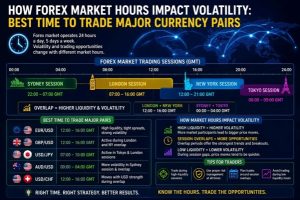 How forex market hours impact volatility: Best time to trade major currency pairs
Among the biggest trading mistakes made by new traders is the idea that the forex market operates in the same manner throughout the day. Indeed, the market activity may differ greatly depending on the time, the trading session and the currencies being traded. That’s the reason why being aware of the forex trading hours is as vital as knowledge of technical analysis or market fundamentals. The time of trading can affect volatility, liquidity, spread, and even which trading strategy is most suitable.
In this blog, we will explore how forex market hours impact volatility. Additionally, we will also learn when traders are most likely to find opportunities to trade major currency pairs.
What are the forex trading hours?
Forex market trading hours refer to the times when the forex market is open for trading.
The forex market does not open and close at a certain time like a stock exchange. Instead, it is open for 24 hours, 5 days a week. This everyday activity is made possible because major financial centres of the world serve as trading centres.
Based on the active trading centres, there are four major forex trading sessions:
- Tokyo Session: It is active from 12:00 AM to 9:00 AM GMT
- London Session: It is active from 8:00 AM to 5:00 PM GMT
- New York Session: It is active from 1:00 PM to 10:00 PM GMT
- Sydney Session: It is active from 10:00 PM to 7:00 AM GMT
Each session is different, and market action may vary based on session activity. These distinctions are important for traders to grasp for better timing and decision-making.
What are the most active forex trading hours?
If there is one period that can be considered the attracts the most attention, it is the overlap between the London and New York sessions. This overlap normally results in greater trading volume and liquidity. Not only that, but it also has greater volatility and narrower spreads.
This is a time period when both traders from Europe and traders in the USA are busy trading at the same time, which is often the time of day when the largest market moves occur. Many traders consider this the best time to trade Forex, as price action is usually more dynamic.
Major currency pairs like EUR/USD, GBP/USD and USD/CHF are especially significant during this time, as both regions have a strong impact on these pairs. These factors can lead to better trade execution and price action when combined with high market participation and liquidity.
This is also a common time for the United States to release large economic data releases. The reports, like inflation data, employment reports, and central bank statements, can add to volatility and generate short-term trading opportunities.
How do different forex trading sessions affect volatility?
Each forex trading session contributes differently to market volatility. This is because there is a variation in trading activity, liquidity and participation during the day.
Generally:
Tokyo Session: The Tokyo session is usually volatile because Asian markets start trading. During this time, the price movements of Japanese Yen/Currency, Australian Dollar/Currency, and New Zealand Dollar/Currency often tend to be more pronounced.
But, usually, volatility during these forex trading hours is below the volatility during the London or NY trading sessions.
London Session: The London session is regarded as the most crucial trading time in the forex market. London is one of the world’s biggest financial hubs, which means that banks, institutions and retail traders are very active in the city.
The surge in the trading volume typically results in increased liquidity and price volatility, making the trading session more active.
New York Session: Volatility is high during the New York trading session, notably during the release of major economic releases from the United States. During this time, market activity can be very elevated as the US dollar is used in many of the world’s most active currency pairs.
The times when markets overlap between the London and New York sessions are particularly recognized for the biggest movements made on the day.
Sydney Session: The Sydney session is typically a quiet one in terms of trading. The trading volume is also lower, and this means that the price movements are not as big and the price is not as volatile.
Traders can see a slight drop in activity in the market, but there are still chances. In these market conditions, some traders opt for the range trading strategy. This is because it involves finding support and resistance levels and trading within a defined price zone instead of waiting for a significant directional trend.
How does economic news change session volatility?
Forex market hours are certainly not the only factor affecting volatility during trading sessions. Even in the same session, the economic news releases can give a drastic change in the prices.
For instance, the New York session is generally used for the release of the US inflation reports, employment data and the Federal Reserve announcement. These events can trigger a rapid change in USD cross pairs in a matter of minutes. Likewise, the European Central Bank (ECB) announcements can have a big influence on euro pairs when trading in the London time zone, which can cause market volatility.
That’s why many traders keep track of the economic calendar and forex trading hours. Knowing the timing of key events can help traders anticipate periods of increased volatility and be ready for it.
Conclusion
Understanding forex trading hours can help traders better understand when and why volatility occurs in the market. Some sessions are relatively calm, while others see a lot of price action with the increased trading volume and institutional participation. By recognising how different sessions affect market activity, traders can make more informed decisions about which market conditions best suit their strategies.