

Why families keep investing in matching pajamas every holiday season
Sponsored content. This article was supplied by a third party and Business Money has been paid to publish it.
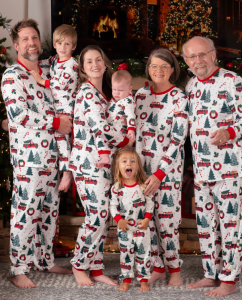 Every December, millions of households make the same small purchase: a matching pajama set for the whole family, bought for one photo and one morning. On paper it looks like a tiny expense, the kind of thing nobody would think twice about when planning a budget. But the fact that families keep buying this, year after year, even when they’re cutting back elsewhere, says something interesting about how people actually decide what’s worth spending on.
Christmas pajamas have become one of the more stable parts of holiday spending — not because they cost a lot, but because they sit in a sweet spot: cheap, meaningful, and actually used more than once. Looking at why families keep buying them says a lot about how people spend money around the holidays, not just about the pajamas themselves.
A cheap purchase that feels worth more than it costs
Most holiday spending moves with income — bigger gifts and nicer trips when money’s good, smaller versions of both when it’s tight. Matching pajamas don’t follow that pattern as closely. A typical family set costs somewhere between $20 and $50 per person, a small amount next to gifts, travel, or hosting a big dinner, yet it shows up in holiday budgets across every income level.
The reason comes down to what people are actually paying for. It’s not really the fabric — it’s a simple, repeatable tradition that photographs well and doesn’t take much effort to pull off. A gift gets opened once. A decoration sits in a box for eleven months. A pajama set gets worn, photographed, and often worn again several times over a couple of weeks. That mix of low price and real use is a big part of why this stays a steady seller even in years when people are spending less overall.
Why it feels like a good deal, even without doing the math
One useful way to think about this is cost per wear rather than the price tag. A $200 outfit worn once is a very different deal than a $40 pajama set worn five or six times in one season — Christmas Eve, Christmas morning, a game night, maybe a visit to relatives. Most families never actually run these numbers, but they seem to feel the value anyway.
This also explains why pajamas have held up better than some other one-time holiday buys. A themed sweater or a costume piece only makes sense for a day or two. Pajamas keep working as normal sleepwear long after the “photo moment” is over, which quietly makes the purchase feel worth it, whether or not that was the original selling point.
How the product itself has grown to match what families want
Retailers selling into this space have changed the product to fit. Sizing now commonly runs from newborn through adult 3XL or 4XL, sometimes with a matching size for the family dog — a range that would have been rare for a single print ten years ago, back when “family matching” often meant a kids’ print stretched awkwardly into one or two adult sizes as an afterthought.
This growth matters for business reasons too, not just for the customer. A single print that every member of a household can buy into — parents, kids, a baby — turns one purchase into five or six items in a single order. That’s a very different sale than one garment bought on its own, even if each piece is priced modestly. It’s really the core of why family matching christmas pajamas have become such an interesting category to watch — the same choice that makes a family feel fully included also happens to grow the size of the order at checkout.
A set that shows how far this product has come
The Matching Family Christmas Pajamas Christmas Tree & Car Print set, priced at $37.99, is a good example of this shift. It comes in adult sizes XS through 4XL, kids from 2Y through 12–13Y, and baby from 0–3M through 12–18M, plus a matching pet size — wide enough to outfit a large household from one single listing instead of several. The set comes with matching socks at no extra cost, and the kids’ and baby sizes meet flame-resistant safety standards for children’s sleepwear, a detail that likely matters more to buyers than any of the marketing copy around it. It’s a fair snapshot of how far this kind of product has moved from its more limited, kids-only beginnings.
Why people keep buying even when money is tight
Spending on extras usually gets cut first when households are being careful with money, but matching pajama sets seem to hold up better than most. Part of the reason is simply the price — it’s low enough that it rarely competes with bigger holiday costs like gifts or travel. A family looking to save money is far more likely to cut a big-ticket item than skip a $30–$40 purchase that also functions as everyday clothing.
There’s another piece to this too. Once a family starts doing this every year, it tends to stop feeling like a choice and starts feeling like something they just do, the same way people don’t re-decide whether to put up a tree each December. Small, repeated purchases like this tend to survive budget cuts far better than one-off big purchases, even if the yearly total adds up to something similar.
Why more sizes means bigger orders
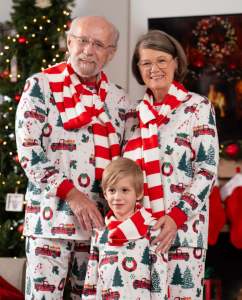 It’s worth pointing out how closely size range connects to order size in this category. A family of five, plus a dog, shopping for a print that only comes in three adult sizes and two kids’ sizes runs into a real problem — someone gets left out, or the family settles for a mismatched substitute instead. A print with a genuinely wide range solves that completely, and removing that kind of obstacle almost always leads to more items sold per order.
This is a good example of how one small decision — how many sizes to offer for a single print — can directly affect how much money comes in per order. Brands that have widened their sizing in this category aren’t just doing it to look inclusive; a wider range clearly leads to more pieces sold per family, since it removes the “someone doesn’t get to match” problem that used to cap most orders at three or four pieces.
What this says about spending habits more broadly
Matching Christmas pajamas are a small slice of overall holiday shopping, but they’re a good example of a bigger pattern: people increasingly judge a purchase by how much use they’ll actually get out of it, not just by what it was originally bought for. Something that photographs well for one morning and keeps working as ordinary sleepwear for weeks afterward is simply a better deal than something that only serves one narrow purpose.
That combination — low price, real everyday use, and a purchase that repeats every year almost automatically — adds up to a surprisingly smart bit of spending behavior, happening across millions of households at roughly the same time each December, for reasons that go well beyond the print on the fabric itself.