

From 4 to 62 days for a refund – new mystery shopping study of UK retailers
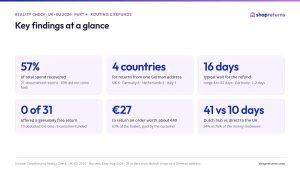
European customers returning products bought from British online retailers waited a median of 16 days to receive their money back, according to a mystery shopping study conducted by ShopReturns and based on real cross-border purchases and returns. ShopReturns tracked 31 self-funded orders from UK retailers delivered to a German consumer address and returned through each shop’s standard customer process. Return parcels were routed to four different countries, while none of the 31 orders offered a genuinely free return. The findings suggest that the distance a parcel travels is only part of the problem: what happens after the return reaches a warehouse can have an even greater impact on how quickly the customer is refunded.
Seventeen of the 49 retailers would not ship to the German address at all, while one quoted delivery above the value of the product. This left 31 real, self-funded orders, with basket values ranging from approximately €15 to €70. Each order was placed by ShopReturns researchers acting as ordinary consumers and then returned through the retailer’s standard customer return process, without special treatment or any contact identifying them as researchers. The study tracked delivery, carriers, DDP or DDU status, cross-border tracking, return-label availability, return destination, shipping costs, refund amounts and timing, and customer-service interactions.
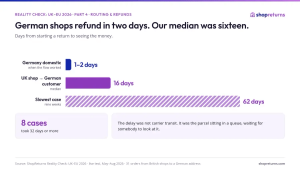
The median refund took 16 days
Across the 20 cases where both the return initiation date and refund date could be documented, customers waited a median of 16 days to receive their money. Individual cases ranged from four to 62 days. Eight cases took 32 days or more, while the slowest took 62 days – almost nine weeks between the customer requesting the return and receiving the money. The study found that in these longest cases, the delay was not primarily caused by carrier transit. Instead, parcels spent time waiting at a facility before being processed and the refund authorised.
– The results show why retailers should not look at cross-border returns purely as a transport problem. A parcel can cross a border and still be refunded relatively quickly, while another return can reach a continental hub and then wait there for weeks. The relevant question is not only where the parcel goes, but how quickly it is identified, checked and connected to the refund process – says Paweł Zakielarz, CEO of ShopReturns, a company specialising in cross-border returns and helping online retailers manage returns locally across European markets.
British returns did not necessarily return to Britain
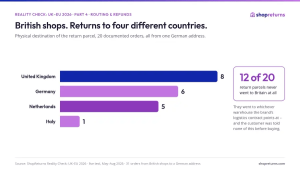
The physical destination of the return parcel was documented for 20 orders. Eight were sent back to the United Kingdom, six remained in Germany, five were routed to the Netherlands and one went to Italy. This means that 12 of the 20 returns for which the
destination was known did not go back to Britain at all, despite every purchase being made from a British shop.
The study also found significant differences between individual routes. Returns sent directly to the UK typically resulted in customers receiving 76% of their original spend back within 10 days. Returns that stayed in Germany produced the fastest individual refund in the entire study: the money arrived on the same day the parcel was scanned by the carrier. But the same group also included cases taking 26 and 62 days.
Five returns were routed to the Netherlands. This was the slowest destination cluster in the study on both refund timing and the proportion of the original spend recovered. These returns typically took 41 days to process, with customers recovering 34% of their original spend on average. However, the findings do not indicate that routing a return to the Netherlands is inherently slow. Three of the five Dutch-bound brands belonged to the same corporate group, shared a back end and sent German returns to the same Dutch facility. Their respective return-to-refund times were 42, 40 and 43 days. A fourth, unrelated footwear retailer also routed its return to the Netherlands but completed the refund in 13 days. The difference therefore appeared to be operational rather than simply geographical.
– A local or continental return address alone does not solve the problem. The findings show that what happens after the parcel arrives matters just as much. Three different brands using the same facility produced almost identical waiting times of around six weeks, while another retailer using the same destination refunded the customer three times faster. Retailers need to measure the actual time between a customer initiating a return and the refund reaching their account, not just the transit time of the parcel – says Zakielarz.
None of the 31 orders offered a genuinely free return
Cost was another major difference between domestic expectations and the cross-border experience. None of the 31 orders offered a genuinely free return. Thirteen retailers deducted the courier cost from the customer’s refund. Nine required the customer to organise and pay for the return shipment themselves. In one case, a customer returning an order worth approximately €40 had to pay €27 upfront for the return courier. The eventual refund was €13. In other recorded cases where customers arranged their own shipping, return costs included €6, €6, €6.95 and €8.70. The study also examined the amount customers ultimately recovered. Among 21 completed returns with a documented refund, €738 was originally spent and €422.40 came back to customers. However, these figures should not be interpreted as meaning that 43% of the value was lost solely because of return costs. Some purchases contained multiple items and not every item was returned. After excluding two anomalous cases – one refund paid on a parcel that was never sent and another on a parcel that was never delivered – 19 clean returns represented €680 in original spend and €396.70 returned to customers. Individual outcomes varied significantly. Four returns resulted in customers receiving less than 20%
of the original order value back. The lowest recovery was 10%, while at the other end of the study one customer recovered 94%.
The study identified three recurring factors behind the difference between the amount originally spent and the refund received: return shipping deducted from the refund, the original outbound delivery fee being retained, and the cost of the cross-border return itself. Basket value also mattered. Every brand in the test where the customer recovered less than 20% had an original basket below €35. Every brand where more than 80% was recovered had a basket above €55.
Distance was not the decisive factor
One of the clearest findings of the study was that a longer physical journey did not automatically mean a slower refund. Several returns sent directly from Germany to the UK were refunded within four to eight days. Two of the three fastest results in the entire study involved UK-bound returns. By comparison, three returns sent to the same Dutch facility took 40, 42 and 43 days. The best overall commercial outcome came from a return sent to Italy by a premium fashion retailer. The customer recovered 94% of the original spend within seven days. Among the highest-performing cases, customers received 94% of their spend back within seven days, 80% within five days and 76% within four days. The retailers behind these results did not share the same technology, carrier or returns-platform provider. One did not have a returns portal at all. What they had in common operationally was a relatively short journey for the parcel and quick processing once it arrived.
– Every unnecessary return mile has a cost, but the study also shows that distance alone does not determine the customer outcome. A retailer needs to know where returns physically go, what they cost and, crucially, how long they wait before someone processes them. If that information is hidden inside a wider shipping operation, it becomes very difficult to see where margin and customer experience are actually being lost – says Zakielarz.
What should retailers measure?
The study suggests that retailers selling cross-border should look beyond their published returns policy and examine what actually happens operationally. Among the metrics worth checking are the physical destination of returns from each market, the median time between return initiation and refund, the 90th percentile for refund timing, and the proportion of refunds where deductions were not clearly communicated before the customer sent the parcel. Retailers using a single continental hub can also compare individual routes through that hub with direct alternatives. The results of the ShopReturns mystery shopping study show why this matters. Across the tested UK retailers, a European customer waited a median of 16 days for a refund. At the extremes, some received their money within four days, while another waited 62. The difference was not explained by geography alone. It was shaped by where the parcel was routed, what the customer had to pay and, above all, what happened after the return arrived.