

Smarter global billing: How AI translation helps finance teams communicate across borders
Key takeaways
- AI translation tools are revolutionizing cross-border financial communication, enabling instant, accurate translations of invoices, contracts, and reports that reduce delays and human error.
- Finance teams benefit from greater compliance, operational efficiency, and scalability, especially when dealing with region-specific regulations and multilingual stakeholders.
- Integrating AI translation into billing systems and ERP platforms helps businesses accelerate global growth, shorten billing cycles, and enhance trust with international clients.
Financial transactions cross borders at unprecedented speed and volume. From SaaS startups invoicing clients in Tokyo to multinational corporations handling payroll across Latin America, billing is no longer confined to a single language—or even a single regulatory environment. Yet, with this global reach comes a growing challenge: how can finance teams effectively communicate and operate across dozens of languages and legal systems without error?
Traditionally, finance professionals have relied on human translators or local offices to manage multilingual documentation. But these methods are time-consuming, expensive, and prone to delays. Worse, a misinterpreted line item or an incorrectly translated contract clause can lead to costly mistakes, legal exposure, or strained client relationships.
Enter AI-powered translation.
Recent advances in artificial intelligence and natural language processing (NLP) are transforming how global finance teams operate. AI translation tools now allow businesses to automate the accurate translation of invoices, compliance documents, financial reports, and even customer communications—almost instantly.
A Wolters Kluwer report found that over 70% of finance leaders are exploring or implementing AI in their operations, citing translation and localization as key areas for productivity gains. As the global economy becomes more interconnected, the demand for smarter, faster, and more scalable billing solutions will only grow.
The new global standard: Why finance needs AI translation
Global billing isn’t just about converting currencies—it’s about navigating a labyrinth of linguistic, cultural, and regulatory differences. Consider this: an invoice destined for France must not only be translated into French, but also comply with French accounting standards and tax codes. Add GDPR or other local data privacy requirements to the mix, and things get exponentially more complex.
For multinational companies or fast-scaling businesses, managing this manually is unsustainable.
Miscommunication in billing—whether due to mistranslations, formatting inconsistencies, or unclear terminology—can result in delayed payments, regulatory fines, or damaged trust. Even a minor discrepancy in a VAT field can raise red flags during audits.
AI translation tools tackle these pain points by:
- Translating content instantly across dozens of languages.
- Maintaining terminology consistency using domain-specific glossaries.
- Integrating with finance platforms to ensure correct context and formatting.
By embedding AI translation into global billing workflows, finance teams can reduce friction, increase efficiency, and improve accuracy at scale.
How can AI translation improve global billing accuracy?
Accuracy is the cornerstone of financial communication. AI translation systems are built not only to convert words but also to understand the semantics of financial documents. Here’s how they help:
- Instant translation of financial documents
AI-powered platforms can translate invoices, contracts, balance sheets, income statements, and tax documents on the fly. Instead of sending documents to external translators and waiting days, finance teams get near-instant results.
- Automated language detection and terminology control
Modern AI systems can auto-detect the source language of a document and apply the correct terminology using finance-specific translation memories. This minimizes human error and ensures that terms like “net payment,” “withholding tax,” or “deferred revenue” are consistently rendered across all markets.
- Built-in glossaries for compliance
AI tools often come equipped with customizable glossaries tailored for accounting and legal compliance, making it easier to meet country-specific regulations.
- Smart formatting
The layout of invoices and statements matters. AI translation tools preserve tables, headers, and footnotes in their proper structure—something that generic machine translation tools often overlook.
Here are some leading tools used in finance translation workflows:
| Tool | Key features |
| MachineTranslation.com | Aggregates top AI engines with finance glossary support, segmented bilingual view, and smart AI Translation Agent that learns user preferences. Offers AI quality scores, key term comparison, customizable output, and human verification—ideal for financial compliance, terminology control, and high-volume workflows. Features document support, API integration, and secure handling for 270+ languages. Built for cost-efficiency, privacy, and accessibility—cutting translation costs by up to 90% while delivering near-professional accuracy. |
| MemoQ | Translation memory and term base management; widely used by financial localization teams for its collaborative CAT environment. |
| DeepL Pro | High-quality neural translations, particularly strong for European languages. API supports ERP system integration. |
| Smartling | Enterprise-grade TMS with automated workflows and finance-specific glossaries for global teams. |
| Lokalise | Optimized for SaaS localization, including UI, support, and billing messages; strong API support. |
What are the benefits of AI translation for finance teams working across borders?
As companies expand into new markets, finance departments are under pressure to keep up with the speed and complexity of global operations. Miscommunication caused by language barriers can slow down processes, introduce compliance risks, and frustrate international partners or clients. AI translation provides a powerful solution, enabling finance teams to operate efficiently, accurately, and collaboratively—no matter where their counterparts are located.
Embracing AI translation offers finance teams significant operational and strategic advantages:
✔ Enhanced collaboration across borders
Multilingual teams often face delays due to translation bottlenecks. With AI, teams in Singapore, Berlin, and São Paulo can all view the same report in their preferred language—instantly.
✔ Streamlined compliance
Whether you’re dealing with France’s SAF-T regulations, Germany’s GoBD compliance, or Brazil’s Nota Fiscal, accurate translations of financial documents are essential. AI tools help maintain compliance by ensuring standardized language across jurisdictions.
✔ Faster reporting and smoother audits
Time is money. With AI translation, month-end reports, quarterly filings, and audit prep can be done faster—freeing up finance teams to focus on strategy rather than paperwork.
✔ Scalability for global growth
Startups entering new markets can localize their billing systems quickly without hiring in-country language specialists. Enterprises can centralize and standardize translation processes across business units.
Case in point: Global SaaS company streamlines billing in 12 languages
Consider a fast-growing SaaS company—serving customers in over 30 countries. As its client base expanded across Europe, Asia, and Latin America, so did the complexity of its billing operations. Each region had different invoice requirements, tax notations, and customer service expectations.
Initially, they outsourced translations to agencies, which led to inconsistencies and delays. In some cases, invoices were sent out days late due to translation backlog—affecting cash flow.
To fix this, They adopted an AI translation platform integrated with its ERP and CRM systems. Using pre-approved finance glossaries and templates, the platform instantly translated customer invoices and support documents into 12 languages.
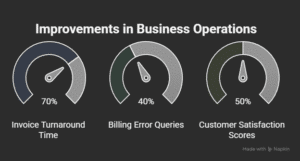 The result?
Not only did reduce billing cycle time, but it also strengthened client trust—essential for long-term retention.
Future outlook: Finance and AI translation go hand in hand
As global finance becomes increasingly digitized, the need for seamless multilingual communication is no longer optional—it’s mission-critical. AI translation is set to play a foundational role in how finance teams operate, collaborate, and grow across borders. The future of financial communication lies in smart, integrated, and adaptive translation solutions that evolve with business needs.
ERP and finance software integrations
AI translation is being embedded directly into leading accounting and ERP platforms like QuickBooks, Xero, and SAP. These integrations allow for the automatic localization of invoice templates, tax tables, and financial reports—streamlining operations and ensuring compliance with region-specific standards.
Real-time translation in financial communication
AI-powered translation is also reshaping client and vendor communication. By integrating into financial helpdesk platforms and CRMs, these tools allow finance professionals to instantly respond to queries in the recipient’s preferred language—boosting service quality and reducing response time across international markets.
Human-in-the-loop systems for critical accuracy
While AI excels at processing high volumes of content, some documents demand a human touch. Contracts, tax filings, merger agreements, and investor reports often require nuanced understanding that only a finance-trained human reviewer can provide. That’s why the most effective systems combine machine translation speed with expert human verification—delivering near-100% accuracy and ensuring regulatory and legal compliance.
MachineTranslation.com offers built-in human verification specifically designed for high-stakes financial documents. This feature allows finance teams to enhance AI-generated translations with expert oversight, ensuring critical information is conveyed with precision. It’s a practical safeguard that adds trust and accountability to multilingual finance workflows.
Smarter billing starts with smarter communication
Cross-border financial operations are no longer optional—they’re standard. But with expansion comes complexity, and language is one of the most persistent barriers.
AI translation tools offer finance teams a powerful solution. They enable instant, accurate, and compliant communication across languages—transforming how businesses handle billing, reporting, and global collaboration.
By leveraging AI-powered translation:
- Finance teams reduce errors and delays.
- Regulatory compliance becomes easier to manage.
- Global scaling becomes faster and more efficient.
For CFOs and finance leaders looking to future-proof their operations, embracing AI translation isn’t just a smart move—it’s a strategic necessity.
Ready to streamline your global billing process? Explore how AI translation tools can help you communicate with clarity across borders.