

10 best market news sources for busy professionals
Sponsored content. This article was supplied by a third party and Business Money has been paid to publish it.
Policy shifts, earnings surprises, geopolitical tensions, and central bank decisions can reshape investment outlooks within hours. If you manage money, lead a team, or run a business, staying informed isn’t optional; it’s critical to your strategy and long‑term success.
The problem isn’t access to information. It’s sorting through the flood of news. Every day, thousands of financial headlines compete for your attention, but only a handful truly matter. Reacting to sensational stories instead of solid data can lead to missed opportunities or bad decisions.
In this guide, we highlight ten market news sources that deliver clarity and efficiency. Let’s explore which outlets offer reliable market coverage and how each one can help you act with confidence.
1) Bloomberg
Bloomberg is one of the most trusted names in financial news. With more than 2 700 journalists across 100+ bureaus, it produces around 5 000 stories a day. Its coverage spans 70 countries, so you get market reports as they happen everywhere from Tokyo to New York.
What makes Bloomberg powerful is the Bloomberg Terminal, a professional platform that combines real‑time market data, advanced analytics, and trading tools.
Investors use it to monitor equities, bonds, currencies, and commodities while digging into historical data and company fundamentals. If you need to watch the Federal Reserve press conference and check bond yields in the same window, the Terminal makes that possible.
Bloomberg’s newsroom is equally valuable. Reporters deliver breaking news on central banks, earnings, geopolitical events, and macroeconomic trends around the clock.
Bloomberg also produces TV shows, podcasts, and newsletters, giving you multiple ways to stay up to date. Even without a Terminal subscription, Bloomberg.com offers concise market summaries and expert commentary that are easy to scan during a busy day.
Thanks to its speed, depth, and global reach, Bloomberg is a top choice for institutional investors, traders, and executives who need accurate information quickly. While the Terminal is expensive, it remains the gold standard for financial data.
2) SmartInvestorsDaily
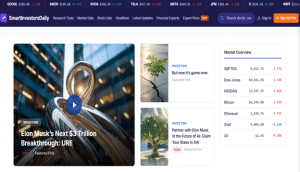 SmartInvestorsDaily is a financial content and stock research website that offers a variety of tools and market data aimed at helping people make investment decisions.
It provides free stock research tools, including screeners, calculators (like FIRE, market cap, etc.), real-time market data, lists of stocks by category, and financial headlines.
Best for: Retail investors who want practical stock research tools without paywalls
Focus: Market data, stock lists, financial calculators, and investing insights
Ideal reader: Self-directed investors, traders, FIRE-focused individuals
Instead of focusing on long opinion-heavy commentary, the site leans toward structured financial data, comparative stock analysis tools, and actionable insights.
Its value proposition revolves around accessibility, providing free utilities that help investors analyze trends, compare securities, and evaluate financial metrics without navigating complex institutional platforms.
3) Reuters
Founded in 1851, Reuters began by transmitting market prices via telegraph and carrier pigeons. Today, it’s one of the world’s largest news agencies. Owned by Thomson Reuters, it serves financial institutions, media companies, and corporations. The group employs more than 2,600 journalists across more than 200 locations.
Reuters is known for its balance of speed and depth. It delivers text, graphics, video, and photos to subscribers worldwide on topics ranging from markets and politics to entertainment and sports. For investors, Reuters’ Refinitiv platform (formerly Eikon) provides real‑time data, analytics, and trading capabilities.
What distinguishes Reuters is its neutral tone. Reports focus on facts with minimal commentary, so you can trust the news without wading through opinions.
For example, when the U.S. Federal Reserve changed interest rates recently, Reuters’ live blog updated markets on the decision and reaction across asset classes, embedding charts and expert quotes while keeping commentary concise.
4) The Wall Street Journal
 Published by Dow Jones since 1889, The Wall Street Journal (WSJ) is a global news organization with a focus on business and markets. It bills itself as a membership for ambitious readers, powered by award‑winning journalism. The Journal has earned 37 Pulitzer Prizes.
WSJ’s newsroom covers national and international news, with analysis and opinion spanning business, economics, financial markets, investing, technology, and culture. In 2024, digital formats accounted for two‑thirds of its traffic, reflecting its strong mobile and video presence.
Morning newsletters like “What’s News” summarize overnight events in a few paragraphs, while its mobile app sends alerts on key market moves.
For investors, WSJ provides detailed coverage of corporate earnings, mergers, and policy changes. When Apple reported record revenue recently, WSJ’s live updates highlighted how iPhone sales, services revenue, and guidance affected the stock and included quotes from analysts.
Deep investigative pieces and opinion columns round out the coverage, making WSJ a benchmark for thoughtful market analysis.
5) Financial Times
 The Financial Times (FT) is known worldwide for its authority, integrity, and accuracy. With more than 2 900 employees, including 700 journalists in 40 countries, it delivers global business and economic news. Its distinctive pink newspaper and digital platform are mainstays for executives and investors.
FT’s services provide essential news and analysis to ambitious readers. Its “FirstFT” morning briefing summarizes overnight developments, while tools like the FT Markets Dashboard offer interactive charts. When the Bank of England surprised markets with a rate cut, FT’s team provided an immediate market reaction, explained the policy background, and compared global bond yield movements.
The FT excels at connecting markets with politics and policy. Opinion columnists challenge consensus views, while deep dives explore topics like sustainable investing and emerging markets. If you value an international perspective and rigorous reporting, the FT is indispensable.
6) CNBC
CNBC started as a television channel and evolved into a multi‑platform network. It provides real‑time stock market news, analysis, and insights. Investors can watch live coverage of Wall Street, get updates on bond yields, commodity prices, and economic indicators, and hear interviews with CEOs and analysts.
CNBC’s mobile app brings Wall Street to your pocket. It offers breaking news alerts, watchlists, and global market data. Users can view real‑time quotes, interactive charts, and pre‑market or after‑hours data.
Live TV streams, podcasts, and premium services provide deeper analysis. When the Dow Jones hit a record high recently, CNBC delivered a minute‑by‑minute live blog with commentary from traders and economists.
For professionals who like to consume news via video or audio during commutes, CNBC’s blend of television and digital coverage makes it easy to stay up to speed on the day’s market moves.
7) MarketWatch
MarketWatch is a digital news site owned by Dow Jones that offers market data, analysis, and insights on stocks, bonds, commodities, and currencies. It’s geared toward active investors who want quick access to quotes and charts without paying for a full trading platform.
The MarketWatch app delivers breaking news, videos, and in‑depth analysis along with real‑time market data. Alerts notify users about index movements and stock prices, while customizable watchlists help track personal portfolios.
When a major company announces results, MarketWatch posts headline summaries with interactive charts showing how the stock reacted compared with peers.
MarketWatch balances comprehensiveness and simplicity. If you want a free or low‑cost way to monitor markets throughout the day, it provides straightforward updates and tools without overwhelming you.
8) Barron’s
Barron’s has guided investors since 1921 and is part of Dow Jones. It delivers news, analysis, investigative reporting and company profiles. Barron’s focuses on investment strategies and market trends, sitting alongside WSJ and MarketWatch in the Dow Jones lineup.
The Barron’s app promotes itself as the world’s premier investing publication, offering comprehensive analysis, daily commentary, and insights from Wall Street veterans.
Subscribers get exclusive articles, real‑time stock quotes within stories, interactive charts, and full digital editions of the weekly magazine. For example, Barron’s might review a tech stock’s quarterly results, compare its valuation metrics, and include a chart of analyst price targets.
For professionals who want deeper analysis than what a free site provides, Barron’s combines magazine‑style depth with digital convenience.
9) The Economist
The Economist has been published since 1843 and is one of the leading sources of analysis on international business and world affairs. Its flagship weekly magazine is renowned for concise writing and a global perspective.
The Economist’s articles are usually anonymous to emphasize a collective voice. Each issue covers business, finance, politics, science, and culture.
When a global event, like a sudden oil price spike, occurs, The Economist will explore the market impact, geopolitical drivers, and long‑term trends in a single essay. The Economist Intelligence Unit (EIU) provides forecasts for more than 200 markets and hosts conferences and briefings to deepen engagement.
For busy professionals who want context rather than daily noise, The Economist offers a weekly digest that puts events into perspective. It’s ideal for investors who need to understand the macro forces shaping markets.
10) Seeking Alpha
Seeking Alpha is a crowd‑sourced platform where investors share analysis and trading ideas. It publishes articles, research reports, and investment ideas from contributors ranging from individual analysts to fund managers. It also provides real‑time market news, earnings call transcript,s and stock analysis tools.
The Seeking Alpha app offers concise news, market‑moving analysis, instant alerts, and price quotes. With more than 22 million monthly users, it’s a massive community.
Premium subscriptions include quant ratings, author performance metrics, and data visualizations. For example, when a biotech stock surges on trial results, Seeking Alpha contributors will publish bull and bear cases along with valuation models.
Seeking Alpha complements traditional news sources by exposing you to diverse opinions and niche analysis. If you enjoy digging into specific sectors or small‑cap stocks, you’ll find perspectives here that bigger outlets often miss.
The bottom line
Staying current on markets doesn’t require constant screen time. The outlets above have earned their reputations by delivering accurate information, thoughtful analysis, and convenient formats.
Whether you prefer the data‑rich environment of Bloomberg, the live video of CNBC, the concise alerts of MarketWatch, the deep weekly insight of The Economist, or the diverse community of Seeking Alpha, there’s a source tailored to your needs.
Sample a few services, establish a routine, and balance immediacy with reflection. With the right tools and habits, even the busiest professional can stay market‑smart without being consumed by noise.