

8 building types that require round-the-clock 24/7 fire watch by code
Sponsored content. This article was supplied by a third party and Business Money has been paid to publish it.
 A fire alarm or sprinkler failure constitutes a significant logistics issue in any commercial building. Nevertheless, in case of high hazard use occupancy, an unattended life safety system becomes an instant crisis situation.
In such emergencies, the deployment of certified fire watch guards guarantees constant physical surveillance and assures your building’s compliance with local fire marshal regulations. In terms of safety requirements defined by the National Fire Protection Association (NFPA 101: Life Safety Code® and NFPA 72), 24/7 physical inspection is legally necessary in all cases of non-working life safety equipment in places of sleep or inability of populations to save themselves from danger.
With the help of a reliable company like The Fast Fire Watch Company, you will be certain that all legal obligations are being met, and the risk of total building destruction is minimized. Below is a list of 8 types of buildings that need 24/7 fire watch during system failures according to law.
What code rules mandate 24/7 fire watch vs. business-hours coverage?
A common point of confusion for facility directors is determining whether fire watch patrols can pause when workers go home. While a vacant daytime warehouse may qualify for reduced off-hours coverage under local Authority Having Jurisdiction (AHJ) discretion, high-risk occupancies never receive off-hours passes.
The core factors that trigger non-negotiable 24/7 coverage include:
- Sleeping occupants: Individuals cannot detect smoke, see visual strobes, or recognize toxic odors while asleep.
- Inability for self-preservation: Occupants who are bedridden, sedated, or mobility-impaired require assisted evacuation during an emergency.
- High fire loads & structural hazards: Facilities storing volatile chemicals or undergoing active construction lack built-in containment barriers during system outages.
8 building types that require continuous 24/7 fire watch
- Hospitals and inpatient healthcare facilities
- Code standard: NFPA 101 Health Care Occupancies / IBC Group I-2
Intensive Care Unit patients, Operating Rooms, and Recovery Wards patients have life support devices attached, or they are under sedation. Patients in such facilities are considered to be incapable of self-preservation; thus, the defend-in-place strategy is applied. According to NFPA 101 sleeping occupancy fire watch standards, physical inspections should walk through the corridors at all times in order to spot the thermal risks prior to smoke entering the patient areas.
- Multi-family apartment complexes and condominiums
- Code standard: NFPA 101 Residential Occupancies / IBC Group R-2
Property managers frequently ask: Is 24-hour fire watch necessary in residential buildings? The answer is unequivocal yes. Residential fires that occur during nighttime have the highest fatality rate statistically. If there are failures of central fire alarms or of sprinkler risers, The Fast Fire Watch Company will assure the proper shift schedule that will ensure the residents’ safety all day long. Certified fire watch guards will perform hourly patrols on each floor in order to provide personal door-to-door notifications in case of fire.
- Hotels, motels, and hospitality properties
- Code standard: NFPA 101 Hotels and Dormitories / IBC Group R-1
Hotel patrons are not familiar with the layout of the floors, emergency exit stairwells, and escape routes. In the event of a systems failure overnight, unattended hallways pose extremely hazardous life safety threats. Physical guards are required to constantly ensure all paths of egress are free and clear.
- Senior living, memory care, and assisted living facilities
- Code standard: NFPA 101 Residential Board and Care / IBC Group I-1
Senior citizens frequently have either cognitive impairments or limited physical capabilities. In case of an alarm malfunction, it would be impossible to evacuate such people. Guards need to be present around the clock to supervise utility rooms, kitchens, and living quarters in order to avoid any hazards.
- Detention and correctional facilities
- Code standard: NFPA 101 Detention and Correctional / IBC Group I-3
The presence of locked doors, gates, and restricted access areas hinders quick self-evacuation from the building. Personnel need to be present in the facility around the clock in order to control access keys, control cell blocks, and notify the building occupants of fire alarms.
- Active construction sites (mass timber & buildings over 40 feet)
- Code standard: NFPA 241 (Standard for Safeguarding Construction Operations)
Under-construction high-rises and wooden structures don’t have installed sprinklers, finished drywall, or an active central alarm system. Off-duty periods pose ideal opportunities for arson, smoldering hot-work embers, or electrical shorts. Constant patrolling protects the exposed structures 24 hours a day.
- High-rise commercial and mixed-use towers
- Code standard: NFPA 101 High-Rise Building Mandates
Evacuation of occupants from high-rise buildings takes a lot of time. Even though the offices shut at 5:00 pm, there are still stores at ground level, residential floors in high rise buildings or night janitorial crew occupying the building. Constant patrolling checks mechanical chutes and stairwells at every level.
- Chemical processing and hazardous material storage facilities
- Code standard: IBC Group H (High Hazard)
Industrial facilities handling volatile organic compounds, flammable gases, or reactive chemicals contain a chemical hazard that is not confined to daytime operations only. There can be thermal runaway or spontaneous reactions at any time.
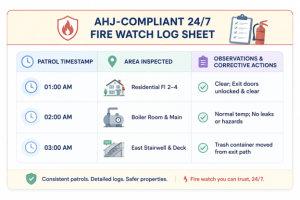
AHJ-compliant log sheet requirements
Whenever 24/7 fire watch is enforced, verbal assurances are not accepted by code officials. Property managers must maintain meticulous, timestamped records for local Fire Marshal inspections.
Frequently asked questions
Is it possible to stop fire watching overnight in case of an empty commercial building?
Yes, if and only if the building has absolutely no sleeping occupancies and a written variance is granted by the AHJ (the local Fire Marshal).
What is the frequency of fire watches in high-risk buildings?
While standard commercial buildings may have fire watch patrols scheduled for once every 30 to 60 minutes, in case of high-risk buildings, such as hospitals, hot work sites, or dense residential buildings, fire watch patrols must be conducted every 15 minutes continuously.
What are the repercussions of not maintaining 24-hour fire watching coverage overnight?
Not maintaining fire watch overnight may result in immediate Stop Work or Cease and Desist orders from the Fire Marshal, heavy daily fines, denial of all insurance claims in case of a fire incident, and criminal prosecution of property owners.
Conclusion: Protecting lives with round-the-clock vigilance
When life safety systems go offline in high-risk facilities, 24/7 fire watch is not merely a recommendation—it is a mandatory legal obligation designed to protect human lives. From multi-family apartments and healthcare wards to high-rise construction sites, understanding your building’s occupancy classification helps you remain compliant. When an unexpected impairment occurs, turning to The Fast Fire Watch Company ensures rapid dispatch of certified guards who keep your facility protected, documented, and fully open for business around the clock.