

AI can write code: Why businesses still need full stack teams
Sponsored content. This article was supplied by a third party and Business Money has been paid to publish it.
You have seen the headline- AI can write code now. In fact, some AI tools mimic full stack development and can build apps in minutes. They can even debug errors, autocomplete snippets,refactor codes and deploy production ready systems.
This is happening right now and it is impressive! And it naturally sparks the big question- Will AI take over full stack developers? Or is there still something that AI can’t do and that’s where human expertise comes in?
The fact that AI can write code is just a piece of the puzzle! Intelligent systems can churn out codes faster than humans but it does not understand why you are building the system.
Building real-world applications requires the understanding of business goals, architecture, design and integrations.
That’s where Full Stack developers come in!
They are the ones who ask the right questions, connect code to real outcomes and take accountability when things go wrong. AI handles the speed while humans focus on strategy, context and outcomes.
In this article, we will explore what AI can do, where it falls short and why businesses still need full stack teams.
What full stack teams actually do?
Full Stack teams build the entire application from scratch. They are experienced in both Frontend (User side) and Backend(server side) architecture. An expert full stack development team builds the user interface and the user experience, as well as the server logic, APIs and databases and everything in between.
Here’s how they build a complete application:
Frontend
- Create the entire user interface using HTML, CSS and Javascript programming languages.
- Ensures that the app looks good on all devices including laptops, mobile phones and tablets.
- Makes the page fast loading and responsive.
Backend
- Build the server side logic that processes data and handles requests.
- Create APIs that connect the frontend and backend.
- Manage authentication and security.
Database
- Design and manage the database where data is stored.
- Write queries to fetch, update and organize data.
- Ensures data integrity and handles multi-user conflicts.
Deployment
- Sets up servers, cloud environments and coding platforms.
- Configure CI/CD pipeline so code moves from deployment to production.
- Provides post-deployment support by fixing bugs, handling errors and creating backups.
Beyond coding, full stack developers define the architecture of the app, including, frontend for users, backend logic and algorithms for data processing, and APIs that connect everything. They test components rigorously to ensure logic works and APIs respond reliably. Human developers also build maintainable code that can be modified based on changing business needs. Moreover, they connect business needs to technical solutions, collaborate with cross functional teams and explain technical concepts to non-technical stakeholders in simple language.
Role of AI in full stack app development
AI is definitely changing ways in which full stack app development works. By leveraging automation, machine learning and natural language processing algorithms, AI can speed things up. Intelligent systems mimic scalable full stack development solutions to generate boilerplate code, create standard functions, and scaffold code snippets from simple english prompts.
Here’s how AI helps in full stack app development:
- Code generation- Tools like Github Copilot suggest code snippets from simple prompts.
- Debugging and testing- AI automatically creates test cases from use case scenarios like payment processing or card expiry. AI tools also identify and fix bugs improving development efficiency.
- Performance checking- AI finds slow database queries and suggests caching to improve it.
- Security scanning- AI tools flags security issues by using encryption standards.
- Deployment help- AI sets up Docker containers and CI/CD workflows so code deploys automatically to the cloud.
- AI Agents- Agentic AI tools like Devin( Cognition AI) or OpenAI Codex build end-to-end application features including frontend, backend, database, tests from a single prompt.
AI handles multiple steps in full stack app development yet they fall short on creativity or oversight of full stack development teams. Despite AI taking over repetitive tasks, developers still review codes, ensure compliance, connect to existing systems and make sure that the product solves business problems.
The real question: Why do businesses still need full stack teams?
Although AI can assist in full stack app development, it misses the big picture. Building applications is about human creativity, problem solving, decision-making, collaboration for which enterprises hire a full stack development team. These are the aspects that an AI tool lacks. Hence it is quite pertinent that businesses will still need full stack development teams to build innovative applications.
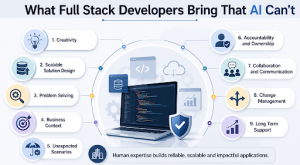
Let’s look at what full stack developers bring and AI can’t:
- Creativity- AI follows patterns it has seen before. It cannot design intuitive user interfaces that feel fresh or cannot solve complex problems. Full stack developers imagine how features should work and design attractive interfaces. An expert development team finds unique solutions where standard approaches do not fit.
- Scalable Solution Design- AI builds applications for today and does not plan how the application will perform when traffic increases or new features are added. Full stack developers design architecture that scale by choosing the right databases, optimizing API performance and building systems that can support heavier loads without crashing.
- Problem solving- AI handles predictable and repetitive tasks well but falls short on complex tasks. When a database query breaks under heavy load or an API returns strange data, AI tools cannot trace the root cause of the problem. Reliable full stack developers dig deep into the challenges by understanding user behavior, business needs and system architecture and find a solution.
- Business context- AI does not understand the business context of an application. It cannot fathom why the feature matters or how it will increase conversions. Full stack developers understand the business behind the application and make decisions that align with company goals.
- Unexpected scenarios- AI works with common scenarios but fails to understand the rare ones. If a user cancels a payment or the network drops during a critical workflow, AI tools lack the intuition to address it. Full stack developers on the other hand, anticipates these edge cases and builds safeguards that prevent crash or data loss.
- Accountability and ownership- When an AI generated code breaks during launch, the tool cannot take responsibility, fix issues or respond to stakeholder queries. An end to end development team on the other hand works under pressure and ensures that the app stays reliable even when things go wrong.
- Collaboration and communication- Full stack developers collaborate with multi-functional teams like designers, product managers or leadership to stay connected to business goals. AI cannot clarify requirements, understand the context or collaborate with stakeholders. Full stack teams bridge the gap between business needs and execution.
- Change management- Technology and business needs evolve, developers adopt agility to stay in tune with the trends. They can adapt to new technologies and frameworks easily. AI tools learn from data but cannot adapt as fast as a full stack team.
- Long term support- Apps need to scale for years and not just launch and work. A full stack AI tool creates an application for immediate need but does not think about maintenance, scaling or upgrades. Human developers on the other hand, plan for growth, monitor performance, install upgrades and manage technical debt when requirements change.
 Human+AI: The future of full stack development
AI is becoming a powerful tool in the developer toolkit but businesses will still need full stack teams. AI cannot replace the creativity, problem-solving and communication skills of human developers. The best teams use AI as a partner and not a replacement. With proper adoption, AI will become a powerful assistant and human-AI collaboration in full stack development will pave new frontiers in technology.
Here’s how this collaboration works in practice:
Automation that cuts repetitive work- AI handles code generation, test case creation, documentation and debugging automatically. Developers spend less time creating boilerplate and more time solving complex tasks. A feature that requires 8 hours of manual coding can be completed in 3 hours with AI taking over repetitive work.
Faster prototyping and iteration- AI generates UI components, API endpoints and database schemas from natural language prompts. This helps teams to build and test prototypes in hours instead of days. When a project manager requests a change, developers can generate codes quickly and compare the best options before delivery.
Better user experiences- AI enables features like personalized recommendations, intelligent search, voice recognition and predictive analytics into workflows. Full stack developers integrate these features to app architecture and ensure that they work smoothly across multiple platforms.
Accelerated development cycle- AI speeds up every phase of the development cycle like planning, coding, testing and deployment. This helps full stack teams to ship features faster and give businesses a competitive edge in changing market conditions.
The bottom line
Businesses need full stack development teams as they bring creativity, accountability and system thinking that AI cannot do. AI speeds up coding but developers design architecture, make judgement calls, provides maintenance and ensures that the application works as intended. Instead of replacing teams, AI will become a powerful tool that will enhance productivity and boost innovation.