

AI SEO vs traditional SEO: A data-driven analysis of modern search visibility
Sponsored content. This article was supplied by a third party and Business Money has been paid to publish it.
 Is the traditional Google 10-blue-links SERP officially dead?
For over two decades, the main goal of Search Engine Optimization (SEO) seemed obvious for more than twenty years: find popular keywords, optimize the presence of HTML on the page, build backlinks to get the highest possible traffic through referrals. However, the search landscape has undergone its most profound structural shift since the inception of the web.
Nowadays, the advent of AI-powered search tools like Google AI Overviews, ChatGPT Search, Perplexity, and Gemini is changing the very source of people’s information discovery. The dilemma marketers have is not whether SEO is still a point but rather if relying on just the traditional SEO strategy can suffice for getting work done in the AI-first search scenario.
Let’s explore what is working in 2026!
The foundation: What traditional SEO still does well
Traditional SEO remains built around a familiar framework:
- Keyword targeting
- Content optimization
- Technical SEO
- Backlink acquisition
- User experience improvements
- Internal linking and site architecture
For years, this model has been remarkably effective. Businesses that kept producing quality content and got authoritative backlinks were the ones to get higher rankings and more organic traffic.
Google still relies heavily on these signals. Page features in AI-generated responses often originate from websites that have already established strong authority through traditional SEO practices.
However, search behaviour is changing at a rapid speed.
Users increasingly expect direct answers rather than lists of links. AI systems are designed specifically to satisfy those expectations.
As a result, visibility is becoming more complex than simply ranking in the top three positions.
AI has changed the search playbook forever
Clicks are shrinking; answers are rising.
Google’s AI Overviews have become one of the most significant developments in search history.
According to Google’s earnings reports, AI Overviews now reach more than 2 billion monthly users across over 200 countries. Google reported that AI Overviews drive “more than 10% additional queries” for the searches where they appear.
The shift represents fundamental change in how information is consumed these days.
2020:
Keyword → Ranking → Click
2026:
Question → AI Answer → Citation → Click (optional)
Rather than needing to visit multiple websites, users today are receiving answers to their questions straight from the search engine results themselves without clicking anything.
In particular, AI solutions provided for information purposes can be located above the organic results, making it harder for the best-ranked sites to be noticed.
Keywords are fading; intent is dominating.
The traffic challenge: When ranking #1 isn’t enough
Historically, securing the first organic position delivered significant traffic advantages.
Recent research suggests that advantage is shrinking.
An Ahrefs analysis of 300,000 keywords found that Google’s AI Overviews reduced click-through rates to the top organic result by 58%, highlighting the growing importance of being cited within AI-generated answers rather than relying solely on rankings. Other large-scale studies have observed substantial declines in organic click-through rates across millions of impressions when AI-generated summaries appear.
This creates a new reality for markets:
A page may rank first and still receive significantly fewer clicks than it would have received a few years ago.
The rise in zero-click searches has emerged because of this trend. Industry-wide studies show that 60% to 80% of all searches finish without a user clicking on an external site with AI-driven results also being one of the factors of this behavior.
For SEO professionals accustomed to measuring success primarily through rankings, these numbers demand a strategic rethink.
Traditional SEO metrics vs AI visibility metrics
Traditional SEO success has typically been measured through:
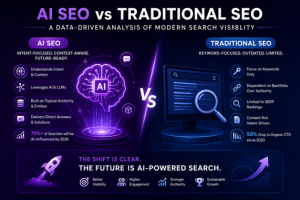
| Aspect | Traditional SEO | AI SEO |
| Focus | Rank on Google search results | Rank in AI search and AI answers |
| Content | Keyword-focused | User intent and context-focused |
| Keywords | Exact-match keywords | Semantic and conversational keywords |
| Optimization | Manual updates | AI-assisted and data-driven optimization |
| Search Target | Search engine results pages (SERPs) | Google AI Overviews, ChatGPT, Gemini, Perplexity |
| User experience | Encourages users to click links | Provides direct answers while increasing visibility |
| Goal | Increase rankings and traffic | Improve AI visibility, authority, and qualified leads |
The distinction is important.
Traditional SEO asks:
“Can Google rank my page?”
AI SEO asks:
“Will AI systems trust and cite my brand when generating answers?”
These are related but increasingly separate objectives.
Research on AI Overviews revealed that top sources cited by AI don’t always match the highest-ranking organic search pages, indicating that AI systems are solving the authority problem in a different way from the traditional ranking algorithms.
AI SEO unpacked: The real story behind the buzz
AI SEO is often misunderstood as an entirely new discipline.
In reality, it builds upon traditional SEO while introducing additional layers.
These include:
- Entity optimization
AI models increasingly rely on entities rather than keywords alone.
Brands, people, products, and organizations that are mentioned consistently in trusted sources can be understood well and recommended by the AI models.
- Citation-worthy content
AI systems actually prioritize content that very clearly answers questions, is backed by evidence, and shows expert skills.
Research that presents new findings, data that are not available elsewhere, and commentaries by experts are among the types of content that usually outperform general articles.
- Topical authority
Instead of isolated keyword targeting, AI search favors comprehensive topical coverage.
Brands that demonstrate expertise across an entire subject area are more likely to be cited. Search is no longer ranked; it’s interpreted.
- Structured data and context
Schema markup, author information, and clear content hierarchies help AI systems interpret information more accurately.
AI doesn’t crawl but understands.
Why expertise matters more than ever
Firsthand expertise becomes a significant result of AI-powered search engines.
AI algorithms are increasingly looking for authoritative sources when giving responses to users.
This aligns closely with Google’s E-E-A-T framework:
- Experience
- Expertise
- Authoritativeness
- Trustworthiness
Content based only on keyword opportunities rather than actual expertise becomes more and more obvious for AI algorithms.
Conversely, brands publishing original studies, surveys, case studies, and expert analysis gain a significant advantage.
Across multiple industries, marketing initiatives that have published research and unique findings will usually be visible not only on regular searches but also through AI-generated answers.
The lesson is clear: Unique information is becoming a competitive moat.
AI + search = next-gen discovery
The most successful organizations are not abandoning traditional SEO. Instead, they are combining it with AI visibility strategies.
Traditional SEO still provides:
- Crawlability
- Indexation
- Authority signals
- Organic rankings
AI SEO adds:
- Brand recognition
- Entity authority
- Citation opportunities
- Presence in AI-generated answers
Think of traditional SEO as building the library.
AI SEO determines whether your book gets quoted.
Both matter.
2026 playbook: Practical steps that deliver results
Organizations seeking sustainable search visibility should focus on five priorities:
- Continue investing in technical SEO
In 2026, technical SEO will still form the basis of online visibility. Both search engines and AI systems give high priority to those websites that open fast, that offer a perfect mobile experience, that boast good core Web Vitals, and whose site architecture is clear and straightforward.
- Publish original research
Original research is one of the best competitive differentiators in today’s SEO landscape. Instead of repackaging content, AI-powered sites refer to original data sets, case studies, surveys, and industry insights more often.
- Strengthen brand authority
Brands with strong reputations have a higher chance of being recognised as reliable, trustworthy, and respected by AI and users, as well as systems. Promoting your brand’s presence through podcasts, industry publications, conferences, webinars, expert interviews, and digital PR initiatives boosts credibility.
- Create topic clusters
Instead of focusing on a few isolated keywords, businesses should construct extensive content ecosystems around key subjects. Topic clusters link pillar pages with content that supports them, demonstrating the depth of their knowledge. Context beats keywords today.
- Measure AI visibility
Traditional rankings for keywords no longer provide a complete view of the performance of a search. Companies should also be aware of the frequency at which their content, brand research, expertise, and other information are mentioned in AI-generated responses. The tracking of AI visibility and citations across new search platforms can help determine the true digital presence by 2026.
As AI becomes the gateway to information, the most valuable position in search is no longer rank #1 but being the source behind the answers.
Build authority before algorithms decide
The debate between AI SEO and traditional SEO creates a false choice.
SEO still isn’t dying out, but remains a foundation of digital marketing. But good ranking alone isn’t enough to draw visitors and attract their attention.
The data suggest that search is moving from a ranking-driven ecosystem to one driven by citations. AI-generated answers are increasingly determining the brands that users will see first and make authority, experience and trust more important than ever before.
The winners in 2026 and beyond will not be the organizations that choose between traditional SEO and AI SEO.
They will be the ones that successfully combine both.
As search engines transition from information retrieval systems to answer generation systems, the goal is no longer just to rank.
The goal is to become the source that AI chooses to cite.
The question is no longer “Can you rank?” but “Will AI choose you?”