

BBEC 2025 marks powerful fourth year with demands for equity, not handouts, for black British businesses
The UK Black Business Entrepreneurs Conference (BBEC) 2025, a powerful display of thought leadership, resilience, and community, took place on Wednesday, 25 June at NatWest Conference Centre in Bishopsgate.
Now in its fourth year, the conference, which has become known as a mecca for Black British entrepreneurs, brought together more than 200 business owners, policymakers, industry thought leaders and advocates to share insights, forge partnerships, and celebrate Black excellence in business.
Boasting a selection of esteemed speakers across business, government, media, publishing, and sports, the event featured dynamic keynote addresses, intimate fireside chats, informative presentations and panel discussions, and captivating performances.
Lord Michael Hastings CBE opened the day with a call to action to the attendees: to be business leaders with character and integrity. The fireside chats saw journalist Henry Bonsu engaging in deep conversation with Afua Hirsch, broadcaster, author and founder of Born in Me Productions, award-winning saxophonist and Soul Mama co-founder YolanDa Brown OBE DL, and Mike WIlliams, co-founder of Flake Bake Ltd.
Panel talks covered essential topics including DEI, public procurement, legal frameworks, and the experiences of Black women in business. Among the panellists were Andrew Lewin, Hatfield & Welwyn Garden City MP, Carole Copeland Thomas, international DEI consultant, Vaughan Gething, member of the Senedd for Cardiff South and Penarth, and Howard Dawber, deputy mayor for Business and Chair of London and Partners.
Presentations were delivered by a stellar line-up including Thomas “Hal” Robson-Kanu, former football player and founder of The Turmeric Co, Lydia Amoah, founder of Backlight and The Black Pound Report, and Sarah Tskenya-Frazer, founder of Tskenya Footwear and author of A Quick Ting on Black British Businesses.
The day also featured live performances by Innocent Masuku, opera singer and Britain’s Got Talent finalist, the Hampton University Choir, and RnB singer Junior Giscombe, who closed the event with a soulful celebration of Black creativity and culture.
Dr Carlton Brown, founder of the BBEC, said: “This conference is designed for us to elevate, to educate and to inspire each other by telling our own stories. It’s important because there are lots of positive stories in our community, and often they are not told.”
During the panel discussion on DEI, Brown added: “Black and ethnic minorities represent around 16% of the UK business population, yet less than 1% of public procurement is spent with them. It must be practical, actionable steps, not platitudes, that are taken to ensure that these communities get the access to opportunities. No one in the Black community is asking for handouts, they are simply asking for access to opportunities.”
Howard Dawber, deputy mayor of London for Business & Growth and chair London & Partners, said: “Black people in London are twice as likely to start a business. But black-owned businesses, on average, earn a third less in their first year than white-owned businesses in London. They find it more difficult to get finance, find premises, and get harder supplies to customers. For that reason, black-owned businesses are more likely to fail, and that’s not acceptable.”
Referencing the theory he put forward in his book The Race Paradox: Why Organisations Fail on Race, Dr Brown said that there is still a “disconnect between the intentions and the reality” of banks and corporates when it comes to investing in or working with black-owned businesses.
He said: “I describe this as an unconscious illusion of inclusion between what organisations purport to be and what they want to do, versus the reality of what actually happens. It’s about: how do we bridge that disconnect and find real, tangible solutions to some of these challenges that exist?”
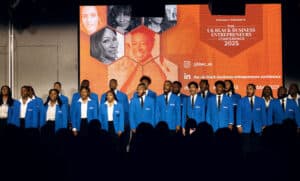
In a landscape where businesses are having to adapt to rapid economic and technological changes, and a political climate where DEI frameworks are at risk, the BBEC 2025 offered transformational expert insights and valuable connections.
As the conference grows in reach and ambition, it remains a vital space to confront economic disparity and reimagine black entrepreneurship in the UK.