

How to choose a direct mail API: Triggers, multi-touch and multi-tenancy
Sponsored content. This article was supplied by a third party and Business Money has been paid to publish it.
7 best direct mail API platforms compared for automated campaigns
Old rule: Direct mail means a vendor portal, a spreadsheet export and weeks of lead time. New rule: mail fires from your CRM the moment a customer acts, and you can see which piece drove the response.
A direct mail API is what makes the new rule work. But “best” depends on how you plan to use mail. A one-off transactional letter needs very different tooling from a multi-touch sequence running across ten client accounts. These seven platforms cover that range, and Postalytics is my top pick for teams that want automation, multi-touch campaigns and multi-tenant support in one place.
Key takeaways
- Postalytics is the top overall pick for multi-touch campaigns, multi-tenant organizations, agencies and SaaS platforms.
- Lob suits engineering-led teams embedding mail into their own applications.
- PostGrid fits transactional and compliance-sensitive mail, especially with international address verification.
- PCM Integrations and Poplar work well for white-label ordering and CRM-led journeys respectively.
- PostPilot is built for ecommerce brands; Click2Mail suits batch and operational mailings.
What is a direct mail API?
A direct mail API lets software create, personalize, print and send physical mail such as postcards, letters and self-mailers without manual steps. Think of it as an email service provider for paper: your system sends the data, and the platform handles variable data printing (VDP), addressing, postage and delivery.
The benefits of automated mail are easiest to judge when you know what each API actually handles for you. Some stop at print and send. Others add triggers, sequencing, tracking and account separation.
Two tracking methods matter here. IMb tracking uses the USPS Intelligent Mail Barcode to show piece-level delivery status. Matchback attribution connects responses and conversions back to specific mail pieces, usually through QR codes and personalized URLs (pURLs).
How I evaluated these platforms
This is a feature-based comparison drawn from each vendor’s own documentation, not a hands-on benchmark. I assessed each platform against five criteria:
- Automation and triggering. Can mail fire from events, workflows or lifecycle stages?
- Multi-touch campaign support. Can it run sequenced mailings, not just single sends, the same way automated lead follow-up works in email and SMS?
- Print and mail reliability. How is production handled, and what coverage does it offer?
- Scalability and governance. Are there controls for budgets, users and reporting as usage grows?
- Multi-tenant architecture. Can separate brands, teams or clients run independently on one platform?
The last two matter most for agencies, franchises and software companies offering mail to their own customers. Without native multi-tenancy, developers end up building account separation themselves.
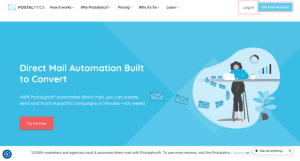 1. Postalytics
Best for: Multi-touch campaigns, multi-tenant organizations, agencies and SaaS platforms.
Postalytics, the creator of the direct mail automation category, offers direct mail built for the digital era: as easy as email to trigger, and measurable down to each piece.
Key API capabilities
- REST API and SDKs with a multi-tenant structure, plus white-label Agency Edition tooling.
- Flows for multi-touch sequences, triggered from CRMs, marketing automation tools and webhooks.
- IMb tracking with pURL and QR code matchback attribution.
- Variable data printing on a two-business-day SLA across a distributed US and Canada production network, with no minimum sends.
Considerations
- Flows, the Salesforce integration and the Agency Edition require the Pro and Agency plans.
- Mailing covers the US and Canada only.
Why it made the list
Postalytics plugs direct mail into the same marketing tech you already use for email and digital campaigns, so a postcard becomes one more step in an existing workflow. Campaigns launch in minutes, not weeks, and mailers can be designed in Canva or Figma.
Pricing
There’s a free plan, and subscriptions add per-piece discounts. Prices include printing, paper and postage, and direct mail credits lock in costs for budgeting.
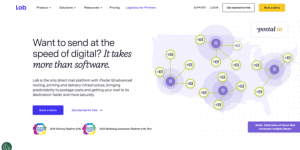 2. Lob
Best for: Engineering-led teams embedding mail into their own applications and backend systems.
Lob is a developer-first platform built around its print and mail APIs, with address verification at its core.
Key API capabilities
- Print & Send API to trigger mail from a CRM or customer data system.
- Real-time and bulk address verification to improve your list quality before anything prints.
- A native integration on the Salesforce AppExchange.
- A Print Delivery Network that handles production and delivery.
Considerations
- Plan for developer time to build and maintain the integration.
- Confirm how multi-touch sequences and separate client accounts would be handled before building.
Why it made the list
Lob is a strong fit when mail needs to live inside your own application and you have engineers to own it. Its address verification is a genuine strength, since clean addresses cut return mail before a campaign ever prints. Marketing-led teams should check how much sequencing logic they would need to build themselves.
Pricing
The API itself is free to use. Costs depend on your account type, mail format, print volume and delivery locations, so model a few realistic monthly volumes before comparing totals.
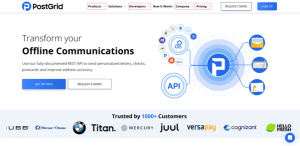 3. PostGrid
Best for: Transactional and compliance-sensitive mail, including international address verification.
PostGrid combines a print and mail API with address verification tooling, aimed at teams that send operational mail where accuracy and data security matter.
Key API capabilities
- REST print and mail API for letters, postcards and cheques.
- Address verification included free with the print and mail API.
- International address verification across 245+ countries.
- A print network that is SOC 2 Type II and HIPAA compliant.
Considerations
- Confirm which countries are supported for actual mailing, not just address verification.
- Check what orchestration and reporting options exist if you plan multi-step marketing journeys.
Why it made the list
PostGrid earns its spot for operational mail where compliance and address accuracy matter most, such as statements and notices. The international verification coverage stands out for teams with customers abroad. If your main goal is marketing sequences rather than transactional sends, ask for a demo built around your actual triggers and destination countries.
Pricing
Free trials are available for setup and quality assurance. Request a written breakdown of per-piece and verification charges for your expected monthly volume, including what changes after the trial ends.
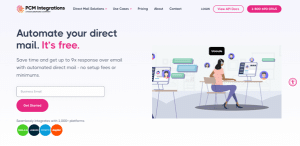 4. PCM Integrations
Best for: Software companies offering white-labeled mail ordering to their own users.
PCM Integrations is the API and integration arm of PostcardMania, built for businesses that want to add direct mail to software products or CRM workflows.
Key API capabilities
- An API for adding direct mail to any software product.
- White-labeled storefronts with list buying and commission tracking.
- Zapier setup plus native Salesforce and HighLevel integrations.
- In-house printing at its Clearwater, Florida facility.
Considerations
- Confirm the depth of delivery tracking and response attribution.
- Check whether multi-step sequences run natively or through your CRM.
Why it made the list
PCM Integrations suits platforms that want to resell mail under their own brand without building a storefront from scratch. Its storefronts let your users buy lists without leaving your branded experience. In-house printing gives it direct control over production quality. Teams that need detailed attribution or piece-level reporting should confirm what the dashboard shows before committing to a full rollout.
Pricing
There are no contracts or monthly fees; pricing is per piece. Confirm current rates for your mail format, print options and expected volume, and ask whether list purchases are billed separately.
 5. Poplar
Best for: Marketing teams that already run their customer journeys inside a CRM or ESP.
Poplar is a self-service programmatic direct mail platform with its own API, designed for brands that want triggered mail to behave like email or SMS.
Key API capabilities
- An API to trigger, personalize and track individual mail pieces.
- Direct integrations with dozens of ESPs, CRMs and martech platforms.
- Last-touch order matching for attribution.
- Formats including bi-folds, tri-folds, postcards and letters.
Considerations
- Flows and dynamic segmentation are managed in your CRM or ESP, not in Poplar.
- Mailing is limited to the US.
Why it made the list
Poplar works well when your sequencing logic already lives in an email or CRM platform and you want mail as one more channel. Its attribution ties mail recipients to resulting orders, which helps prove the channel’s impact on revenue. The trade-off is that multi-touch orchestration depends on your other tools rather than on Poplar itself.
Pricing
Plans range from Free to Enterprise, with all-inclusive pricing covering production, postage, processing and reporting. Compare plan tiers against your expected monthly volume before choosing one, and check which features each tier includes.
 6. PostPilot
Best for: Ecommerce and DTC brands selling through Shopify and similar storefronts.
PostPilot is a programmatic direct mail platform built for ecommerce marketers, pairing triggered postcards with done-for-you creative and performance reporting.
Key API capabilities
- Native Shopify integrations plus connections to Klaviyo, Attentive, Omnisend and Sendlane.
- An open API for custom triggered campaigns from other tools.
- A real-time ROI dashboard with A/B testing and holdout groups.
- Done-for-you strategy and design.
Considerations
- Built around ecommerce, so B2B and service businesses should confirm the platform fits their use case.
- Confirm support for separate client or brand accounts if you’re an agency.
Why it made the list
PostPilot is a natural fit for Shopify brands that want postcards running alongside their email and SMS flows. Holdout groups help prove incremental lift, which many direct mail programs struggle to show. Outside ecommerce, its integration set is less relevant, so other businesses should weigh that carefully. Its done-for-you service also suits lean teams without in-house designers or direct mail experience.
Pricing
Request current pricing for your expected volume, and confirm exactly what the done-for-you strategy and design service includes before comparing it with self-service platforms.
 7. Click2Mail
Best for: Digitizing batch and operational mailings, including certified and EDDM mail.
Click2Mail offers API access to a broad catalog of USPS mail products, aimed at organizations moving established print and mail processes online without rebuilding them.
Key API capabilities
- REST, REST Batch XML and SOAP interfaces.
- Formats including letters, postcards, certified mail, EDDM and Priority Mail.
- A staging environment for testing before going live.
- Volume from a single postcard to a million-piece mailing.
Considerations
- Submission is job-based, so confirm support for triggered and multi-touch sends.
- Plan to combine its tracking data with your CRM or analytics tools for full campaign reporting.
Why it made the list
Click2Mail is the practical choice for organizations moving legacy print processes online, especially where certified mail or EDDM matter. The range of USPS products is broad. For lifecycle marketing sequences, a campaign-focused API will need far less custom work to build and maintain. Its staging environment also lets developers test mailings safely before anything prints.
Pricing
Pricing varies by product, page count, print options and postage class. Get an estimate for your exact mailing, and check submission cutoffs separately from expected delivery timing.
Direct mail API comparison
| Platform | Best for | Standout capability |
| Postalytics | Multi-touch, multi-tenant programs | Flows plus native multi-tenant API |
| Lob | Engineering-led embedding | Real-time and bulk address verification |
| PostGrid | Transactional and compliance mail | 245+ country address verification |
| PCM Integrations | White-label mail ordering | Branded storefronts with commission tracking |
| Poplar | CRM- and ESP-led journeys | Last-touch order matching |
| PostPilot | Shopify and DTC brands | Holdout-based ROI tracking |
| Click2Mail | Batch and operational mail | Broad USPS product catalog |
Conclusion
Postalytics is my top pick for organizations running automated, multi-touch direct mail across teams, brands or clients. Its native multi-tenant API, Flows and matchback attribution cover the criteria that usually decide the choice.
Lob is the runner-up for engineering-led teams, while PostGrid suits compliance-sensitive transactional mail. Poplar and PostPilot fit teams whose journeys already live in a CRM or ecommerce stack.
Start with one trigger and one audience, confirm the tracking setup, then add touches once the first sequence works.
FAQ
What is the best direct mail API?
It depends on your use case. For automated, multi-touch campaigns across several teams or clients, a platform with native multi-tenant architecture fits best. For transactional or developer-led sends, a simpler print and mail API may be enough.
What is a multi-tenant direct mail API?
It lets separate brands, clients or teams operate independently on one platform, each with its own budgets, templates, reporting and permissions. Agencies, franchises and software platforms rely on this most.
What is headless direct mail?
It means using API-first components to embed direct mail functionality in your own product without using the vendor’s full interface.
How is a direct mail API different from a print vendor?
A direct mail API handles triggering, personalization, CRM integration and tracking automatically. A traditional print vendor typically focuses on production and fulfillment, often with manual steps.
Do I need a developer?
Not always. Platforms with native CRM integrations can run triggered mail without code. Custom applications, headless setups and multi-tenant builds are more likely to need engineering time.