

First-time buyers drove 75% of property market activity in 2025
First-time buyers emerged as the driving force of the housing market in 2025, according to new conveyancing data from Bird & Co, as fewer landlords and existing homeowners chose to buy. An analysis of Bird & Co’s internal client figures shows that last year’s market was increasingly shaped by people purchasing their first home. With participation from equity-backed buyers continuing to fall, market activity was increasingly driven by people entering homeownership without access to existing property assets.
The 2025 data reveals several clear trends shaping buyer behaviour:
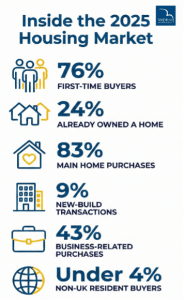
- First-time buyers made up 76% of Bird & Co’s clients, up from 71% the previous year.
- Just 24% of buyers already owned a residential property, extending a multi-year decline.
- More than four in five purchases were made for use as a main home.
- New-build properties accounted for only 9% of transactions, falling again year on year.
- Around 43% of purchases were linked to business use, up sharply from roughly a third in recent years.
- Non-UK residents accounted for just under 4% of buyers, edging slightly higher than in 2024. Commenting on the findings, Bird & Co partner, Daniel Chard, said, “In 2025, first-time buyers were no longer a supporting act; they were driving the market. Despite ongoing affordability pressures, many were willing to commit to owner-occupation, likely influenced by rising rents and a desire for long-term stability.”
- Notably, first-time buyers were not simply testing the market. The proportion of buyers purchasing their first home with the intention of living in it rose to 61% in 2025, up from 56% the year before. This shift suggests a growing emphasis on long-term housing security rather than short-term or transitional ownership.
- At the same time, fewer buyers entered the market with access to existing housing equity. Only a small proportion (9%) reported buying alongside partners who already owned property, indicating that many first-time buyers were navigating the market without inherited or accumulated assets.
Higher mortgage rates, rising transaction costs and ongoing economic uncertainty are all likely to have shaped buyer behaviour, discouraging discretionary moves among existing homeowners while encouraging renters to consider ownership as a more stable alternative.
While traditional residential investment softened, one of the standout findings from the 2025 data is the growing importance of business-related purchases. Around 43% of transactions were linked to business use, signalling sustained demand for flexible commercial and mixed-use property, even as buy-to-let activity declined.
Despite ongoing government focus on energy efficiency and housing supply, appetite for new-build homes continued to weaken. Demand for newly constructed properties has now fallen consistently for several years, indicating that price sensitivity, location and space may be outweighing modern specifications for many buyers.
Finally, overseas buyer activity, while still limited, showed signs of levelling out. Non-UK residents accounted for just under 4% of purchases, a modest increase on 2024, though regulatory and economic headwinds likely continued to restrict international investment.
Daniel adds, “Looking ahead to 2026, first-time buyers are likely to remain central to market activity, particularly if rental costs stay high and mortgage rates continue to stabilise.
“At the same time, investment behaviour is expected to keep evolving, shaped by regulatory pressure, energy efficiency requirements and wider economic conditions.
“Together, these forces point towards a market increasingly driven by owner-occupation rather than speculative investment.”