

AI input governance for enterprise teams
Sponsored content. This article was supplied by a third party and Business Money has been paid to publish it.
How to govern AI inputs at enterprise scale
I once watched a credit team paste a full loan policy manual into one prompt. The model invented a debt-to-income threshold that did not exist, and the mistake almost reached production.
That was not a model problem. It was an input problem.
At enterprise scale, accuracy, cost, and compliance depend on what you send to a model and what you keep from it.
Treat that layer as a governed system, and you get grounded answers across lending, fraud, and customer operations. Ignore it, and you invite hallucinations, overspending, and audit pain.
Key takeaways
A few operating rules separate reliable AI from expensive guesswork.
- Input control is a control surface, not a prompt trick. The policies and tools that decide what a model sees drive output quality more than model size alone.
- Use retrieval instead of raw long prompts. Retrieval-augmented generation pulls in relevant source material and avoids the lost-in-the-middle problem that buries key facts.
- Keep session memory separate from governed knowledge. Short-lived task memory and vetted knowledge indexes solve different problems and need different controls.
- Redact and classify before retrieval. Detectors for personally identifiable information, payment card data, and protected health information should run at ingest and query time, with every decision logged.
- Log and version everything. High-risk systems under the EU AI Act must keep automatically generated logs for at least six months.
- Measure quality, risk, and cost together. Track groundedness, privacy leak rate, tokens per successful task, and cache hit ratio side by side.
What good AI input control means
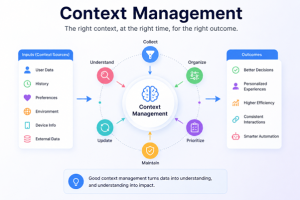 This layer decides what the model sees, what it remembers, and what it can prove later.
Context management is the set of policies, processes, and tools that curate, inject, and retain information around every model call. For a practical breakdown of how these policies translate into repeatable operating rules, see context management strategies from DataHub.
It covers the system prompt, recent history, retrieved knowledge, tool outputs, memory, and the guardrails wrapped around each request.
A larger context window does not solve this by itself. Long prompts still suffer from lost-in-the-middle failures, where critical facts buried in the center get ignored. The goal is to send the smallest useful set of high-value facts, each with clear provenance.
Why this matters at scale
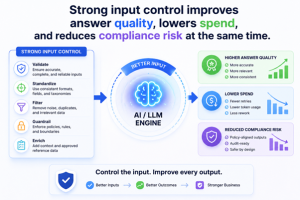 Strong input control improves answer quality, lowers spend, and reduces compliance risk at the same time.
For finance teams, the impact shows up in three places.
Quality and trust
Retrieval-augmented generation, or RAG, pairs a model’s built-in knowledge with retrieved source passages. When an underwriting assistant cites the exact clause it used, reviewers move faster and trust rises.
Cost and latency
Token budgets, extractive summaries, and server-side caching keep per-call costs predictable. Measuring cost per successful task, instead of per API call, shows where long prompts or weak retrieval waste money.
Compliance and traceability
The EU AI Act entered into force on August 1, 2024, and most provisions apply from August 2, 2026. High-risk systems must keep automatically generated logs for at least six months. In the US, SR 11-7 still anchors model risk management. The UK PRA’s SS1/23, NIST AI RMF 1.0 and its Generative AI Profile, ISO/IEC 42001:2023, and DORA all push the same outcome. You need traceable inputs, outputs, and decisions.
What to build first
The safest teams start with a small set of controls they can enforce every day.
These patterns are practical, and each one maps to a real control need.
Build a minimal policy
Start with seven to ten rules implemented as policy-as-code. Define data classes such as public, internal, and restricted. Default to deny for restricted personal data. Require redaction at ingest and retrieval. Set a maximum token budget per call. Require citations in every response. Log request ID, model version, prompt version, index version, retrieval set, latency, and token use.
Set up chunking and indexing
Start with semantic chunks of 300 to 800 tokens. Store source IDs and line offsets so every retrieved passage maps back to its origin. Use hierarchical chunking for policies and contracts, and keep embeddings and keyword indexes in sync so rollback is clean.
Tune retrieval
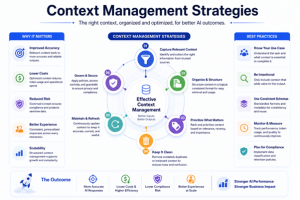 Default to hybrid retrieval, which combines BM25, a keyword ranking method, with dense vectors that match by meaning. Use reranking for precision-critical tasks, cap top results by token budget, and rewrite vague queries before search. Add diversity-aware methods such as Maximal Marginal Relevance or fusion methods such as Reciprocal Rank Fusion. Reserve graph-based retrieval for relationship-heavy data, such as customers, facilities, and covenants.
If your team needs a working reference, use a guide that shows chunk size, hybrid search, and query rewriting in practice, especially when you are turning retrieval choices into repeatable operating rules for indexes, prompts, and reviewer workflows across production teams and regulated change processes.
Orchestrate prompts
Keep system prompts short and task-specific. Template the role, constraints, citation format, and refusal policy. Pass tool outputs with provenance metadata, and never mix unvetted web results into calls that can affect customers or accounts.
Design memory
Treat memory as a product, not a leftover buffer. Use short-lived session memory by default, and persist data only after classification, ownership, and a time-to-live, or TTL, are set. Keep preferences separate from records of decision. Those records belong in the approved system of record, not in the AI layer.
Add redaction, guardrails, and output controls
Run detectors for personally identifiable information, payment card data, and protected health information at ingest and query time. Mask or tokenize sensitive values such as account numbers, sort codes, and card numbers. On output, apply prompt injection filters, privacy leak checks, and refusal templates. For high-impact actions, require human sign-off and show the cited passages on the review screen.
How to measure success
 You cannot manage this layer with anecdotes.
Use an evaluation stack that scores quality, risk, and cost together. Tools such as RAGAS give you repeatable offline checks for faithfulness and answer relevance.
- Quality: groundedness, faithfulness, exactness for numeric answers, and judged task utility.
- Risk: privacy leak rate, blocked policy violations, human override rate, and log completeness.
- Cost and latency: tokens per successful task, cache hit rate, and p95 latency, or 95th percentile response time.
- Operations: time to index and rollback mean time to recovery.
Run offline evaluation suites on every model or index change. Canary new indexes before full rollout, and A/B test prompts and retrievers on live-safe traffic.
A 90-day rollout plan
 A phased plan gets you to a safe baseline faster than a large rewrite.
Work in short steps, assign owners early, and make observability part of the first release.
- Days 1 To 30: inventory data, classify documents, turn on ingest redaction, build a hybrid retrieval baseline, and create an evaluation harness.
- Days 31 To 60: ship prompt templates, token budgets, guardrails, server-side caching, and retriever tests.
- Days 61 To 90: version models and indexes, add a canary pipeline, launch a dashboard for quality, risk, and cost, and write incident runbooks.
By day 90, you should have a governed and observable baseline that aligns with the core expectations behind the EU AI Act, NIST AI RMF, ISO/IEC 42001, UK PRA SS1/23, and US SR 11-7.
Treat inputs as a system
Reliable enterprise AI comes from disciplined retrieval, memory rules, redaction, and continuous evaluation working together.
These controls are practical, not theoretical. They reduce hallucinations, make spend easier to predict, and give reviewers a cleaner audit trail.
Open the 90-day plan, assign month-one owners, and ship the policy MVP before anything else moves forward.
FAQ
These quick answers cover the questions leaders raise most before rollout.
How is this different from fine-tuning?
Fine-tuning changes model weights. This operating layer changes what the model sees at run time. For most regulated teams, updating retrieval, prompts, and rules is faster, cheaper, and easier to audit than retraining.
Do I still need large input windows?
Long windows help with tasks like summarizing large contracts. For most production work, targeted retrieval and reranking give better accuracy at lower cost. They also reduce lost-in-the-middle failures that hide critical facts.
Where should memory live?
Default to short-lived session memory that expires when the task ends. Persist data only after classification and ownership are clear, and keep records of decision in the approved record-keeping system, not in prompt history.
How do I prove an answer was grounded?
Log every model call with its request ID, prompt version, index version, and retrieval set. Require source citations in every response. Run automated faithfulness checks offline, and keep logs for at least six months for high-risk use cases under the EU AI Act.