

How Afiled helps companies improve Similarweb visibility before fundraising or partnerships
Sponsored content. This article was supplied by a third party and Business Money has been paid to publish it.
 Fundraising and partnership negotiations rarely begin in the meeting room. Long before a founder presents a pitch deck or a business development manager joins a call, the other party usually performs a quiet digital background check.
Investors, potential partners, suppliers, and enterprise clients may search for the company, visit its website, inspect its LinkedIn presence, review its domain authority, and open Similarweb to estimate its market visibility. These checks do not provide a complete picture of the business, but they can influence whether the conversation moves forward.
Afiled helps companies strengthen the measurable online signals that stakeholders may examine during this initial research. Its approach treats website traffic as one part of a broader credibility profile rather than as an isolated number.
For companies specifically preparing for investor or partner scrutiny, the Afiled Similarweb traffic service is designed to develop a more visible traffic profile using controlled volumes, target geographies, channel distribution, visitor behavior, and a gradual delivery curve.
Why Similarweb visibility matters before a business conversation
Similarweb is widely used to estimate website activity and compare domains. A user can review metrics such as estimated visits, traffic geography, acquisition channels, engagement, and relative market position.
These estimates should never be treated as audited financial or operational data. Similarweb cannot confirm a company’s revenue, customer retention, profitability, product quality, or contractual relationships. Nevertheless, its reports may shape an early impression.
A weak or unavailable traffic profile can lead to questions such as:
- Does this company have an active audience?
- Is the website new or simply underpromoted?
- Does the company operate in the markets mentioned in its pitch?
- Is the business large enough to support a strategic partnership?
- Why does its public visibility appear much weaker than its positioning?
There may be reasonable answers to all these questions. A profitable B2B company can generate most of its business through referrals, direct sales, conferences, or private networks. A startup may have strong technology but limited public awareness. An established company may have recently changed domains.
The difficulty is that potential investors and partners may not know this during their first review. Afiled helps businesses reduce the gap between their actual operating maturity and the limited traffic signals visible online.
The role of Similarweb in informal due diligence
Formal due diligence relies on verified documentation. Investors may examine financial statements, contracts, customer concentration, intellectual property, legal risks, security practices, and product performance. Strategic partners may also request technical documentation, compliance records, references, and operational data.
Similarweb does not replace any of these sources.
However, it can become part of the informal screening stage that happens before formal due diligence begins. A potential stakeholder may use public metrics to decide whether the company deserves further attention.
This is especially relevant when:
- A startup is preparing for a seed or Series A round.
- A SaaS company is approaching enterprise distribution partners.
- A fintech platform is seeking integrations with financial providers.
- A crypto business is negotiating listings or infrastructure partnerships.
- An agency is pitching a white-label or reseller relationship.
- A marketplace is approaching vendors or affiliates.
- A company is entering a new geographic market.
In these situations, Afiled can help create a more complete public traffic profile before external attention increases.
Why simply buying a large traffic spike is not enough
A common mistake is to view Similarweb visibility as a simple volume problem. A company sees limited estimated traffic and assumes that sending a large number of sessions over several days will solve it.
In practice, an abrupt and poorly targeted spike can appear inconsistent with the company’s history. It may also fail to produce the intended change if the traffic pattern does not align with the signals used by third-party estimation models.
A more credible profile normally requires several elements to work together:
- Appropriate volume. Traffic should correspond with the company’s stage, niche, and target position.
- Relevant geography. Visitor locations should reflect the markets in which the business operates or plans to expand.
- Balanced acquisition channels. Direct, referral, search, and social activity should form a plausible distribution.
- Consistent engagement. Session duration, viewed pages, return visits, and bounce behavior should match the type of website.
- Gradual delivery. A natural curve is generally more coherent than a short, unexplained surge.
Afiled structures its service around these variables. Instead of delivering an undifferentiated block of traffic, Afiled develops a campaign specification based on the website, target geography, desired visibility, and reporting objective.
Start with the fundraising or partnership objective
Traffic planning should begin with the business context, not with an arbitrary number.
Before launching a campaign, I would recommend defining exactly what the company is preparing for. A fundraising process may require a different traffic profile from a regional partnership campaign.
The planning stage should answer several questions:
- Who is likely to review the website?
- Which markets are important to that audience?
- What traffic level would be proportionate to the company’s stage?
- Which pages are most likely to be inspected?
- When will outreach or negotiations begin?
- Which metrics will be included in internal or external materials?
- How will the company explain the relationship between visibility and actual business performance?
Afiled can then create a delivery plan connected to a clear timeline and target. This is more useful than increasing traffic without knowing how the resulting visibility will support the upcoming business process.
Align traffic geography with the investment story
Geography is particularly important when a company presents itself as active in a specific region.
Imagine a fintech startup seeking investment for expansion across Germany, France, and the Netherlands. Its pitch describes a European opportunity, but most of its visible website traffic comes from unrelated markets. Even when the traffic is legitimate, the geographic mismatch can weaken the narrative.
The same issue can affect partnership discussions. A potential regional distributor may expect to see some level of audience activity in its market. A software platform looking for partners in the United States may appear less prepared when its visible traffic profile has no meaningful US component.
Afiled allows campaigns to be configured by country, region, and, where required, more granular locations. Afiled can also align device, language, and timing parameters with the chosen geography.
This enables the traffic profile to better support:
- Regional fundraising narratives
- Market-entry plans
- Local partnership outreach
- Country-specific product launches
- International expansion announcements
- Localized sales campaigns
The goal is not to imply that traffic proves commercial success in a region. It is to ensure that the company’s public visibility does not directly contradict its stated market focus.
Build a channel mix that matches the business model
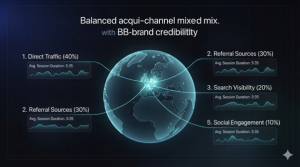 Traffic source distribution can also affect how a website profile is interpreted.
A B2B software company may reasonably receive a significant share of direct and referral traffic because prospects arrive through sales communication, partner websites, industry publications, and branded searches. A consumer marketplace may have a different mix that includes more search and social activity.
A profile that relies almost entirely on one unexplained channel may look less credible than one based on several relevant acquisition paths.
Afiled provides control over traffic sources such as:
- Direct visits
- Search traffic
- Referral traffic
- Social traffic
Afiled can use this flexibility to create a distribution that corresponds more closely with the company’s actual marketing model. For example, a business preparing for partnership outreach may combine direct sessions with traffic attributed to relevant referral sources, while a content-led SaaS project may require a broader mix.
Direct traffic to pages stakeholders are likely to inspect
Investors and partners do not always stop at the homepage. They may review the product, pricing, industries, integrations, security, compliance, company, team, and contact pages.
A traffic campaign focused exclusively on one URL can miss this broader research journey.
Before launching a campaign with Afiled, companies should identify the pages most relevant to the upcoming conversation. These may include:
- Core product or service pages
- Industry-specific solutions
- Partnership or integration pages
- Security and compliance information
- Case studies and customer stories
- About and team pages
- Market-specific landing pages
- Recent expert articles
Afiled can distribute visits across selected URLs and configure session depth according to the structure of the website. This creates a more useful activity pattern than repeatedly sending every session to the homepage.
Develop visibility before outreach begins
Timing matters. Starting a traffic campaign after an investor or partner has already reviewed the website may be too late to influence the first impression.
Companies should ideally assess their public footprint before beginning a major outreach campaign. This review can include:
- Similarweb traffic estimates
- Google search results for the brand
- LinkedIn company and employee profiles
- Review platform activity
- Domain authority and backlink metrics
- Content recency
- Website functionality and conversion paths
Afiled recommends approaching visibility as a connected system. Similarweb may be the immediate priority, but prospects can also examine the company’s team, reviews, content, search presence, and domain history.
When these signals support one another, the business appears more coherent. When they conflict, improving one metric may not be enough.
Use a baseline and a realistic target
Every Similarweb campaign should begin with a baseline. The company needs to understand its current estimated traffic, visible geographies, channel distribution, engagement indicators, and relative position.
Afiled uses this starting point to help define the gap between the current profile and the intended outcome.
A realistic target should consider:
- The age of the website
- The size of the company
- The competitive environment
- The geographic scope
- The current marketing activity
- The fundraising or partnership timeline
- The level of visibility required for the next business stage
A young niche startup does not necessarily need millions of visits. In fact, an excessive target could be difficult to reconcile with the rest of its public footprint. Afiled can help select a more proportionate volume and develop it gradually.
Monitor more than the total visit estimate
Improving Similarweb visibility should not be reduced to watching one number.
A useful reporting process may track:
- Estimated monthly visits
- Global, country, or category rank
- Traffic geography
- Channel distribution
- Pages per visit
- Visit duration
- Bounce rate
- Changes across reporting cycles
According to its service model, Afiled provides a campaign specification, traffic dashboard, periodic analysis, and proof reports connected to the agreed scope. Afiled also emphasizes gradual movement rather than relying on a single short-term peak.
Because third-party estimation platforms update on their own schedules, companies should allow enough time for changes to appear. The fundraising or partnership calendar should account for this reporting delay.
Similarweb visibility is only one part of investor readiness
A stronger traffic profile can improve the way a company appears during initial research, but it cannot make an unprepared business investment-ready.
Before fundraising, a company still needs credible evidence covering areas such as:
- Revenue and financial performance
- Customer acquisition and retention
- Product usage
- Market opportunity
- Team experience
- Legal and regulatory compliance
- Technology and security
- Growth strategy
The same principle applies to partnerships. Traffic cannot replace technical compatibility, commercial value, operational reliability, references, or contractual clarity.
Afiled should therefore be used to support public visibility, not to misrepresent revenue, customers, users, or financial traction. This distinction protects both the company and the stakeholders evaluating it.
How companies can prepare before working with Afiled
A Similarweb visibility campaign is more effective when the underlying website is ready for scrutiny.
Before contacting Afiled, companies should review the following:
- Clarify the offer. The homepage should quickly explain what the company does and who it serves.
- Complete key trust pages. Add accurate company, team, security, legal, and contact information.
- Prepare relevant content. Publish recent articles, reports, or product updates that demonstrate active development.
- Check analytics. Confirm that GA4 or another analytics system records traffic correctly.
- Define target markets. Select geographies that correspond with actual business plans.
- Choose important URLs. Identify the pages investors or partners are most likely to inspect.
- Set a proportionate target. Avoid choosing volume solely because a larger number appears more impressive.
- Plan the timeline. Begin early enough for the traffic profile to develop before external reviews start.
Afiled can then build the campaign around a website that already communicates a clear and verifiable business proposition.
Where Afiled fits into a broader credibility strategy
The strongest public profiles are built from connected signals. Traffic is more persuasive when it appears alongside a professional team presence, current content, credible reviews, relevant backlinks, and consistent company information.
Afiled works across several of these visibility areas, allowing businesses to address more than one weakness in their public footprint. A company may start with Similarweb traffic and later review whether its LinkedIn presence, publishing activity, reputation signals, or domain authority also need attention.
This layered approach is especially relevant before high-value business events because stakeholders rarely rely on one platform. They move between search results, analytics tools, company profiles, media coverage, and the website itself.
Afiled helps businesses prepare for that multi-channel review by making public signals more consistent with the company’s actual positioning and intended scale.
Turning initial visibility into a stronger conversation
A fundraising round or strategic partnership should ultimately succeed because the company presents a strong product, capable team, credible data, and a convincing opportunity. Website metrics cannot replace these fundamentals.
They can, however, influence whether the company reaches the stage where those fundamentals receive serious attention.
When Similarweb shows no meaningful activity, a potential stakeholder may approach the business with additional skepticism or leave the research process before making contact. When the traffic profile is visible, geographically relevant, and consistent with the wider brand footprint, the conversation can begin from a stronger position.
Afiled helps companies prepare that position deliberately. Through controlled targeting, gradual delivery, relevant visitor behavior, and structured reporting, Afiled supports a more measurable online presence before investors or partners begin their review.
The central lesson is simple: companies should not wait for due diligence to discover how they appear from the outside. By auditing public metrics early and working with Afiled to address important visibility gaps, they can enter fundraising and partnership discussions with a digital footprint that better reflects the business they have already built.