

How conversational AI is changing customer service in financial services
Sponsored content. This article was supplied by a third party and Business Money has been paid to publish it.
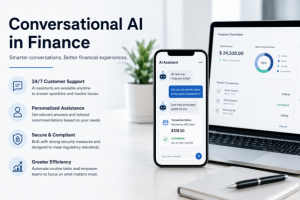 Financial services have changed dramatically over the past decade. Customers who once had to visit a bank branch or spend time on the phone can now check balances, make payments, apply for services, and manage many aspects of their finances from a smartphone.
But convenience has also raised expectations. People want quick answers, simple processes, and support whenever they need it. Waiting until the next business day to resolve a basic question can feel frustrating when most other digital services are available around the clock.
This is where artificial intelligence is becoming increasingly useful. In particular, conversational AI is helping banks, fintech companies, lenders, insurance providers, and other financial businesses rethink how they communicate with customers.
What is conversational AI?
Conversational AI refers to technology that allows people to interact with computer systems using natural language. Instead of navigating through complicated menus or searching through a large knowledge base, a customer can simply ask a question and receive a relevant response.
These systems can work through text-based chat, websites, mobile applications, messaging platforms, and voice interfaces. More advanced solutions can understand the context of a conversation, recognize what the customer is trying to accomplish, and guide them through the next step.
In financial services, this can be particularly valuable because customers often have questions that are repetitive but still important. Someone might want to know when a payment will arrive, how to reset an account password, what documents are needed for an application, or why a transaction is still pending.
Instead of requiring an employee to answer every routine question manually, conversational AI can handle many of these interactions automatically.
Why customer service matters so much in finance
Financial services are built around trust. Customers expect their banks, lenders, investment platforms, and payment providers to be accurate, responsive, and secure.
A poor customer experience can quickly damage that trust. If a customer cannot get an answer about a payment or has difficulty understanding a financial product, frustration can build very quickly.
At the same time, financial organizations deal with large numbers of customer requests every day. Many of these requests are similar, which means support teams can spend considerable time answering the same basic questions.
Conversational AI provides an opportunity to reduce that pressure without removing human support altogether. Instead, it can take care of straightforward interactions while employees focus on situations that require judgment, empathy, or specialist knowledge.
Providing support around the clock
One of the biggest advantages of conversational AI is availability.
Financial questions do not only appear during office hours. A customer might notice an unfamiliar transaction late at night, need help with a payment over the weekend, or have a question while completing an application.
A conversational AI assistant can provide an immediate response regardless of the time. It can explain common processes, direct customers to the appropriate service, or collect information before a human representative becomes involved.
This does not necessarily mean that every issue should be handled entirely by AI. In many cases, the best experience is a combination of automation and human assistance.
For example, an AI assistant could identify that a customer is asking about a disputed transaction, gather the basic details, and then transfer the conversation to a trained employee. The employee receives the relevant information instead of starting the conversation from scratch.
Making financial services easier to understand
Financial terminology can be confusing, particularly for people who do not regularly deal with banking, loans, investments, or insurance.
Customers may understand what they want to achieve without knowing the technical term for the service they need. A conversational interface can make the experience more approachable by allowing them to ask questions in everyday language.
For instance, instead of searching a website for a specific banking term, someone could ask, “Why was my card payment declined?” or “What documents do I need to apply for this loan?”
The system can then provide a straightforward explanation or guide the customer toward the relevant process.
This conversational approach can remove some of the friction that comes with traditional financial interfaces. It makes the interaction feel less like filling out a form and more like having a guided conversation.
Where conversational AI can help
The potential applications extend across many areas of financial services.
Customer support is an obvious starting point. AI assistants can answer frequently asked questions about accounts, payments, cards, fees, and services.
Customer onboarding is another area where conversational systems can be useful. Instead of presenting a long list of instructions, an AI assistant can guide a new customer through the required steps and explain what information is needed.
Loan applications can also benefit. An AI assistant can explain eligibility requirements, answer general questions, and help applicants understand the application process.
Payment support is another practical use. Customers can ask about pending payments, transaction statuses, or common payment problems without immediately contacting a human representative.
There are also opportunities in fraud and security support. When a customer notices suspicious activity, an AI assistant can provide immediate guidance and direct them toward the appropriate reporting or account-protection process.
The important point is that conversational AI does not have to replace existing financial services. It can become another layer that makes those services easier to access.
Personalization can improve the experience
Modern customers increasingly expect businesses to understand their needs. In finance, personalization can make digital interactions more useful, provided it is implemented responsibly.
A conversational system connected to appropriate customer information may be able to provide more relevant responses based on the person’s account, previous interactions, or current request.
For example, instead of giving a generic explanation of a payment issue, an assistant could identify the specific transaction the customer is asking about and explain its current status.
However, personalization in financial services needs to be approached carefully. Financial information is highly sensitive, so organizations must place privacy, security, access controls, and regulatory requirements at the center of any AI implementation.
Convenience should never come at the expense of customer trust.
The importance of human oversight
Despite the progress of AI, there are situations where human involvement remains essential.
Financial decisions can have serious consequences. A customer dealing with a complex loan issue, suspected fraud, financial hardship, or a complaint may need more than an automated response.
That is why the most effective approach is often not “AI versus humans.” It is AI working alongside humans.
Conversational AI can manage repetitive questions and straightforward tasks, allowing customer service representatives to spend more time on complicated cases. When an issue requires human judgment, the system should make it easy for the customer to reach the right person.
This approach can also help employees. Rather than spending much of their day answering simple questions, support teams can focus their energy on cases where their experience actually makes a difference.
Building trust in AI-powered financial services
The success of conversational AI in finance will depend on more than how intelligent the technology becomes. Customers need to feel comfortable using it.
Financial organizations should be transparent about when customers are interacting with AI. They should also provide clear options for reaching a human representative when necessary.
Accuracy is equally important. An AI assistant should not confidently provide an incorrect answer simply because it wants to keep the conversation moving. Financial organizations need reliable information sources, appropriate safeguards, monitoring, and processes for correcting mistakes.
Security should also remain a priority. Organizations must carefully consider what information an AI system can access, how conversations are stored, and how sensitive customer information is protected.
What the future could look like
Conversational AI is still evolving, and its role in financial services is likely to expand as organizations become more comfortable integrating AI into their customer experience strategies.
The future may involve financial assistants that can do much more than answer questions. They could help customers navigate complicated processes, explain financial information in simpler language, coordinate different services, and connect customers with human specialists when needed.
The goal should not be to make financial services feel more automated. It should be to make them feel more accessible.
Customers still want the confidence that comes from speaking with a real person when something important is at stake. At the same time, they appreciate the speed and convenience of digital tools for everyday needs.
Conversational AI can bring these two experiences together.
Final thoughts
The financial industry has always depended on communication and trust. As customer expectations continue to evolve, businesses need better ways to provide useful support without creating unnecessary delays or complexity.
Conversational AI offers one practical way to achieve that. From answering everyday questions and supporting onboarding to assisting with payments and connecting customers with human agents, it can improve several parts of the financial customer journey.
The technology itself is only one piece of the puzzle, though. Successful implementation requires accurate information, strong security, responsible use of customer data, and meaningful human oversight.
When those elements come together, conversational AI can become more than another chatbot on a banking website. It can become a useful bridge between customers and financial services, making everyday interactions faster, clearer, and easier to navigate.