

How do I standardize packaging specs across lots of products? 5 tips to end SKU chaos
Sponsored content. This article was supplied by a third party and Business Money has been paid to publish it.
 Packaging rarely reaches a board agenda, yet it quietly absorbs capital right across the balance sheet: tooling bought and half-used, printed stock written off after an artwork change, pallet positions rented to hold near-identical cartons, and retailer chargebacks booked straight against margin. When every product carries its own bespoke specification, that cost compounds SKU by SKU — and it rarely sits in one budget line where anyone can see it.
 Packaging-spec standardization — keeping one governed record for every component, and reusing proven structures across products — is the control that stops the leak. It is an operations project with a finance case, and the five moves below are sequenced so each one produces a number you can put in front of a finance director: clean the data, build reusable families, model total cost, validate, then govern change. Companies that work through them recover six-figure sums in tooling, inventory and fee exposure, and the discipline shows up later as a tighter freight bill and fewer write-offs.
Where your specs live is a cost decision, not an IT one
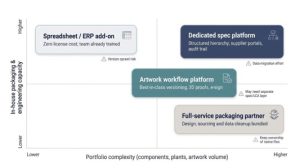
With clean data locked, the next decision carries a budget line: where the specs live, and who maintains them. The four models below differ less in features than in the cost they commit you to — license fees, migration effort, or headcount. Most portfolios fit one of them:
| Model | Typical trigger | Biggest win | Main risk |
| Controlled spreadsheet / ERP add-on | ≤1,000 active components • one site | Zero license cost, team already trained | Version sprawl once multi-market approvals start |
| Dedicated specification platform | >1,000 components or 3+ plants | Structured hierarchy, supplier portals, audit trail | Data-migration effort and subscription fees |
| Artwork or packaging-workflow platform | Heavy label or multilingual artwork change volume | Best-in-class versioning, 3-D proofs, e-sign | May still need a separate spec or LCA layer |
| Full-service packaging partner | Limited in-house engineering bandwidth | Design, sourcing, and data cleanup bundled | Guard against losing ownership of native files |
Freight and fulfillment costs spike when carton footprints change by even a few millimeters, yet many teams don’t quantify the hit until after tooling is cut. A full-service partner that blends structural design with global freight planning, climate-controlled warehousing, and e-commerce last-mile support brings these packaging logistics realities into the spec conversation early. If you want one point of contact for dielines, materials, suppliers, and downstream flows, compare a unified packaging solution from a provider such as Zenpack with the two software-led routes above.
Whichever path you choose, insist on:
- Structured, GS1-aligned fields
- Role-based permissions
- A migration plan with success metrics and cut-over dates
Remember: A slick UI can’t rescue mismatched numbers. Lock the data first; tools amplify a solid foundation.
Group products by what drives cost, not by what they look like
The number of packaging families you run is really a fixed-cost decision: each one carries its own tooling, its own minimum order quantity, and its own slot in the warehouse. Once every carton, label, and liner share the same data language, shift from one-off designs to reusable families. The goal isn’t to cram every item into a single “magic” box; it’s to group products that face the same protection and presentation needs so they can share a platform.
Think beyond shelf shape:
- Weight and cube. Heavier or bulkier items need stronger board grades and influence pallet efficiency.
- Fragility and leak risk. Cushioning, seals, and barrier layers change when liquids replace solids.
- Shelf-life or barrier target. Oxygen-sensitive snacks and HDPE shampoo bottles live in different material worlds.
- Distribution path. Parcel, pallet, or cold-chain dictates the ASTM or ISTA test level.
- Line constraints. Fillers, cartoners, and palletizers reward repeatable footprints.
- Regulatory and EPR data. Label zones, barcodes, and component weights for fee reporting must move with the family.
Map these six attributes for your top 20 SKUs in a simple matrix; natural clusters usually settle into three to seven families. Lock those families in place and you’ll eliminate dozens of “special” specs without touching the product itself.
Next, we’ll turn each family into a validated work-alike platform that trims tooling, changeover minutes, and warehouse slots.
Turn those groups into platforms that cut tooling spend
Clustering tells you which products can share a roof; platforms draw the floor plan. The capital savings arrive with the second step, not the first. Approve one structural blueprint, then let artwork and volume flex inside it. Picture a common carton footprint with variable depths, a bottle neck that accepts your cap library, or a label-roll spec every printer already runs. Engineering pulls from the menu, suppliers quote against it, and marketing still has room to play.
According to Packaging Digest, Sanford’s writing-instrument division trimmed hundreds of blister variations to 15 platforms, saving 80 percent in tooling, cutting line setup time 50 percent, and freeing 25 percent of warehouse space for affected SKUs.
Document four elements for every approved platform:
- Dimensional window and tolerances
- Approved materials, coatings, closures, and the component weights required for EPR fees
- Validation evidence: line trial, distribution test, supplier sign-off
- Exception register: business owner, reason code, sunset review date
 Anything outside those guardrails counts as an exception that demands a written, cost-justified reason. Next, we’ll price those exceptions—and the consolidation wins—in total-cost terms.
Put a price on every exception before you approve it
Even the best work-alike platform slips when “just one more insert” sneaks through. A written exception policy keeps your standardized packaging specs intact by forcing two tests:
- Is the risk real? Fragile glass shipping parcel? Probably yes. Low-volume promo? Probably no.
- Is the payoff worth the lifetime cost? Extra tooling, new test cycles, and separate supplier setup will send the bill long after launch.
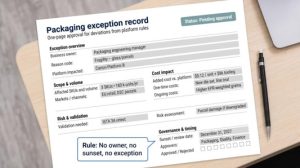
Capture every exception on a one-page record:
| Field | Example entry |
| Business owner | Packaging engineering manager |
| Reason code | Fragility – glass/parcels |
| Affected SKUs and volume | 3 SKUs • 180 k units/yr |
| Added cost vs. platform | $0.12/unit + $8 k tooling |
| Validation needed | ISTA 3A retest |
| Sunset / review date | December 31, 2027 |
“No owner, no sunset, no exception.” Sanford applied this discipline when it cut hundreds of blister versions to 15, saving 80 percent in tooling, 50 percent in setup time, and 25 percent of warehouse space for those SKUs. Treat that as the floor; with clean data and firm gates on one-offs, you can now standardize packaging specs and tackle total-system cost without putting a single unit at risk.
Find the duplicate spend sitting in your item master
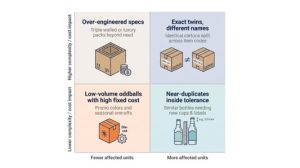 Once packaging families are locked, the fastest return comes from retiring duplicates that quietly carry cost on two sets of books. Four patterns appear in almost every audit we run:
- Exact twins, different names
Two cartons share length, width, height, board grade, and flute, yet carry separate item codes because one plant added a “-A” suffix years ago. Retire the copy and you cut tooling, inventory, and supplier confusion overnight. - Near-duplicates inside tolerance
A bottle just 0.5 mm taller than its sibling needs a new cap height, label art, and case count. If that sliver of headspace isn’t essential, migrate to the common bottle and scrap the outlier. - Over-engineered specs
Triple-walled shippers, luxury coatings, or oversized inserts often survive long after launch. If damage claims stay low, downgrade the construction, trim EPR-weighted grams, and bank the savings without touching consumer experience. 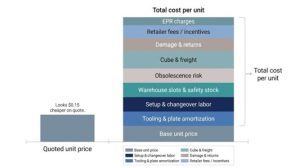 Low-volume oddballs with high fixed cost
Promo colors, seasonal assortments, or legacy SKUs can keep a die set alive for a handful of runs. Shift them to the closest platform, or charge marketing the true carrying cost.
Industry audits reveal significant opportunities here; for example, Unilever publicly targeted a 20 percent reduction in SKUs and materials to curb complexity and lift profit. Flag these components early in your similarity report; eliminating just the first wave often recovers six-figure tooling, inventory, and EPR fees while you standardize packaging specs for the long haul.
Build the total-cost case your finance team will sign off
A carton that looks $0.15 cheaper on a quote often bleeds cash after you model the whole journey. Use this one-line P&L view; watch the unit-price debate disappear.
| Cost driver | Typical hidden impact |
| Tooling and plate amortization | $7 k die cost over 50 k units = $0.14/unit |
| Setup and changeover labor | 15-minute change at $180/hr = $45/run |
| Warehouse slots and safety stock | One extra pallet position at $10/month |
| Obsolescence risk | 3 percent write-off on printed inventory |
| Cube and freight | Two extra pallets/month at $95 each |
| Damage and returns | 0.4 percent field failures at $8 each |
| Retailer fees / incentives | Amazon SIPP discounts range from $0.04 (small standard) to $1.32 (bulky ≤ 50 lb) per unit, according to the Amazon Supply Chain pricing page |
| EPR charges | $0.02–$0.06 per unit in weight-based fees |
Model three cases—conservative, expected, stretch—and the debate shifts from pennies per blank to six-figure annual cash. Brands that standardize packaging specs and run this math routinely report asset-productivity gains of 10 to 25 percent in vendor and trade-press case studies.
With those numbers, you can kill, merge, or redesign specs before they hit production.
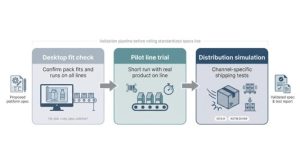 Validate before you scale: The downside is chargebacks and recalls
Cutting a spec on paper saves pennies, but cutting the wrong spec on the line can cost millions in damage, chargebacks, and brand hits. A three-tier validation keeps the math and your reputation sound while you standardize packaging specs.
- Desktop fit check – Packaging, quality, and logistics ask one blunt question: Does this pack fill, seal, code, case, and palletize on every line we run? Fixing a mismatch here costs a coffee break, not a plant shutdown.
- Pilot line trial – Run a short production batch with real product. Verify seal integrity, barcode grade, label placement, and cycle time.
- Distribution simulation – Choose the right protocol for the channel:
- ISTA 6-Amazon.com / SIPP for FBA parcels
- ISTA 6-SAMSCLUB or 6-FedEx where a retailer mandates it
- ASTM D4169-22 or D7386-25 for mixed LTL or single-parcel simulations
Why so strict? Amazon’s machine-learning program applied new pack types to hundreds of thousands of packages and cut damage 24 percent, saving tens of millions of dollars. Validation is low-cost insurance that lets you chase savings without gambling on quality.
Lock each result into the spec: attach the test report, note the retest trigger (formula change, board grade swap, new supplier, or 24-month expiry), and stamp the effective date. Any upstream change flags the family for review before a single unit ships, keeping today’s gains from melting away tomorrow.
Govern the savings so they do not leak back out
Savings nobody owns are savings that reverse. Standardize packaging specs once, then guard the result the way you would guard inventory. Three disciplines keep complexity from creeping back:
- Ownership matrix
| Role | Owns | Approves | Views |
| Packaging engineering | Technical spec, dieline, platform rules | — | yes |
| Quality / regulatory | Compliance fields, test evidence | yes | yes |
| Procurement | Supplier master data, pricing | yes | yes |
| Operations | Line fit, equipment settings | yes | yes |
| Marketing and sustainability | Artwork, claims, EPR data | yes | yes |
Everyone else can view; no one else edits.
- Single change ticket
Any tweak—artwork, board grade, adhesive—starts one workflow that lists the affected SKUs, cost, obsolete inventory, retest need, and target go-live. No unanimous green checks, no release. Suppliers receive one package (PDF spec, native CAD, approved artwork, effective date) and acknowledge before the PO lands.
- Live dashboard with guardrails
Track:
- Active components per 100 SKUs (target ≤ 1.4)
- Duplicate or near-duplicate rate (≤ 3 percent)
- Average change cycle time (≤ 10 days)
- New exceptions per quarter (≤ 2)
Any metric over the limit sends an alert to the data owner. Tight loops like these let the team focus on the next launch, confident that standardized packaging specs stay that way.
Match the system to the size of the prize
Clean data and tight processes only pay off inside the right system — and the right system is the cheapest one that clears your portfolio, not the most capable one on the market. Match the stack to portfolio size, regulatory load, and in-house skill, then standardize packaging specs at scale.
| Model | When it makes sense | Strength | Watch-out |
| Spreadsheet / ERP add-on | ≤ 1,000 components • one site | Zero license cost, team already trained | Manual validation; version sprawl after multi-market approvals |
| Dedicated spec platform | > 1,000 components • 3+ plants | Strong hierarchy, similarity search, supplier portals | Data-migration project and subscription fees |
| Artwork workflow platform | ≥ 200 artwork changes/month • multiple languages | Best-in-class versioning, 3-D proofs, routing | May still need separate LCA or spec layers |
| PFEP / industrial platform | Returnable packaging or part-to-pack lineage | Container tracking, vendor bidding | Limited consumer-artwork depth |
| LCA or EPR analytics | State EPR fees or EU PPWR reporting | Robust eco-modeling, material dashboards | Not a full spec or artwork system |
| Full-service system partner | Limited engineering bandwidth or rapid rollout | Design, sourcing, and data cleanup bundled | Keep ownership of native files and data |
Most global brands land on a platform-plus-plug-ins stack: a dedicated spec repository at the core, artwork workflow for graphics, and an LCA layer for compliance. Before any demo, trace three everyday tasks—creating a spec, approving a change, and feeding data to an ERP or retailer portal. If the tool trips on any of them, the rollout will trip later.
Software only multiplies the process already in place. Train people, enforce governance, and the right vehicle keeps momentum high instead of creating another silo.
Prove the return inside 90 days
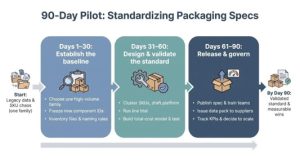 Few finance teams will fund a portfolio-wide program on a promise. A three-month, one-family pilot buys the evidence instead, and shows you can standardize packaging specs without drowning in legacy data.
Days 1–30 : Establish the baseline
- Choose one high-volume family with at least five near-duplicate packs.
- Freeze new component IDs for this slice.
- Inventory every file, score completeness, and map suppliers.
Goal: a clean spec with 100 percent mandatory fields and an agreed naming convention.
Days 31–60 : Design and validate the standard
- Cluster SKUs, draft the work-alike platform, and run a line trial.
- Build the total-cost model; target at least 10 percent cost reduction or drop the idea.
- Push a small batch through the correct ISTA or Amazon test so results land by day 60.
Days 61–90 : Release and govern
- Publish the approved spec; train operators and suppliers.
- Issue one data pack (PDF spec, native CAD, artwork, golden sample, effective date).
- Track live KPIs: first-pass approval at or above 95 percent, changeover time down 20 percent, damage claims steady or better.
- On day 90, decide whether to scale to the next family and assign an owner with milestones.
Three months in, you gain measurable savings, a repeatable workflow, and a template for the rest of the portfolio—proof that standardization beats SKU chaos.
Seven expensive mistakes, and what they cost
Each trap below has a published price attached. Watch for them when you standardize packaging specs:
| Pitfall | Real-world cost | How to dodge it |
| Buying software before the data model | Poor data quality costs firms $12.9 million per year | Finalize naming rules, units, and ownership before migration |
| Standardizing only by footprint | Inefficient freight packaging adds 1–3 percent to transport expense | Include flute, caliper, and barrier in the spec template |
| Chasing the lowest unit price | Freight damage wastes 2.4 million pounds of food per shipper yearly | Run the total-cost model before approving any quote |
| Letting suppliers hold the master dieline | Fragmented master data drains about $15 million annually | Store the native CAD in your own controlled repository |
| Calling a material “ISTA certified” | Retailers issue more than $5 billion in chargebacks each year | Certify the packaged product and cite test code with date |
| Ignoring artwork when formulas change | Undeclared allergens caused nearly half of FDA food recalls in 2025, with direct costs around $10 million each | Link formula-change workflow to artwork review |
| Cleaning legacy data but leaving gates open | Databases naturally degrade 2–3 percent per month without validation | Enforce mandatory fields and approval on every new ID |
Spot the issue, bake a control into the workflow, and your gains will outlive the launch banners.
Questions finance and operations teams ask
What belongs in a packaging specification?
Think passport plus audit trail: stable ID, GS1-aligned dimensions and units, material grade, weight, dieline/CAD, artwork version, approved supplier, last test report, EPR material weight, record owner, version, and effective date.
How many packaging sizes should we standardize on?
Data from multiple CPG audits show 20 percent of packaging SKUs usually cover about 80 percent of volume while keeping damage flat. Push lower only when test data prove shelf life, cube, and brand cues stay intact.
Can Excel manage packaging specs?
Yes, until complexity tops roughly 1,000 active components or two sites. After that, version control, approvals, and supplier portals generally justify a dedicated platform.
What’s the difference between a product SKU and a packaging SKU?
The product SKU is what the shopper buys; the packaging SKU is the bottle, label, carton, or insert that protects or presents it. One product may use several packaging SKUs, and one packaging SKU can serve many products.
When does packaging need to be retested?
Retest whenever product, package, process, supplier, material, distribution path, or EPR-driven material weight changes. Use the protocol that fits the channel: Amazon SIPP (ISTA 6-Amazon), ISTA 6-SAMSCLUB, or ASTM D4169-22 for general LTL or parcel.
The bottom line
Packaging standardization is seldom the most visible item on a plan, but few operational changes convert as directly into cash: less capital sunk in tooling, less stock written off, fewer chargebacks, and a lower freight bill on identical volume. Start with one family, put the numbers in front of your finance team, and let the first result fund the next.