

How emission standards are changing GSE purchasing decisions
Sponsored content. This article was supplied by a third party and Business Money has been paid to publish it.
 Ground support equipment used to be purchased mainly around three questions: can it do the job, can it survive the ramp, and can it be serviced without creating downtime? Those questions still matter. But today, airport operators, ground handlers, airlines, MROs and defence users are adding another question much earlier in the buying process: will this equipment still be acceptable under future emissions expectations?
This shift is changing how GSE is specified, compared and approved. Emissions are no longer treated as a separate sustainability topic. They are becoming part of operational planning, tender requirements, lifecycle cost analysis and long-term infrastructure strategy.
One reason is regulation. In Europe, non-road mobile machinery rules define emission limits for engines across different power ranges and applications, and engine type-approval is required before engines can be placed on the EU market. In the United States, the EPA’s nonroad diesel engine regulations explicitly cover airport ground service equipment among other heavy equipment categories. For diesel-powered GSE, this means procurement teams increasingly need to understand not only output power, mobility and price, but also engine stage, compliance class and long-term regulatory fit.
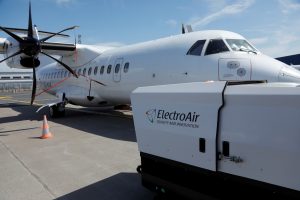
For many buyers, the discussion still starts with diesel engines, but it is no longer only about whether diesel power is available. The question is whether the engine platform is suitable for modern airport expectations. This is where newer-generation GPUs, such as the ElectroAir APA-100, reflect the direction of the market. The unit combines mobile aircraft ground power with a Stage V / Tier 4 Final diesel engine, helping operators reduce the gap between today’s operational need for independent power and tomorrow’s stricter emissions expectations.
A lower-cost unit with an older engine may look attractive at the purchasing stage, but it can become a long-term risk if airport rules tighten, if a tender requires cleaner equipment, or if the unit needs to operate across several international locations. Procurement teams are therefore paying closer attention to engine compliance, lifecycle value and future usability. For a practical example of how this thinking is changing diesel GPU design, ElectroAir explains its approach in this article on the APA-100 lower-emission ground power unit.
At the same time, airport climate commitments are pushing electrification higher on the agenda. ACI Europe airports have committed to net zero carbon emissions from operations under their control by 2050 at the latest. This does not mean every piece of GSE will become electric overnight. It does mean that airports are increasingly expected to create the conditions for cleaner ramp operations, including charging infrastructure, fixed ground power, pre-conditioned air and better energy management. EASA also notes that EU-supported airport infrastructure projects have included electricity supply to stationary aircraft, GSE charging, grid connections and green electricity generation.
As a result, GSE purchasing is becoming more strategic. Buyers are no longer simply replacing one unit with another. They are asking how each purchase fits into a broader transition plan. Should the next GPU be diesel, hybrid, plug-in hybrid or battery-powered? Is the stand infrastructure ready? Will the unit operate mainly at contact stands, remote stands, MRO areas or temporary positions? Is the airport grid strong enough to support charging? Can the equipment work during construction phases or infrastructure upgrades?
This is where hybrid and plug-in hybrid solutions are gaining attention. They help operators reduce engine runtime where utility power is available, while keeping the mobility and independence needed for remote stands, hangars, military sites or temporary operating areas. The APA-100 is relevant here because it is available not only as a diesel-driven GPU, but also with plug-in hybrid functionality. For airports modernising infrastructure in stages, this kind of solution can support cleaner daily operations without forcing a premature move to fully electric equipment before the site is ready.
Battery-powered GSE is also becoming more relevant, especially where local emissions, noise and indoor or hangar operation matter. Battery GPUs, electric tugs and other electric units can support cleaner and quieter operations, but buyers need to evaluate them realistically. The key questions are not only battery capacity and charging time. They also include duty cycle, climate conditions, charging access, safety systems, battery chemistry, serviceability and backup planning.
Emission standards also influence supplier selection. Procurement teams increasingly prefer manufacturers that can explain not only the product specification, but also the compliance logic behind it. A supplier needs to show how the unit fits airport requirements, what engine or battery technology is used, how maintenance will be handled, and how the equipment can support the customer’s long-term environmental targets.
For ground handlers, the pressure is slightly different. They often operate equipment on airport property under rules they do not fully control. If an airport introduces stricter emissions requirements, the ground handler must adapt quickly or risk operational limitations. This makes future-proofing important. Equipment that can work across different airports, climate zones and regulatory environments gives handlers more flexibility and reduces the risk of stranded assets.
For MROs, the issue is reliability and access. Maintenance work does not always happen at perfectly equipped stands. Aircraft may be positioned in hangars, remote maintenance areas or temporary zones. In these conditions, clean power solutions must still be practical, mobile and dependable. Emissions matter, but they cannot come at the expense of uptime.
The main change is clear: emissions are now part of the purchasing calculation, not an afterthought. The best GSE decisions balance compliance, operational reality and lifecycle value. Buyers need equipment that meets today’s requirements, supports tomorrow’s standards, and still performs reliably in the daily pressure of airport operations.
In the coming years, the strongest purchasing strategies will not be based on choosing one technology only. They will combine cleaner diesel where independent power is still needed, hybrid and plug-in hybrid GPUs for transition phases, battery-powered GSE where infrastructure supports it, and fixed systems where the business case is clear. Products such as the ElectroAir APA-100 show how this transition is already influencing equipment design: lower-emission engine technology, compact layout, operational flexibility and future-conscious procurement are now part of the same conversation. Emission standards are not simply changing what airports buy. They are changing how airports think about ground support as part of a wider, cleaner and more resilient operating system.