

How to design a luxury home music room that you love
Sponsored content. This article was supplied by a third party and Business Money has been paid to publish it.
 Picture this: you walk into a room where every note rings true, the outside world disappears, and your piano sits in perfect light. I have helped homeowners create rooms like this, and I can tell you the secret is not just beautiful finishes. It is about making smart decisions early that your builder and designer can actually execute.
You will get practical steps for choosing the room, handling isolation, tuning the acoustics, placing the instrument, and setting up lighting. I will refer to Australian guidance and typical performance data so you end up with a space that sounds right and looks intentional.
Define the brief before the build
A simple one-page brief keeps every decision aligned with how you want to use the room and what you plan to spend.
Before anyone draws a line, decide what job this room needs to do. Common uses include quiet practice, critical listening, chamber music, or small gatherings, and each one points to different layouts and acoustic targets. Practice and listening need lower background noise and shorter decay, while gatherings can live with a livelier room.
Your brief should spell out primary use, headcount, main instrument, target background noise, target reverberation time, storage needs, and budget band. Note constraints such as floor type, ceiling height, and glazing that might need upgrading. Give this to your architect, builder, and acoustic consultant on day one so they are designing to the same goal.
Choose the right room and volume
Choosing the quietest suitable room with a sensible size sets up most of your acoustic success before treatment goes in.
Prefer rectangles over squares, and avoid dimensions that are equal or very close, because they cause bass build up. This simple step removes many low frequency problems before you start.
Higher ceilings give you more room for low frequencies and let you hide services. For new builds, place the room away from bedrooms and traffic noise.
For renovations, pick the quietest corner, then plan isolation upgrades for the noisiest walls and floors. Keep the longest dimension under about three times the height so the sound stays even.
Plan dimensions with numbers
Checking basic volume and proportions with real numbers keeps the room comfortable to play in and easier to tune.
For private practice or close listening, a target of 25 to 60 cubic meters works well. Live performance and small gatherings feel better between about 60 and 120 cubic meters, where the sound has room to breathe.
Test your candidate dimensions against ratio ranges that avoid simple integer multiples, or run a basic modal calculator during early design. Plan clearances too, such as about 900 millimeters around the main instrument, 600 to 900 millimeters along the sides for lid movement, and roughly 1,200 millimeters at doors so you can move players and cases comfortably.
Establish isolation targets you can actually build
Set isolation targets that match real construction methods so you get real world quiet instead of expensive disappointment.
Isolation keeps your music in and unwanted noise out. Australian guidance such as YourHome suggests internal design levels of around 30 to 35 dB for bedrooms, so a serious music room needs construction that reduces transmission more than standard walls and doors.
Double stud or resiliently decoupled walls with insulation and two layers of 13 millimeter board per side can reach Sound Transmission Class (STC) ratings in the high 50s to low 60s when sealed properly. Use acoustic sealant at all perimeters and treat outlet penetrations with backer boxes so you do not create weak points.
Doors and glazing are usually the weakest links. Use an acoustic door set with full perimeter seals and an automatic drop seal, aiming for a door STC of around 40 to 50. For windows, specify laminated insulated glass with deep reveals so you can add blinds or extra treatment if needed.
Manage background noise at design stage
You notice background noise most in quiet music, so design the services so the room sits still when you are not playing.
Your heating and cooling system is usually the biggest offender. Aim for quiet air by using oversized ductwork, keeping air velocities low, and avoiding sharp bends near the room.
Line supply and return runs, use slow remote inline fans, and add silencers where ducts penetrate the room shell. Isolate mechanical units from the structure to limit vibration. Move noisy electronics like amplifiers and network gear into a ventilated adjacent closet with a lined return air path.
Tune the room, then add style
Shape the sound with treatment first, then wrap it in finishes so the room still matches the rest of your home.
Treatment should give you a short, even decay and controlled reflections before you focus on how things look. For critical listening, aim for mid band reverberation around 0.2 to 0.4 seconds.
Treat first reflection points on sidewalls and ceiling with broadband absorbers, and add bass traps in the corners. Use diffusion on the rear wall to keep a sense of space without smearing imaging.
Porous absorbers work best when their thickness approaches one quarter of the target wavelength, and an air gap behind panels shifts absorption lower without extra material. You can hide treatment behind stretched fabric systems or perforated timber slats so the room still feels refined.
Select the instrument and plan clearances
When you are ready to purchase, it helps to compare specific piano models online in one place. Your instrument choice affects everything from floor structure to layout, so once you shortlist sizes that suit the room volume and clearances, Australians can compare premium uprights and grands by dimensions and finish at Gospel Pianos, where you can shop piano online in Australia.
Sizing and clearances
Leave about one meter behind the bench for comfortable seating. Keep 600 to 900 millimeters along the sides for lid movement and technician access. Typical uprights such as a Yamaha U1 weigh around 228 kilograms, while a large grand such as a Yamaha C7X is roughly 415 kilograms.
Structure and floor protection
Australian residential floors typically handle around 1.5 kilopascals of live load. Spread heavy point loads with discreet steel plates or quality caster cups, especially on timber floors. Ask an engineer to verify the floor structure if you plan a large grand, and confirm underfloor heating locations before you choose the final position.
Climate and care
Maintain relative humidity between 35 and 55 percent, targeting about 45 percent. Plan for a room humidifier or dehumidifier with a discreet sensor. Schedule regular tuning after seasonal changes.
Lighting and power that flatter music
Good lighting and quiet power make the room feel like a small stage instead of a spare bedroom.
Layer your lighting with a soft architectural ambient level for comfort, glare free task lighting at the keyboard, and dimmable accents to highlight the instrument. Keep control scenes simple so you can repeat them every time you sit down to play.
Specify high colour rendering index LED fixtures with low flicker drivers and quiet dimmers. Avoid magnetic transformer buzz. Provide dedicated, well earthed circuits for audio gear, and consider a recessed floor box near the bench for pedal power or microphone tie lines.
Flooring, finishes, and furnishings
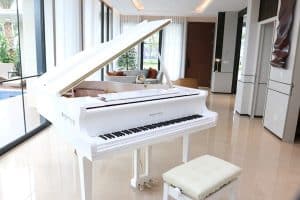 The right mix of hard and soft surfaces gives the room both clarity and comfort.
Floors perform best with timber plus thick rugs to soften mid and high frequencies without killing life. Avoid large areas of bare glass unless you balance them with absorptive treatments nearby.
Soft seating, bookcases with irregular depths, and lined drapery all behave as broadband treatment. Choose a restrained palette that frames the instrument as the focal point. Hide storage for scores and cases in built ins so the floor stays clear and the room feels calm.
Conclusion
A room you genuinely enjoy comes from clear purpose, supportive dimensions, solid isolation and noise control, honest acoustic tuning, and thoughtful choices for placement, lighting, and finishes.
Document your decisions in the drawings and engage the right trades early so nothing important gets missed on site. When commissioning measurements confirm your targets, you will have a space that looks and sounds exactly as you intended for years to come.
FAQs
This section answers common practical questions that come up when you plan or build a dedicated music room.
What room size works well for private practice?
A practical target is 25 to 60 cubic meters, which gives short, even decay without heavy treatment. Check the proportions so the dimensions are not equal or very close.
Can I achieve good isolation on a timber floor?
Yes, but plan for a decoupled ceiling below, seal all penetrations, and use a properly sealed acoustic door. Spread heavy loads with plates or caster cups so you protect the structure and finishes.
How do I keep the piano stable across seasons?
Maintain indoor humidity around 35 to 55 percent. Avoid direct sunlight and strong drafts, and schedule regular tuning after major seasonal changes.
Do I need a special door for this room?
For serious rooms, specify an acoustic door set with full perimeter seals and a drop seal, aiming for an STC rating of around 40 to 50.