

Enterprise technology and industrial equipment: 2026 outlook
Sponsored content. This article was supplied by a third party and Business Money has been paid to publish it.
Innovations driving efficiency in enterprise and industrial sectors
The strategic value of enterprise technology and industrial equipment
The confluence of enterprise technology and industrial equipment is reshaping the global manufacturing landscape, driving unprecedented levels of efficiency, innovation, and competitive advantage. This isn’t merely an incremental improvement; it’s a fundamental shift towards smarter, more connected, and autonomous operations. The integration of advanced digital tools with physical machinery allows businesses to move beyond traditional production models, embracing real-time insights, predictive capabilities, and adaptive systems. This strategic value extends across the entire industrial value chain, from design and production to supply chain management and aftermarket services.
At the heart of this transformation is the idea of an interconnected ecosystem, where every piece of equipment, every data point, and every process communicates seamlessly. This holistic approach enables manufacturers to optimize resource allocation, minimize downtime, and respond with agility to market demands. The strategic adoption of these technologies is no longer optional; it is essential for maintaining relevance and achieving sustained growth in an increasingly dynamic global economy.
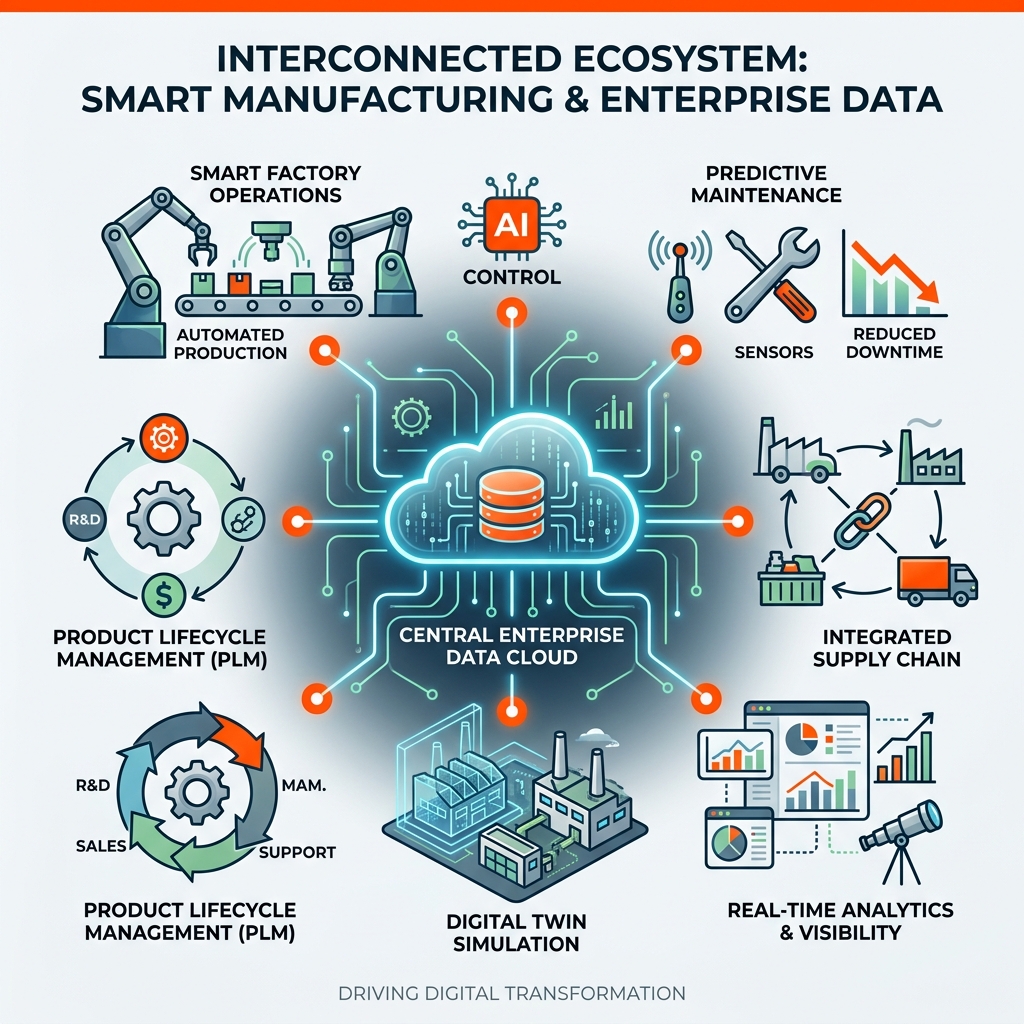
The evolution of industrial autonomy
The journey toward industrial autonomy is accelerating, marked by significant advancements in automation, robotics, and artificial intelligence (AI). What began with simple mechanization has evolved into sophisticated systems capable of performing complex tasks with minimal human intervention. Today’s smart factories are leveraging AI to orchestrate intricate production processes, optimize energy consumption, and ensure product quality at every stage. This shift is not about replacing humans but augmenting their capabilities, allowing them to focus on higher-value tasks, innovation, and strategic decision-making. The future of manufacturing is increasingly defined by AI-powered factories, where machines learn, adapt, and even self-correct, leading to unprecedented levels of efficiency and output. Real-time monitoring systems, powered by advanced sensors and data analytics, provide continuous visibility into operations, enabling proactive adjustments and preventing costly disruptions. This evolution towards greater autonomy is a cornerstone of modern enterprise technology and industrial equipment strategies, promising a more resilient and responsive industrial future. We believe that understanding and investing in the AI-powered factory of the future is paramount for manufacturers seeking to lead their industries.
Core technologies transforming the manufacturing landscape
The industrial sector is experiencing a technological renaissance, driven by a suite of core enterprise technologies that are fundamentally reshaping manufacturing processes and operations. These innovations are enabling a transition from reactive to proactive, from isolated to interconnected, and from rigid to adaptive systems.

The Industrial Internet of Things (IIoT) stands at the forefront, connecting machines, sensors, and control systems across the factory floor and beyond. This vast network generates an enormous volume of data, which, when analyzed, unlocks powerful insights for optimization. Complementing IIoT are technologies like predictive maintenance and digital twins. The predictive maintenance market, for instance, is expected to grow substantially in the coming years, enabling manufacturers to shift from scheduled or reactive maintenance to proactive interventions based on real-time equipment health data. This approach significantly reduces downtime and extends asset lifespan.
Digital twins take this a step further by creating virtual replicas of physical assets, processes, or even entire factories. These digital models enable real-time monitoring, simulation, and optimization, allowing engineers to test scenarios, predict outcomes, and identify potential issues before they manifest in the physical world. The digital twin market is also projected to expand rapidly, underscoring its growing importance in optimizing complex industrial systems.
Beyond these, advanced manufacturing techniques like 3D printing (additive manufacturing) are revolutionizing prototyping, tooling, and even end-part production. This technology enables the creation of complex geometries, rapid iteration, and on-demand manufacturing, resulting in shorter lead times and customized solutions. From specialized vibratory equipment to advanced material-handling solutions, integrating these technologies with a plant’s physical infrastructure, as offered by leading Carrier industrial equipment technology providers, is creating highly efficient, intelligent production environments. The smart factory solutions market is expected to exceed $320 billion by 2032, highlighting the immense potential and ongoing investment in these transformative technologies.
The role of agentic AI in enterprise technology and industrial equipment
Agentic AI represents a significant leap forward in artificial intelligence, moving beyond mere data analysis to enable autonomous actions and decision-making within industrial environments. Unlike traditional AI that primarily provides insights, agentic AI systems are designed to identify problems, formulate plans, and execute solutions independently, often learning and adapting over time. This capability is revolutionizing various aspects of enterprise technology and industrial equipment operations.
In supply chains, agentic AI can proactively identify and mitigate risks by analyzing global data, predicting disruptions, and autonomously re-routing shipments or sourcing alternative suppliers. For aftermarket services, it can detect component wear on industrial machinery, automatically order replacement parts, and schedule maintenance, transforming customer experience with predictive and proactive support. This level of automation can significantly improve uptime and operational efficiency. Furthermore, the rise of physical AI, where AI systems control robotic and automated equipment directly, is set to expand dramatically. Nearly one-quarter (22%) of manufacturers plan to use physical AI in just two years, a more than twofold increase from today (9%). This indicates a rapid adoption curve for AI that can interact directly with the physical world. Broader manufacturing outlook reports further emphasize the transformative potential of agentic AI across the sector, highlighting its role in boosting competitiveness and agility.
Enhancing performance with software-defined infrastructure
As industrial operations become increasingly data-intensive, the underlying IT infrastructure must evolve to support real-time processing, massive data volumes, and low-latency requirements. This is where software-defined infrastructure, particularly in memory and data fabric, becomes critical. A robust industrial data fabric integrates operational information across disparate systems, providing a unified view for faster, more informed decision-making. This integration is essential for leveraging the full potential of IIoT, AI, and digital twins.
High-performance computing (HPC) is no longer confined to research labs; it’s becoming integral to advanced manufacturing, powering complex simulations, AI models, and real-time analytics. However, the performance of HPC and other data-intensive applications is often bottlenecked by memory limitations and data access speeds. This is where innovations like software-defined enterprise memory offer a transformative solution. By disaggregating memory from compute, software-defined memory (SDM) allows for dynamic allocation and scaling of memory resources, dramatically improving infrastructure scalability and reducing latency. This means applications can access vast pools of memory as needed, eliminating the need for costly, inefficient overprovisioning of server-attached memory. For industrial equipment providers and manufacturers, this translates into faster data processing, more efficient AI model training, and the ability to handle larger, more complex datasets in real time. The result is a more agile, responsive, and powerful infrastructure that can keep pace with the accelerating demands of modern enterprise technology.
Strategic integration of GIS and location intelligence
In the intricate world of industrial operations, location is more than just a coordinate; it’s a critical dimension that influences everything from supply chain efficiency to risk management and strategic planning. The strategic integration of Geographic Information Systems (GIS) and location intelligence has emerged as a powerful enterprise technology and industrial equipment asset, providing unparalleled spatial insights.
GIS enables industrial firms to visualize, analyze, and interpret spatial data, revealing patterns and relationships that would otherwise be invisible. This capability is invaluable for optimizing logistics and supply chains, enabling companies to map out transportation routes, track assets in real time, and identify optimal distribution points. For risk management, GIS can pinpoint areas vulnerable to natural disasters, geopolitical instability, or infrastructure failure, allowing businesses to develop more robust contingency plans. Furthermore, in site selection for new facilities or expansions, location intelligence provides critical data on demographics, labor availability, proximity to suppliers and customers, and environmental factors, ensuring optimal placement. The growing trend of reshoring manufacturing operations, as highlighted in the survey report, further underscores the need for sophisticated site-selection tools. By understanding the spatial context of their operations, industrial companies can make more informed decisions, reduce operational costs, and enhance overall efficiency.
GIS as a keystone enterprise technology and industrial equipment asset
Once considered a niche tool for cartographers and environmental scientists, GIS has evolved into a keystone enterprise technology, indispensable for a wide array of industrial applications. Its widespread adoption is evident in the fact that more than three-quarters of Fortune 500 companies now leverage GIS for critical business functions. This pervasive use demonstrates its transition from a specialized application to an essential component of enterprise-wide business intelligence.
GIS seamlessly integrates with other enterprise systems, such as ERP (Enterprise Resource Planning) and CRM (Customer Relationship Management), enriching existing data with a crucial spatial dimension. This integration allows for a more comprehensive understanding of operations, customer behavior, and market dynamics. For instance, in climate risk assessment, GIS can overlay environmental data with asset locations to identify vulnerabilities to extreme weather events or rising sea levels and inform mitigation strategies. In market analysis, it enables precise trade-area analysis, helping industrial equipment providers understand customer demographics, market potential, and optimal service territories. The insights gained from GIS are not just for high-level strategists; they inform decisions from the executive suite down to field workers, providing context and clarity. As indicated by the NAM manufacturers’ outlook survey, manufacturers are increasingly relying on data-driven insights to navigate complex economic landscapes, and location intelligence is a significant part of that. The ability to visualize and analyze data spatially empowers industrial firms to optimize resource deployment, enhance operational resilience, and uncover new growth opportunities.
Navigating economic policy and federal procurement
For many industrial equipment providers, serving government agencies represents a significant market opportunity. However, navigating the complexities of federal procurement requires a deep understanding of specific contract vehicles and the relevant policy landscape. Federal contracts like GSA (General Services Administration) Schedules, SEWP V (Solutions for Enterprise-Wide Procurement), CHESS ITES-SW2 (Army Computer Hardware, Enterprise Software and Solutions Information Technology Enterprise Solutions – Software 2), and CMAS (California Multiple Award Schedules) play a crucial role in enabling industrial equipment providers to serve government agencies efficiently. These contracts establish long-term, government-wide agreements with commercial firms, providing streamlined access to a wide range of products and services, often with pre-negotiated pricing and terms.
Federal Contract Vehicle Description Key Benefits for Providers GSA (General Services Administration) The GSA establishes long-term government-wide contracts with commercial firms for access to millions of products and services. Streamlined market access, pre-negotiated pricing, and simplified purchasing pathways. SEWP V (Solutions for Enterprise-Wide Procurement) A series of government-wide acquisition contracts (GWACs) for IT products and services, including hardware, software, and related services. Access to federal IT buyers, faster procurement cycles, and broad agency reach. CHESS ITES-SW2 (Army Computer Hardware, Enterprise Software and Solutions Information Technology Enterprise Solutions – Software 2) A contract vehicle specifically for the U.S. Army, providing commercial off-the-shelf (COTS) software products and related services. Direct alignment with Army procurement requirements and easier access to defense-related opportunities. CMAS (California Multiple Award Schedules) A state-level contract program in California, similar to GSA Schedules, providing access to a wide range of commercial products and services for state and local government entities. Expanded access to state and local buyers, reduced contracting friction, and recognized pricing structures.