

Listen to annual reports and build better analyst notes
Sponsored content. This article was supplied by a third party and Business Money has been paid to publish it.

Figure 1. Photo by Nur Nur on Pexels. Used under the Pexels License.
An annual report asks the reader to hold two views of a company at once. The narrative sections explain the business, the year, and management’s priorities. The financial statements show how those ideas appear in revenue, margins, cash flow, investment, and the balance sheet. Moving back and forth between the two can consume a large part of an analyst’s morning.
Listening creates a useful first pass through the narrative. The analyst can hear the company’s story in sequence, collect the claims that matter, and return to the tables with a focused set of questions. To see how this works, consider a concrete assignment: prepare a short note on a manufacturer’s margin direction before a team meeting the next day.
The assignment behind the margin question
The analyst is not trying to absorb every page. The brief is narrower: understand how management describes the change in margin, identify the operating themes behind that description, and collect the figures needed for a one-page internal note.
At the top of a blank document, the analyst writes the question: “What does management say is changing in the margin mix?” Beneath it are three simple areas titled Story, Evidence, and Follow-up. Story will hold management’s framing. Evidence will hold the financial line or table connected to that framing. Follow-up will become the agenda for the next stage of research.
This note creates a destination for the reading. A comment about premium products belongs in Story. The segment margin table belongs in Evidence. A question about whether the mix can continue belongs in Follow-up. The sections stay connected without turning the note into a copy of the report.
Before listening: Draw a route through the report
The contents page supplies the route. For a margin assignment, the analyst marks the chief executive’s letter, the business overview, the operating review, and the relevant financial discussion. These sections describe the company from broad strategy down to operating performance.
Each section receives a short label in the note. “CEO letter — year in one paragraph.” “Business overview — segments and customers.” “Operating review — price, volume, mix, and cost.” “Financial discussion — figures behind the story.” The labels make it easy to resume and give the eventual memo a natural order.
The analyst also opens last year’s note beside the new one. Repeated language becomes visible immediately. A company that previously emphasized volume may now emphasize product mix or efficiency. That shift is worth hearing in full before reducing it to a sentence.
During listening: Capture the company’s own framing
The first audio pass begins with the CEO letter and continues into the business overview. The analyst listens for recurring phrases, named priorities, and the relationship management draws between the market and its decisions. Rather than typing continuously, the analyst adds one sentence to Story at the end of each section.
The operating review gets closer attention. When management connects margin with pricing, product mix, utilization, sourcing, or investment, the analyst saves the section heading and a few exact terms. The purpose is to preserve the shape of the argument: which forces management places first, which ones receive detail, and how the explanation develops from one segment to another.
CastReader’s online PDF text-to-speech workspace keeps the report visible while the narrative is spoken. Highlighted text gives each note a clear location in the document. The analyst can hear a complete passage, add its meaning to story, and leave the precise wording available for the later writing pass.
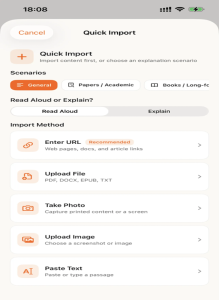
Figure 2. CastReader’s mobile import screen presents document import options for a flexible listening workflow. Source: official CastReader product interface; © CAST AI PTE. LTD. Provided by CastReader for editorial use.
The session has a steady rhythm. The audio carries several paragraphs at a time; a heading creates a natural pause; one useful sentence enters the note. By the end of the operating review, the analyst has a compact account of the margin story rather than a long collection of fragments.
After listening connect the story to the figures
Now the analyst returns to the screen and works through the Evidence area. Each statement from Story receives a financial companion. A discussion of product mix leads to segment revenue and margin. A statement about efficiency leads to operating expenses or productivity commentary. A claim about investment leads to capital expenditure, depreciation, or capacity information.
The annual report’s table titles and page references sit beside the notes, creating a traceable route back to the source. The analyst is no longer scanning hundreds of pages for something interesting; the audio pass has already identified the relationships that deserve attention.
The Follow-up area grows from the gaps between story and evidence. Perhaps one segment carries most of the improvement, or management’s priority has shifted since the previous report. Those observations become focused prompts for an earnings transcript, investor presentation, peer comparison, or tomorrow’s team discussion.
Shape the work note into a clear brief
The final memo can follow the same order as the listening route. Begin with management’s one-sentence account of the year. Name the two or three forces attached to margin. Add the figures that show where those forces appear, then close with the next question the team should explore.
Because the report was heard in sequence, the brief retains the logic of the company’s explanation. Because the evidence was added afterward, the memo also has the precision expected from financial analysis. Listening and screen work play different roles, and the note brings them together.
The same structure can support other assignments. Replace the margin question with customer growth, regional demand, working capital, capital allocation, or a competitor’s investment priorities. Story, Evidence, and Follow-up remain useful, while the route through the report.