

Machine translation post-editing: The smartest translation choice
Sponsored content. This article was supplied by a third party and Business Money has been paid to publish it.
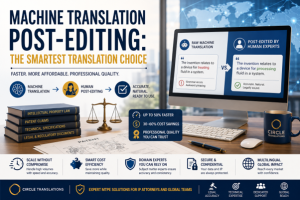 Why machine translation post-editing is the smarter path to scalable, high-quality translation
So, you’re staring down a mountain of content that needs translating. Maybe it’s a product catalog with thousands of SKUs, a legal document full of dense terminology, or a marketing campaign that needs to go live in five different languages by Friday. You’ve got two obvious options on the table: use a machine translation (MT) tool and hope for the best, or hire a team of human translators and burn through your budget and your timeline. But what if neither extreme is actually the right answer?
That’s where machine translation post-editing (MTPE) comes in – and if you haven’t already made it a core part of your localization strategy, you’re leaving serious value on the table.
What exactly is machine translation post-editing?
Let’s start with the basics. Machine translation post-editing is exactly what it sounds like: you run your content through a machine translation engine (think Google Translate, DeepL, or a proprietary MT system), and then a professional human translator steps in to review, correct, and refine the output. The result? A translation that’s faster than full human translation and far more accurate than raw MT output.
Think of it like autocorrect on steroids. Your phone’s autocorrect catches obvious typos, but it still needs you to proofread before you send that email to your boss. MTPE works on the same principle – machines do the heavy lifting, humans add the intelligence.
The two flavors of post-editing
Not all post-editing is created equal. There are two main approaches:
Light post-editing (LPE): The editor focuses only on making the translation accurate enough to understand. Fluency and stylistic polish take a back seat. This is ideal for internal documents, technical manuals, or anything where the goal is information transfer, not persuasion.
Full post-editing (FPE): The translator gives the text a thorough review, fixing not just errors but also improving style, tone, and readability until the translation reads as naturally as if it had been written by a human from scratch. This is what you’d want for marketing copy, customer-facing content, or anything with your brand’s voice on the line.
The problem with relying purely on machine translation
Raw machine translation has come a long way. Anyone who used Google Translate back in 2008 and compares it to what the tools do today will tell you – it’s a completely different beast. Modern neural machine translation (NMT) engines are genuinely impressive. But here’s the thing: impressive isn’t the same as reliable.
Where MT falls short
Machines don’t understand context the way humans do. They don’t pick up on cultural nuance, industry-specific jargon, humor, idiom, or the subtle tone shifts that make copy feel human. A sentence that reads perfectly grammatically correct can still be completely wrong in context.
Imagine your MT engine translating a legal clause and subtly shifting the meaning of a liability statement. Or picture a marketing slogan that gets translated word-for-word and ends up being accidentally offensive in the target culture. These aren’t hypothetical horror stories – they happen all the time to businesses that skip the human review step.
The bottom line is that raw MT output is a first draft, not a finished product. And nobody publishes a first draft.
The problem with relying purely on full human translation
On the flip side, full human translation is the gold standard – but it comes with real constraints. It’s time-intensive, it’s expensive, and when you’re dealing with high-volume content, it simply doesn’t scale.
The speed and cost reality
A professional human translator typically translates somewhere between 1,500 and 2,500 words per day. If you’ve got 100,000 words of e-commerce product descriptions that need to go live in six languages simultaneously, that math gets painful very quickly. The costs stack up just as fast.
Does that mean full human translation is obsolete? Absolutely not. For high-stakes content – legal contracts, medical documentation, literary works, flagship marketing campaigns – you still want a human at the wheel from start to finish. But for the vast middle ground of business content? There’s a smarter way.
Why MTPE is the smart middle ground
Here’s where it gets interesting. Machine translation post-editing doesn’t just split the difference between MT and human translation – it actually captures the best of both worlds.
Speed without sacrificing accuracy
When a post-editor works with MT output rather than translating from scratch, they can work significantly faster. Studies across the translation industry have consistently shown that post-editors can process roughly 30 to 50 percent more words per hour compared to full human translation. That speed advantage compounds massively on large projects.
For context, that could mean the difference between a two-week turnaround and a one-week turnaround on a major product launch. In competitive markets, that week matters.
Cost efficiency that actually makes sense
Because post-editors work faster, they charge less per word than they would for full translation. The MT engine handles the initial rendering for pennies on the dollar, and the human editor focuses their expertise where it’s needed most – on judgment calls, corrections, and refinements. For businesses managing large volumes of multilingual content, the cost savings can be dramatic.
A real-world cost comparison
To put it in concrete terms: full human translation might cost $0.10 to $0.25 per word depending on the language pair and subject matter. Light post-editing of MT output might come in at $0.03 to $0.08 per word. On a 50,000-word project, that’s potentially a difference of thousands of dollars – without a significant drop in quality when the MT engine and post-editing workflow are properly set up.
Quality that meets professional standards
Here’s the part that surprises a lot of people. When MTPE is done correctly – with a good MT engine trained on relevant domain content and a skilled post-editor who knows the subject matter – the output quality is genuinely comparable to full human translation for most content types. Several independent studies have found that readers often can’t reliably distinguish between well-executed MTPE and full human translation.
That’s not a knock on human translators. It’s a testament to how effective the combination of machine efficiency and human expertise can be.
How Circle Translations approaches MTPE
At Circle Translations, MTPE isn’t just a service offering – it’s a carefully engineered workflow designed to maximize both quality and efficiency. The team at Circle Translations understands that the technology is only as good as the human expertise behind it, which is why every MTPE project is matched with post-editors who have domain-specific knowledge relevant to the content.
The Circle Translations MTPE process
Circle Translations starts every MTPE engagement by evaluating the source content and selecting the most appropriate MT engine for the language pair and subject matter. Not all MT engines perform equally well across all domains – a system trained heavily on legal texts will outperform a general-purpose engine when translating contracts, for instance.
From there, the MT output goes to experienced post-editors who are native speakers of the target language. They work through the content systematically, applying either light or full post-editing depending on the content type and the client’s quality requirements. The result goes through a quality assurance review before delivery.
Why domain expertise matters in post-editing
One of the most common mistakes businesses make when implementing MTPE is treating all post-editors as interchangeable. They’re not. A post-editor reviewing financial translation output needs to understand financial terminology. A post-editor working on pharmaceutical content needs a firm grasp of medical and regulatory language. Circle Translations maintains a network of specialized post-editors across dozens of industries precisely because subject matter expertise is what separates acceptable MTPE from excellent MTPE.
Technology and human expertise working together
The team at Circle Translations also leverages translation memory and terminology management tools alongside MT engines. This means that consistent terminology is maintained across projects, repeat content is handled efficiently, and the MT output that post-editors receive is already improved by company-specific glossaries and style guides. It’s a layered approach to quality that treats MTPE as a system, not just a shortcut.
When should you choose MTPE over full human translation?
MTPE is powerful, but it’s not the right fit for every project. Here’s a practical framework for deciding.
MTPE is the right call when:
You’re dealing with high-volume content that needs to move quickly. You have structured, relatively formulaic content like product descriptions, FAQs, user manuals, or internal reports. Your budget is constrained but your quality requirements are still professional-grade. You’re publishing in multiple languages simultaneously and speed to market is a competitive advantage.
Stick with full human translation when:
Your content is highly creative, emotionally resonant, or heavily reliant on cultural nuance – think brand storytelling, advertising copy, poetry, or literature. The stakes for errors are extremely high, such as in legal or medical contexts where a mistranslation could have serious consequences. The source content is poorly structured, ambiguous, or so domain-specific that MT output would require more work to fix than a fresh human translation would take.
The future of MTPE: Where is this heading?
Machine translation technology is not standing still. The gap between raw MT output and human translation quality is narrowing every year, which means the role of the post-editor is evolving. The best post-editors are increasingly becoming what the industry calls “language engineers” – professionals who understand both linguistics and the technology well enough to configure, train, and optimize MT systems, not just correct their output.
AI and human collaboration is the new standard
The most forward-thinking translation agencies aren’t debating whether to use AI or humans. They’re figuring out the smartest way to deploy both. MTPE is the practical, proven expression of that thinking right now. As MT engines continue to improve and as the tools for managing MTPE workflows become more sophisticated, this approach will only become more central to how professional translation gets done.
Making MTPE work for your business
If you’re ready to explore MTPE as part of your localization strategy, the first step is an honest assessment of your content types, volumes, and quality requirements. Not every piece of content warrants the same treatment, and a smart MTPE strategy involves segmenting your content by type and routing it to the appropriate workflow.
Partnering with an experienced provider like Circle Translations makes this process significantly smoother. The team can help you evaluate your MT engine options, establish quality benchmarks, build out terminology management systems, and design a post-editing workflow that scales with your business needs.
Conclusion
Machine translation post-editing isn’t a compromise – it’s a strategy. It’s the recognition that in a world where content volumes are massive, timelines are short, and language pairs are multiplying, the smartest approach is to let machines do what machines do best and let humans do what humans do best. When those two capabilities are properly integrated and managed, the result is translation that’s faster, more affordable, and genuinely professional in quality.
Whether you’re a global enterprise managing millions of words of multilingual content or a growing business just starting to think seriously about localization, MTPE deserves a central place in your translation strategy. And with a partner like Circle Translations guiding the process, you can be confident that speed and quality aren’t mutually exclusive – they’re exactly what you get when you find the smart middle ground.
Frequently asked questions (FAQs)
- Is machine translation post-editing suitable for all types of content? MTPE works best for structured, high-volume content like product descriptions, technical manuals, and FAQs; highly creative or legally sensitive content typically benefits more from full human translation.
- How much can businesses save with MTPE compared to full human translation? Depending on the language pair and content type, businesses typically save between 30 and 60 percent on translation costs when using MTPE instead of full human translation.
- How does Circle Translations ensure quality in MTPE projects? Circle Translations matches every project with domain-specific post-editors, uses terminology management tools, and conducts a final quality assurance review before delivery.
- What is the difference between light and full post-editing? Light post-editing corrects only critical errors for basic comprehension, while full post-editing refines the translation for fluency, tone, and stylistic quality comparable to human translation.
- Will machine translation eventually replace human translators entirely? No – while MT is rapidly improving, human expertise remains essential for quality control, cultural nuance, and creative judgment, making collaboration between humans and machines the sustainable long-term model.