

Top commercial real estate investment guide 2026
Sponsored content. This article was supplied by a third party and Business Money has been paid to publish it.
Navigating commercial real estate: Flexible spaces and financing solutions
Property types and emerging market trends
 Commercial real estate touches our lives every day. From our local coffee shops to the offices where we work, these properties are vital. Investing in commercial real estate offers many unique benefits. It can provide steady income, asset growth, and portfolio diversity.
In this guide, we will explore commercial real estate investment. We will cover the different types of properties, from large office buildings to specialized options like commercial real estate storage Hoover. We will also discuss various investment strategies.
You will learn about financing solutions and how to manage your investments for success. Our goal is to equip you with the knowledge to navigate this complex market.

Photo by Craftsman Concrete Floors
Understanding the diverse landscape of commercial real estate (CRE) is the first step for any aspiring investor. Unlike residential properties, which primarily serve as homes, CRE is designed for business activities, generating income through leases from commercial tenants. This fundamental difference shapes everything from valuation to financing and management.
Commercial vs. residential: Key distinctions: While both involve real estate, the investment dynamics of commercial and residential properties diverge significantly. Residential real estate typically involves shorter lease terms (e.g., one year), focuses on individual tenants, and is often valued based on comparable sales in the area. Commercial real estate, on the other hand, frequently features longer lease agreements (3-20+ years), caters to businesses, and is primarily valued based on its income-generating potential. This means commercial properties often provide more stable and predictable cash flows over extended periods.
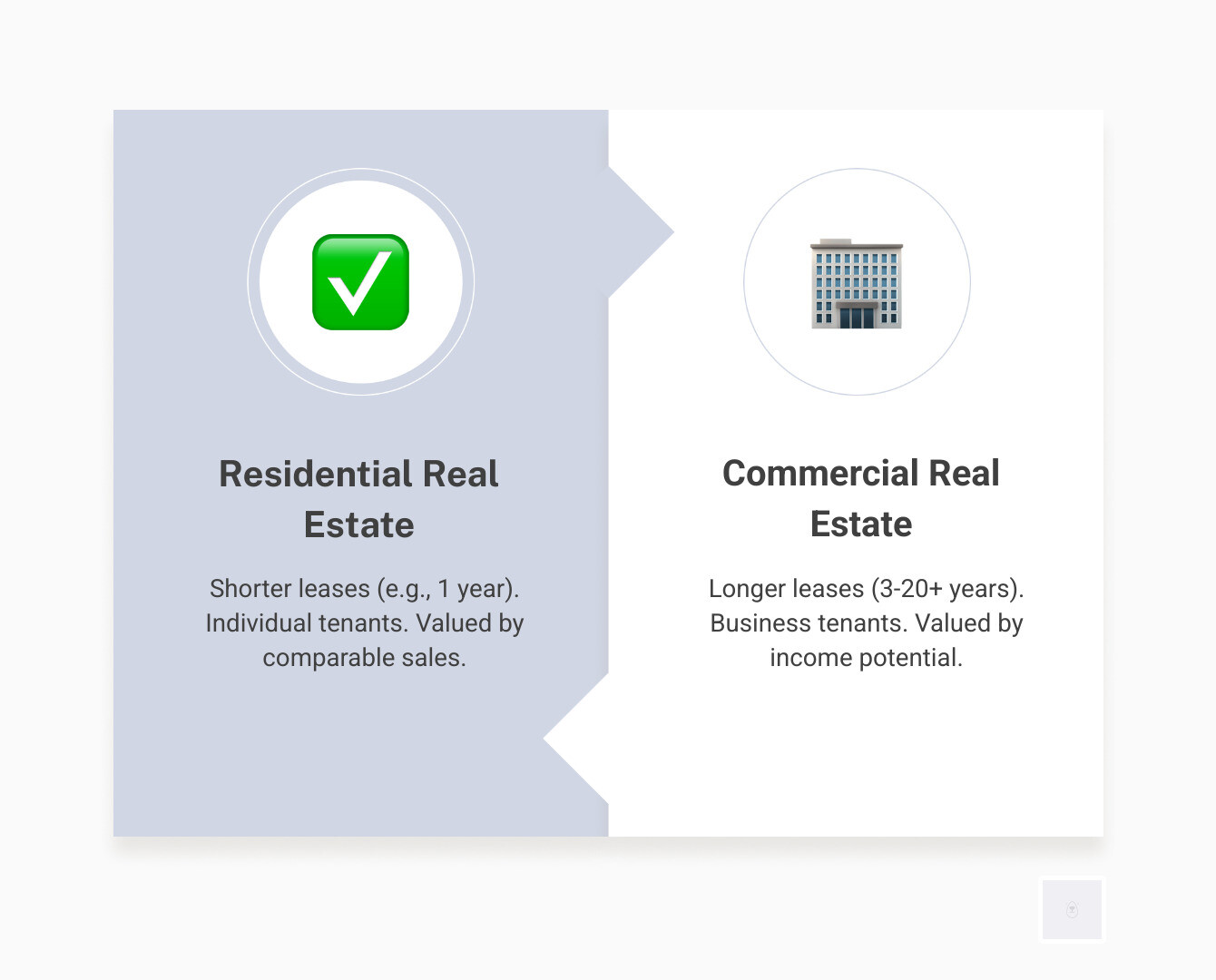
Main types of commercial real estate properties: The CRE market is segmented into several primary property types, each with its own characteristics, risks, and benefits:
- Office: These properties range from single-tenant buildings to large multi-story complexes. They are categorized into Class A (prime locations, modern amenities), Class B (well-maintained but older, good locations), and Class C (older, often in less desirable locations, requiring significant renovation). The office market has seen significant shifts recently, with increased demand for flexible workspaces and amenities that support hybrid work models.
- Retail: This category includes shopping centers, strip malls, freestanding stores, and urban retail spaces. Success in retail CRE is heavily dependent on location, foot traffic, tenant mix, and economic conditions that drive consumer spending.
- Industrial: Encompassing warehouses, distribution centers, manufacturing facilities, and flex spaces, industrial properties have experienced booming demand, largely driven by the growth of e-commerce and logistics. These properties are critical for supply chains and often feature large footprints, high clear heights, and robust loading docks. For those seeking specific opportunities, exploring options like industrial properties in Huntsville AL Commercial Property for Sale Guide can be beneficial.
- Multifamily: While often considered a hybrid, multifamily properties (apartment buildings with five or more units) are classified as commercial because they generate income from multiple tenants. They are generally seen as resilient investments, providing stable cash flow and often appreciating in value in growing urban and suburban areas.
- Special purpose: This broad category includes properties designed for specific uses, such as hotels, medical facilities, self-storage units, data centers, and educational institutions. These often require specialized management and have unique market drivers.
Emerging market trends and flexible spaces: The commercial real estate landscape is constantly evolving. Beyond traditional categories, “flex space” is gaining prominence. These properties combine elements of office, warehouse, showroom, and storage, offering businesses versatile and adaptable solutions. This adaptability is particularly appealing to startups, small businesses, and those seeking scalability without long-term commitments.
Local markets, such as those in Alabama, present distinct opportunities. For example, investors might find value in various commercial properties available in Auburn, AL Commercial Real Estate Properties for Sale | LoopNet, or explore listings in Opelika, AL Commercial Real Estate for Sale and Lease. Similarly, dynamic areas like Irondale offer diverse options, from properties listed on Irondale, AL Commercial Real Estate Properties for Sale | LoopNet to those available for lease and sale in Irondale, AL Commercial Real Estate for Lease and Sale. For a broader perspective on the state’s commercial landscape, resources like the Commercial Real Estate Birmingham Complete Guide and the Commercial Property Birmingham Ultimate Guide offer valuable insights. Additionally, those interested in the Huntsville market can find comprehensive information in the Commercial Property Huntsville guide.
Property classifications and risk profiles: Understanding property classifications (Class A, B, C) is crucial as they directly correlate with risk and return expectations.
- Class A properties are top-tier, newer, well-located, and command the highest rents. They offer stable income but often lower capitalization rates (cap rates) due to their perceived lower risk.
- Class B properties are older but still well-maintained, offering a balance of income and potential for value-add improvements. They typically have moderate risk and higher cap rates than Class A.
- Class C properties are older, often in less desirable locations, and may require significant capital expenditure. They carry higher risk but offer the potential for substantial returns if successfully redeveloped or repositioned.
Property Class Description Risk Profile Typical Returns Class A Newest, best locations, premium amenities Low Stable, moderate Class B Older but well-maintained, good locations Medium Moderate to good Class C Older, less desirable locations, needs upgrades High High potential, volatile Strategic Commercial Real Estate Investment: Benefits and Risks
Investing in commercial real estate can be a powerful wealth-building tool, but it requires a clear understanding of both its advantages and inherent risks. Developing an effective investment strategy involves aligning your financial goals with appropriate risk tolerance and market opportunities.
Key benefits of commercial real estate investment
- Consistent cash flow: Many CRE properties, particularly those with long-term leases to creditworthy tenants, provide steady rental income. This can be a significant source of passive income for investors.
- Appreciation potential: Over time, commercial properties can appreciate in value due to market demand, inflation, and strategic improvements. This capital appreciation contributes to overall investment returns.
- Portfolio diversification: Adding commercial real estate to a diversified investment portfolio can help reduce overall risk. Its performance often correlates differently with traditional assets like stocks and bonds, providing a hedge against market volatility.
- Inflation hedge: Real estate values and rents tend to increase with inflation, making CRE a strong hedge against the eroding purchasing power of currency.
- Tax advantages: Investors can benefit from various tax deductions, including depreciation, mortgage interest, and property taxes, which can significantly reduce taxable income.
- Tangible asset: Unlike stocks or bonds, commercial real estate is a physical asset that you can see, touch, and improve. This tangibility offers a sense of security and control.
Primary commercial real estate investment strategies: Investors typically employ various strategies based on their risk appetite, return expectations, and market conditions:
- Core: This strategy focuses on acquiring high-quality, fully leased properties in prime locations with stable tenants. The goal is predictable, long-term income with minimal risk. Returns are generally lower but more consistent.
- Core-plus: Builds on the core strategy by targeting properties that require minor improvements or have slightly shorter lease terms. This offers a balance of stable income with the potential for moderate capital appreciation through proactive management or light renovations.
- Value-add: Involves purchasing properties that are underperforming, under-managed, or require significant renovations. The investor’s goal is to increase the property’s value through strategic improvements, aggressive leasing, or operational efficiencies. This strategy carries higher risk but offers the potential for greater returns. Companies like BrightBridge real estate investment specialize in providing capital solutions that can support these types of value-add projects, offering tailored financing to unlock a property’s full potential.
- Opportunistic: This is the highest-risk, highest-reward strategy. It involves investing in distressed assets, ground-up developments, or highly complex projects in emerging markets. These investments often require substantial capital, extensive expertise, and a longer time horizon, but can yield superior returns if successful. The PILLAR Fund, for instance, exemplifies an opportunistic approach by targeting distressed office properties to capitalize on market resets, as detailed on The PILLAR Fund | Redefining Commercial Property Investment.
Risks of investing in commercial real estate: While attractive, CRE investment is not without its risks:
- Market volatility: Economic downturns, changes in interest rates, or shifts in local demographics can negatively impact property values and rental income.
- Tenant risk: Vacancies, tenant defaults, or the inability to find new tenants can significantly reduce cash flow and property value.
- Illiquidity: Commercial real estate is not as easily bought or sold as stocks or bonds. Transactions can take months, making it difficult to access capital quickly.
- High capital requirements: Direct ownership often requires substantial down payments and ongoing capital for maintenance, repairs, and property management.
- Legal and regulatory risks: Zoning changes, environmental regulations, and landlord-tenant laws can impact property operations and profitability.
Common pitfalls and risk mitigation: Beginners often fall into traps such as underestimating operating costs, failing to conduct thorough due diligence, or investing without a clear strategy. To mitigate these risks:
- Thorough due diligence: Always conduct comprehensive physical inspections, financial audits, and market analyses.
- Diversification: Spread your investments across different property types, locations, and investment vehicles (e.g., direct ownership, REITs, funds).
- Professional guidance: Work with experienced brokers, attorneys, and property managers. Local experts, such as those at Crunkleton Commercial Real Estate Group – Huntsville or Triad Properties: Home, can provide invaluable market insights.
- Financial reserves: Maintain adequate cash reserves to cover unexpected expenses, vacancies, or market downturns.
- Understand your market: Research local economic indicators, population growth, and employment trends. For instance, those looking at opportunities in Hoover, AL, can find listings on Hoover Commercial Real Estate Properties for Sale – LoopNet or explore options on Hoover, AL Commercial Real Estate for Lease and Sale.
Financing solutions and capital structures
Securing the right financing is a cornerstone of successful commercial real estate investment. Unlike residential mortgages, commercial loans are often more complex, requiring a deeper understanding of various options and their implications.
Financing solutions for commercial real Estate investment
- Senior mortgages: These are the most common type of commercial real estate financing. They are secured by the property itself and typically have the lowest interest rates because they are the first to be repaid in case of default. Loan-to-value (LTV) ratios for senior mortgages usually range up to 70-75%.
- Mezzanine loans: These are subordinate to senior mortgages but senior to equity. Mezzanine loans are unsecured by the property directly but are secured by the equity interests in the borrowing entity. They carry higher interest rates due to their higher risk profile and are often used to fill a gap between the senior mortgage and the borrower’s equity.
- Bridge loans: Short-term financing (typically 6 months to 3 years) used to “bridge” a gap until more permanent financing can be arranged or a property can be sold or stabilized. Bridge loans are often used for value-add or opportunistic projects.
- SBA loans: The Small Business Administration (SBA) offers programs like the SBA 504 loan, which can provide long-term, fixed-rate financing for owner-occupied commercial properties. These loans often require lower down payments than conventional commercial mortgages.
- Conventional mortgages: Offered by traditional banks and credit unions, these loans are tailored for commercial properties. They typically require a down payment of 20-30% or more, and lenders scrutinize both the borrower’s financial health and the property’s income-generating potential.
- Debt coverage ratio (DCR): Lenders heavily rely on the DCR, which compares a property’s net operating income (NOI) to its annual debt service. A DCR of 1.25 or higher is generally preferred, indicating the property generates enough income to comfortably cover its mortgage payments.
- Equity requirements: Beyond the loan, investors must contribute their own capital, known as equity. This can come from personal savings, partnerships, or other investment vehicles.
For businesses looking for flexible leasing options rather than outright purchase, understanding the nuances of commercial leases is vital. Resources like Commercial Leasing Near Me and the Commercial Leasing Space Complete Guide can help navigate these options.
Capital structures and investment vehicles: The way capital is structured for a commercial real estate deal can vary widely:
- Private equity funds: These funds pool capital from accredited investors to acquire and manage a portfolio of commercial properties, often focusing on value-add or opportunistic strategies.
- Crowdfunding: Online platforms allow multiple investors to contribute smaller amounts of capital to specific CRE projects, making direct investment more accessible.
- REITs (real estate investment trusts): REITs are companies that own, operate, or finance income-producing real estate. They are publicly traded, offering investors a way to invest in large-scale commercial properties without direct ownership. REITs are legally required to distribute at least 90% of their taxable income to shareholders annually, typically as dividends. Companies like Homepage | Realty Income are well-known for providing consistent monthly dividends by investing in a diversified portfolio of net-leased properties. Similarly, Home Page – Broadstone operates as an established net lease REIT with a diversified strategy focused on single-tenant commercial properties.
- Commercial real estate ETFs: Exchange-traded funds (ETFs) that invest in commercial real estate can offer diversification and liquidity. For instance, the commercial real estate ETF provides exposure to commercial real estate debt investments, such as commercial mortgage-backed securities (CMBS), offering a different risk-return profile than equity-focused REITs.
Lower-risk entry points for beginners: For those new to commercial real estate, direct ownership can be capital-intensive and complex. Lower-risk entry points include:
- REITs: As mentioned, these provide liquidity, diversification across various property types and geographies, and professional management. They allow investors to earn passive income through dividends without the responsibilities of property management.
- Private equity funds (as limited partners): While still requiring significant capital, investing as a limited partner in a well-managed private equity fund allows you to benefit from the expertise of experienced sponsors without active involvement.
- Crowdfunding platforms: These platforms have democratized access to CRE, allowing individuals to invest in specific projects with smaller capital commitments, though due diligence on the platform and project is still crucial.
These options provide a pathway to participate in the commercial real estate market, offering varying degrees of risk, liquidity, and management involvement.
Executing the transaction: From identification to management
Successfully navigating a commercial real estate transaction requires a structured approach, from identifying promising opportunities to meticulous due diligence and ongoing portfolio management. This process involves a team of professionals and a deep understanding of market dynamics.
Identifying profitable commercial real estate investment opportunities: The hunt for profitable opportunities begins with thorough market research and property analysis. We look for properties that align with our investment strategy, whether it’s core, value-add, or opportunistic.
- Market research: This involves analyzing local economic indicators, population growth, employment trends, and supply-demand dynamics for specific property types. For example, a growing tech sector might signal demand for office or industrial space, while a rising population could indicate a need for multifamily properties.
- Property analysis: Once a market is identified, we delve into specific properties. Key financial metrics are crucial here:
- Cap rates (capitalization rates): Calculated by dividing net operating income (NOI) by the property’s purchase price. A higher cap rate generally indicates a higher potential return but also potentially higher risk. It helps compare the relative value of similar properties.
- NOI (net operating income): The property’s income after deducting all operating expenses (excluding mortgage payments and income taxes). It’s a key measure of a property’s profitability.
- GRM (Gross rent multiplier): A simpler metric, calculated by dividing the property’s price by its annual gross rental income. Useful for quick comparisons but less comprehensive than cap rate.
- Cash-on-cash return: Measures the annual pre-tax cash flow against the total cash invested. It indicates the actual return on the cash equity put into a deal.
- Location factors: Beyond financial metrics, qualitative factors are vital. Walkability scores and transit scores indicate a property’s accessibility and desirability, especially for retail, office, and multifamily assets. Properties with high scores often command higher rents and experience lower vacancy rates.
- Professional networks: Leveraging relationships with brokers, developers, and other investors can provide access to off-market deals and valuable insights. For comprehensive services in identifying and evaluating properties, platforms like Commercial real estate investment properties | CBRE offer extensive resources and deal flow.
Executing a commercial real estate transaction: The transaction process is multi-faceted and requires expert guidance.
- Brokers: Commercial real estate brokers play a pivotal role in identifying opportunities, marketing properties, and facilitating negotiations. They bring market knowledge and a network of contacts.
- Attorneys: Legal counsel is essential for drafting and reviewing purchase agreements, lease contracts, and ensuring compliance with all local, state, and federal regulations.
- Property managers: For investors not looking for hands-on management, property managers handle day-to-day operations, tenant relations, maintenance, and rent collection. For specific local insights, resources like Commercial Real Estate Hoover AL or the Commercial Lease Huntsville AL Guide can be invaluable. For those seeking industrial spaces, a Commercial Warehouse for Lease guide can offer tailored advice.
Due diligence and portfolio management: Once an opportunity is identified and an offer is made, the due diligence phase begins. This is a critical period where the investor thoroughly investigates the property to confirm all representations and uncover any potential issues.
- Physical inspections: Thorough inspections by qualified professionals assess the structural integrity, mechanical systems (HVAC, plumbing, electrical), roof, and overall condition of the property.
- Financial Audits: Reviewing historical financial statements, rent rolls, operating expenses, and lease agreements to verify income and expense projections.
- Title searches: Ensuring clear title to the property, free from any liens, encumbrances, or disputes.
- Environmental assessments: Phase I and sometimes Phase II environmental site assessments are conducted to identify potential environmental contamination risks.
- Lease management: For multi-tenant properties, meticulous review of all existing leases is crucial, including terms, renewal options, rent escalations, and tenant responsibilities.
- Capital improvements: Planning and executing strategic upgrades or renovations to enhance property value and tenant appeal.
- Ongoing management: Effective portfolio management involves continuous monitoring of market trends, proactive tenant relations, regular maintenance, and strategic financial planning to maximize returns. For a broader understanding of leasing considerations, the Commercial Spaces Lease Guide 2025 offers forward-looking advice.
By meticulously executing each step, investors can mitigate risks and position their commercial real estate portfolio for long-term success.
Why MicroFlex is the optimal solution for modern business needs
In today’s dynamic business environment, flexibility and adaptability are paramount. This is where MicroFlex stands out as an optimal solution, particularly for small to medium-sized businesses and those seeking agile commercial spaces. Our approach is built around understanding the evolving needs of modern enterprises, offering solutions that traditional commercial real estate often overlooks.
We specialize in providing flexible terms, which is a significant advantage for businesses that need to scale rapidly or navigate uncertain market conditions. Unlike rigid, long-term leases that can tie businesses down, our flexible options empower tenants with greater control over their operational costs and growth trajectory.
Our focus is squarely on the small business community. We understand the unique challenges and opportunities faced by entrepreneurs and growing companies. This dedication means we design our spaces and services to cater specifically to their requirements, fostering an environment where they can thrive without the burden of excessive overhead or unsuitable facilities.
Scalability is a core tenet of the MicroFlex offering. Whether a business needs to expand its footprint as it grows or downsize during leaner periods, our multi-function warehouses and studio spaces are designed to accommodate these shifts seamlessly. This inherent scalability minimizes disruption and ensures that our clients always have the right amount of space for their current needs.
We are deeply rooted in the communities we serve, particularly across Alabama. Our strategically located properties in areas like Irondale, Birmingham-Irondale, Hoover, Birmingham-Hoover, Auburn, Huntsville, and Madison are chosen for their accessibility, local amenities, and potential for community growth. This local presence allows us to provide tailored solutions and responsive support to our tenants.
Our multi-function warehouses and studio spaces are prime examples of our commitment to versatility. These are not just empty shells; they are thoughtfully designed environments that can serve a multitude of purposes—from light manufacturing and storage to creative studios and professional offices. This adaptability makes them ideal for a wide range of industries and business models. We pride ourselves on cultivating a professional environment within all our locations, ensuring that businesses can operate efficiently and present a polished image to their clients. This commitment extends to fostering a sense of community among our tenants, encouraging collaboration and mutual support.
By focusing on these key aspects, MicroFlex provides more than just commercial space; we offer a strategic advantage for businesses looking for efficiency, flexibility, and a supportive ecosystem in Alabama.
Frequently asked questions
What is the typical down payment for a commercial property?
The typical down payment for a commercial property varies significantly based on the lender, the property type, and the borrower’s financial strength. Generally, lenders require a down payment in the range of 20% to 30% of the property’s purchase price. For example, a $1 million commercial property might require an equity injection of $200,000 to $300,000. Some specialized loans, like SBA programs for owner-occupied properties, may allow for lower down payments, but these often come with additional qualifications and stricter documentation requirements.
How does commercial real estate differ from residential investing?
Commercial real estate (CRE) investing differs from residential investing in several key ways. Firstly, lease lengths are typically much longer in CRE, often ranging from 3 to 20+ years, compared to the standard one-year residential lease. This provides more stable and predictable income streams. Secondly, tenant types are businesses in CRE, meaning their financial health and business performance directly impact the investment, unlike individual tenants in residential. Thirdly, valuation methods for CRE primarily focus on the property’s income-generating potential (e.g., using cap rates and NOI), whereas residential properties are often valued using comparable sales. Lastly, CRE investments are generally treated as business ventures, with more complex financing, legal, and tax considerations.
What are the most profitable types of commercial properties?
While profitability can fluctuate with market cycles and location, multifamily properties and industrial real estate are often cited as among the most profitable types of commercial properties. Multifamily assets tend to be resilient, providing consistent cash flow even during economic downturns due to ongoing housing demand. Industrial real estate, encompassing warehouses and distribution centers, has seen immense growth driven by the surge in e-commerce and the need for efficient logistics hubs. These properties benefit from low capital expenditure requirements and strong tenant demand, making them attractive for investors seeking stable returns. Other profitable sectors can include specialized properties like self-storage or data centers, depending on specific market dynamics.
Conclusion
The world of commercial real estate investment is rich with opportunity, offering avenues for wealth creation, portfolio diversification, and long-term financial stability. From understanding the nuances of different property types and investment strategies to navigating complex financing options, a strategic and informed approach is paramount.
We’ve explored how a clear investment strategy, whether core, core-plus, value-add, or opportunistic, can align with your risk tolerance and financial goals. We’ve also highlighted the critical role of robust due diligence, professional guidance, and proactive portfolio management in mitigating risks and maximizing returns. The rise of flexible spaces and varied financing solutions, including REITs and private equity funds, further democratizes access to this asset class, offering pathways for beginners and seasoned investors alike.
Success in commercial real estate hinges on strategic planning, setting realistic long-term goals, and building a strong network of professionals. By staying attuned to market trends and continually educating ourselves, we can confidently navigate this dynamic landscape, ensuring market resilience and fostering sustained growth for our investments.