

Top express shipping to Europe guide 2026
Sponsored content. This article was supplied by a third party and Business Money has been paid to publish it.
Navigating global logistics: Efficient international shipping solutions
Introduction
 In today’s interconnected world, sending goods from North America to Europe is common, yet it often raises complex questions. For businesses and individuals alike, speed and reliability are paramount when shipping internationally. We know that getting your packages across the Atlantic efficiently can be the difference between success and delay.
This extensive guide aims to simplify the landscape of express shipping to Europe. We will explore the fastest delivery options, compare services, and walk you through crucial steps such as customs and packaging. Our goal is to provide you with a clear roadmap for efficient international shipping, ensuring your items reach their European destinations swiftly and securely.
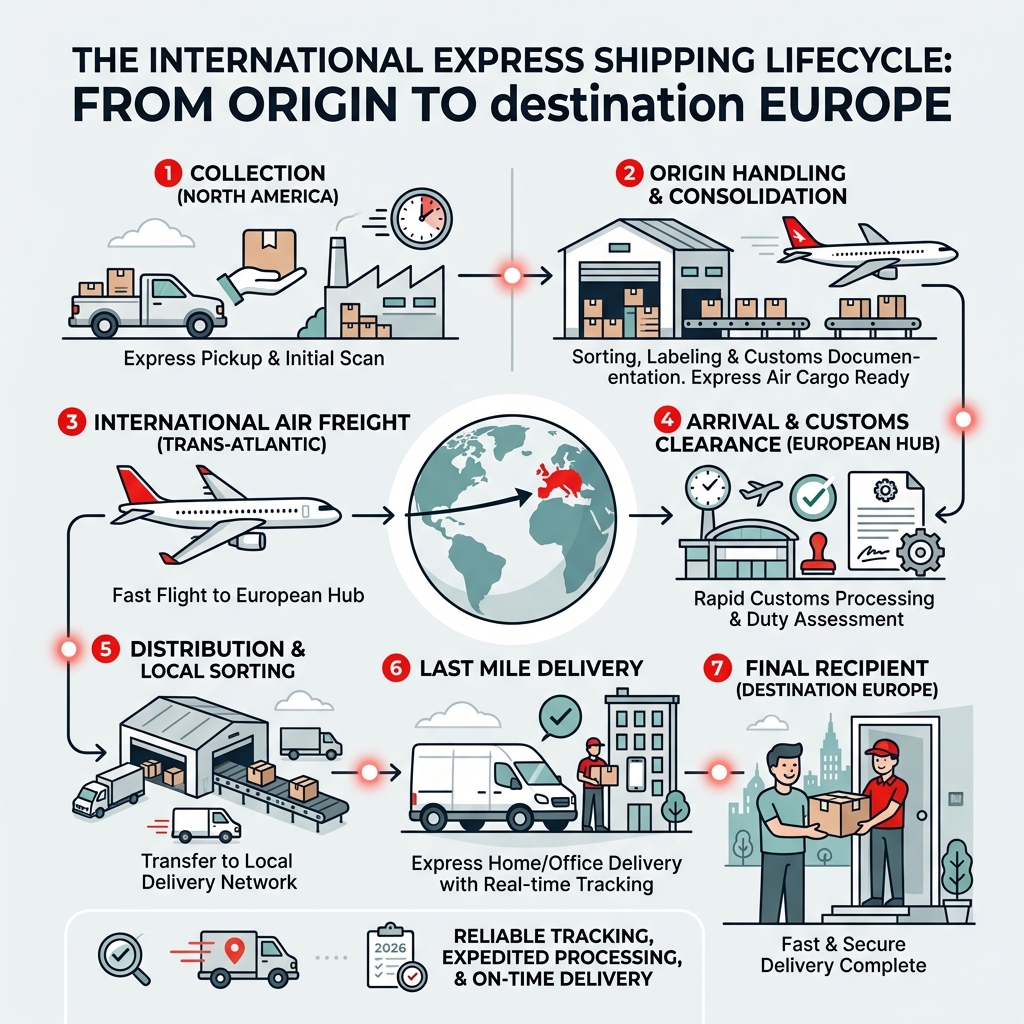
Core components of international shipping logistics
International shipping logistics encompasses a comprehensive network of services that seamlessly move goods across borders. It involves more than just putting a package on a plane or ship; it’s about orchestrating a complex supply chain from origin to destination. At its heart, effective international shipping relies on robust freight forwarding, which acts as the intermediary between shippers and various transportation services. These services utilize diverse transit modes, including air freight for speed and sea freight for volume and cost-efficiency.
The success of these operations hinges on a well-developed infrastructure, comprising ports, airports, warehouses, and customs facilities. Modern supply chain management ensures that every step, from initial pickup to final delivery, is coordinated and optimized. Multimodal transport, which combines different modes such as truck, rail, air, and sea, is often used to leverage the strengths of each, ensuring flexibility and efficiency. Proper cargo handling procedures are critical to prevent damage, while strategically located warehouse networks facilitate consolidation, storage, and distribution, ultimately contributing to a smooth international shipping experience.

Strategic planning in international shipping logistics
Strategic planning is the bedrock of successful international shipping. It begins with meticulous route optimization to identify the most efficient and cost-effective paths for goods to travel from North America to Europe. This involves careful carrier selection, where we evaluate providers based on their track record, service offerings, and specific capabilities for European destinations. Scheduling is paramount, ensuring that shipments align with transit times and delivery deadlines.
Accurate transit time estimation is crucial for managing expectations and planning subsequent logistics. Our logistics coordination ensures that all parties—from origin to destination—are synchronized. Furthermore, contingency planning is an essential element that allows us to anticipate and mitigate potential disruptions, such as weather delays, port congestion, or unforeseen regulatory changes, ensuring minimal impact on your shipment.
Technology and real-time tracking
In today’s global marketplace, technology plays a pivotal role in demystifying international shipping. Digital manifests streamline documentation, reducing errors and accelerating customs clearance. GPS monitoring provides precise location data for shipments, while milestone updates keep you informed at every critical juncture. This commitment to transparency is fundamental, allowing us to offer clients unparalleled visibility into their cargo’s journey.
Data analytics enables us to continuously refine our processes, identify bottlenecks, and optimize routes for greater efficiency. Automated notifications provide timely alerts regarding shipment status, potential delays, or successful deliveries. For those looking to keep a close eye on their valuable consignments, our comprehensive tracking solutions offer peace of mind, allowing you to monitor your parcel’s progress every step of the way.
Navigating customs and regulatory compliance
One of the most intricate aspects of shipping from North America to Europe is navigating the complex landscape of customs and regulatory compliance. Each European country, and the European Union as a whole, has specific import duties and Value Added Tax (VAT) regulations that must be adhered to. Proper customs brokerage is essential to ensure that all necessary declarations are accurately completed and submitted, preventing delays and additional costs.
We stay abreast of the ever-evolving regulatory frameworks and trade compliance requirements to ensure every shipment meets international standards. Using Harmonized System (HS) codes correctly is critical for accurate classification of goods, which directly impacts duties and taxes. Furthermore, security screenings are a standard part of the process, designed to safeguard international trade. Understanding these elements is key to a smooth, efficient customs clearance process, enabling your goods to enter Europe without unnecessary complications.
Documentation requirements for international shipping logistics
The foundation of successful international shipping lies in meticulous documentation. A complete and accurate set of documents is not just a formality; it’s a necessity for smooth customs clearance and efficient transit. Key documents include the Bill of Lading (for sea freight) or Air Waybill (for air freight), which serves as a contract between the shipper and the carrier, and a receipt for the goods. The commercial invoice provides details about the transaction, including the goods’ value, quantity, and terms of sale.
A detailed packing list outlines the contents of each package, aiding in inspection and inventory. For certain goods, a certificate of origin may be required to verify the country of manufacture, affecting tariffs and trade agreements. Export declarations are mandatory for most international shipments, providing governments with crucial trade data. We specialize in preparing all necessary paperwork to ensure your shipments comply with international regulations. For a comprehensive overview of how we manage these critical aspects, learn more about our Doma Express shipping logistics. Electronic Data Interchange (EDI) systems further streamline this process, enabling rapid, accurate information exchange among all parties.
Restricted and prohibited items
When planning your express shipment to Europe, it’s crucial to be aware of items that are either restricted or outright prohibited. These regulations are in place for safety, security, and economic reasons, varying by destination country and, often, by mode of transport. Hazardous materials, such as flammable liquids, gases, or corrosive substances, are almost universally prohibited or subject to stringent shipping requirements. Lithium batteries, commonly used in electronics, are also heavily regulated due to their potential fire risk, with specific packaging and labeling requirements.
Perishable goods, such as certain foods or biological samples, require specialized handling, temperature control, and often require specific permits. Dual-use items, which have both civilian and military applications, are subject to strict export controls. Adherence to international postal conventions and specific safety regulations is non-negotiable. For instance, if you’re considering shipping personal effects to Poland, understanding these nuances is vital to avoid customs issues. Always consult your shipping provider and the customs authority of the destination country for the most current list of restricted and prohibited items.
Specialized transport: From parcels to full containers
International logistics offers a spectrum of transport solutions, ranging from small parcels to full container loads, each tailored to specific shipping needs. For smaller, individual items, parcel consolidation services efficiently group multiple packages, optimizing space and cost for overseas delivery. Ensuring cargo security is paramount across all scales of transport, employing measures to protect goods from theft or damage. Effective inventory management is critical for businesses, allowing for precise control over goods in transit.
Many clients benefit from comprehensive door-to-door service, where we manage the entire shipping process from pickup at the origin to delivery at the final European address. This end-to-end solution simplifies the logistics for the shipper. To help you understand the options, here’s a comparison of common shipping methods:
Feature Full Container Load (FCL) Less than Container Load (LCL) Volume/Size Ideal for large shipments, fills an entire container Suitable for smaller shipments, shares container space Cost Flat rate per container, potentially cheaper per unit for large volumes Priced by volume/weight, can be more expensive per unit for larger LCLs Speed Generally faster, direct transit without consolidation/deconsolidation delays Slower due to consolidation/deconsolidation at hubs Security High, container sealed at origin, opened at destination Moderate, cargo handled multiple times at consolidation points Flexibility Less flexible for smaller volumes Highly flexible for varying shipment sizes Handling Less handling, reduced risk of damage More handling, slightly higher risk of damage Best For High-volume, time-sensitive, or delicate cargo Smaller shipments, cost-sensitive, flexible delivery times Full Container Load (FCL) Solutions
For businesses with substantial shipping volumes, Full Container Load (FCL) solutions offer a dedicated, efficient way to transport goods across the Atlantic. When you opt for FCL, your cargo occupies an entire shipping container, whether it’s a 20-foot or 40-foot unit. This means your goods are not consolidated with other shippers’ items, providing enhanced security with seal integrity from origin to destination.
FCL shipments typically benefit from direct routing, reducing transit times as there are fewer stops for loading or unloading other cargo. This method is particularly advantageous for high-volume shipments, offering a predictable cost structure and often a faster journey across the maritime freight lanes. The process also includes seamless intermodal transfers, as containers can be easily moved between ships, trains, and trucks, facilitating efficient delivery to inland European destinations. For those with significant cargo, exploring full container load shipping can be a highly cost-effective and secure choice.
Less than container load (LCL) efficiency
For businesses or individuals with smaller volumes of goods that don’t require an entire shipping container, Less than Container Load (LCL) shipping offers an efficient and economical alternative. With LCL, your cargo shares space in a container with shipments from other parties, making it a flexible solution for shipments of varying sizes. This method is particularly useful for palletized cargo or smaller consignments.
The efficiency of LCL relies on consolidation hubs, where multiple smaller shipments are gathered and loaded into a single container for transport. Upon arrival in Europe, the container is deconsolidated, and individual shipments are then distributed. This approach allows for flexible volume shipping, as you only pay for the space your goods occupy. It supports inventory-on-demand strategies by enabling frequent, smaller shipments rather than large, infrequent ones, optimizing distribution logistics and reducing warehousing costs. If your shipping needs are more modest, our less than container load shipping options provide a smart, cost-effective way to reach your European markets.
Best practices for preparing overseas shipments
Proper preparation is paramount to ensure your goods arrive safely and securely in Europe. Adhering to stringent packaging standards is the first line of defense against the rigors of international transit. This means using export-grade materials that can withstand varying temperatures, humidity, and handling. Moisture protection, such as desiccant packs or waterproof liners, is crucial, especially for sea freight, to prevent damage from condensation or water exposure.
Effective cushioning, using materials like bubble wrap, foam, or airbags, protects fragile items from impact. The structural integrity of the outer packaging, typically a sturdy corrugated box or crate, must be robust enough to support the weight of its contents and resist external pressure. Finally, clear and accurate labeling requirements, including destination address, tracking numbers, and any special handling instructions, are essential for smooth processing and delivery.
Risk management and cargo protection
Mitigating risks and protecting your cargo are critical components of our international shipping strategy. We understand that unforeseen events can occur, which is why we emphasize comprehensive risk management. Transit insurance is highly recommended for all shipments, providing financial protection against loss or damage during the journey. We guide our clients in selecting appropriate coverage to safeguard their investment.
Damage prevention is integrated into every stage of our process, from careful handling at pickup to secure loading procedures. Our quality control measures ensure that cargo is inspected and packed in accordance with best practices. We also advise on liability coverage, clarify responsibilities, and ensure transparency. By adhering to these principles, we strive to minimize potential issues and provide peace of mind that your goods are well-protected on their way to Europe. For those moving entire households, understanding these protections is particularly important; our relocation services to Poland incorporate robust cargo protection strategies.
Handling fragile and high-value goods
Shipping fragile and high-value goods requires heightened care and specialized handling. For delicate items, we often recommend specialized crating, custom-built to provide maximum protection and stability. Shock-absorbing materials, such as custom foam inserts or suspension packaging, are used to cushion items against vibrations and impacts during transit.
For sensitive goods, climate control options can be arranged to protect against extreme temperature fluctuations or humidity, which might otherwise cause damage. These shipments are typically given priority handling throughout the logistics chain, minimizing transit time and reducing exposure to potential risks. We also offer white-glove services for items requiring exceptional care, ensuring a secure chain of custody from pickup to final delivery. This meticulous approach guarantees that even your most precious or sensitive items arrive at their European destination in pristine condition. Our general expertise in international parcel shipping extends to these specialized requirements, ensuring all goods are handled with the utmost professionalism.
Frequently asked questions about global logistics
What is the typical duration for transit from the USA to Europe?
Transit times vary significantly by mode of transport, origin and destination, and service level. For express air freight, you can generally expect delivery within 1 to 5 business days, with some premium services offering next-day options to major European hubs. Standard air freight typically takes 5-10 business days. For sea freight, which is more cost-effective for larger or less urgent shipments, transit times range from 2 to 6 weeks, depending on the specific port-to-port route and potential customs clearance delays. For instance, air express shipping from the US to Europe can take 7 to 10 business days, while to specific destinations like Poland it might take 5-8 business days. Meest USA indicates that standard packages can arrive in 7-14 business days by air, express delivery in 3-7 business days, and sea shipping in 4-6 weeks. Always use a shipping calculator for the most accurate estimates based on your specific shipment details.
How are customs duties and taxes determined for international shipments?
Customs duties and taxes for international shipments to Europe are primarily determined by several factors: the declared value of the goods, their specific classification using the Harmonized System (HS) code, and the import regulations of the destination country within Europe. The HS code is a standardized numerical system for classifying traded products and determines the applicable duty rate. The declared value, which should reflect the true commercial value of the goods, is used to calculate both duties and Value Added Tax (VAT). VAT rates vary significantly across European countries, typically ranging from 17% to 27%. Additionally, the origin of the goods can affect duties under trade agreements or tariffs. It’s crucial to accurately declare the contents and value of your shipment, and to ensure proper HS code assignment, to avoid delays or unexpected charges.
What is the difference between FCL and LCL shipping?
FCL (Full Container Load) and LCL (Less than Container Load) are two primary methods for sea freight, differing mainly in how container space is utilized. FCL involves a dedicated shipping container for a single shipper’s goods. This means your cargo is the only one in the container, offering maximum security as the container is sealed at the origin and typically remains sealed until it reaches its destination. FCL is generally faster than LCL because there are no stops for consolidation or deconsolidation, making it ideal for high-volume or time-sensitive shipments.
LCL, on the other hand, allows multiple shippers to share space in a single container. Your goods are consolidated with other compatible shipments going to the same general region. While LCL is more cost-effective for smaller volumes, as you only pay for the space your cargo occupies, it can be slower due to the additional time required for consolidation at the origin port and deconsolidation at the destination port. LCL also involves more handling, which can slightly increase the risk of damage. The choice between FCL and LCL depends on the volume of your shipment, your budget, and your urgency requirements.
Conclusion
Navigating the complexities of express shipping from North America to Europe demands a partner committed to operational excellence and unwavering reliability. We understand that each shipment represents more than just goods; it’s a promise, a business opportunity, or a personal connection. Our dedication to professional oversight ensures that every detail, from the initial pickup to the final delivery, is meticulously managed.
We pride ourselves on fostering global connectivity, extending our reach across the Atlantic to ensure your packages arrive swiftly and securely. Through streamlined documentation processes and a deep understanding of international regulations, we aim to eliminate the common hurdles of cross-border shipping. By choosing us, you’re not just selecting a service; you’re partnering with expertise that guarantees your express delivery to Europe is as efficient and hassle-free as possible, ensuring your items reach their destination in perfect condition.