

Office refurbishment costs: The line most finance teams cut is the wrong one
Sponsored content. This article was supplied by a third party and Business Money has been paid to publish it.

Flat-vector poster: what a meeting room table costs per hour of use.
TL;DR
- A £1,600 meeting room table in a room booked three hours a day across 240 working days costs about 32p per hour of use. With four people in the room, under 8p per person-hour.
- Furniture built to residential specification in a commercial setting typically needs replacing around year three against a seven-year model, which understates the cost by roughly the price of the item.
- The Annual Investment Allowance sits at £1 million per accounting period, but not every line in a fit-out is treated the same way.
- Room count, not room quality, is where the money leaks. Two surplus rooms are a rent commitment for the length of the lease.
Short version: the furniture line is cut first because it is the only one that looks optional, which is a fact about the spreadsheet rather than about the cost.

The asset is idle most of the week. That is the real cost problem, and it is not solved by buying a cheaper table.
Specify the rooms you keep, and keep fewer of them
The sequence that survives contact with a real budget is to work out how many rooms the meeting volume justifies, build that number, and then specify properly for the ones you build.
Done that way round, the cost of fitting out a meeting room to commercial specification is higher per room and lower per year. A single-year fit-out budget is structured to obscure exactly that trade, because it shows the capital figure and none of the duration behind it.
Room count is where refurbishment budgets genuinely leak. Rooms consume floor area, floor area is rent, and rent recurs for the length of the lease while furniture does not. A business that builds six meeting rooms and needs four has committed to two empty rooms every month for years. No saving on table specification comes close to that number.
The cost per usable hour, worked through
A meeting room carries more load than most assets in an office, not because rooms are used well but because when they are used several people occupy them at once.
| Assumption | Value |
| Table cost | £1,600 |
| Booked hours per day | 3 |
| Working days per year | 240 |
| Annual hours of use | 720 |
| Modelled life | 7 years |
| Cost per hour of use | ~32p |
| Cost per person-hour, four people | ~8p |
Set that against the loaded cost of four people in the room and the furniture line stops being the interesting number. It was never the interesting number. It was the one that could be cut without a conversation.
The assumptions are stated because that is where the argument lives. If your rooms sit empty most of the week the denominator collapses and the maths reverses. That is a real finding when it turns up, and the response to it is fewer rooms, not worse tables.
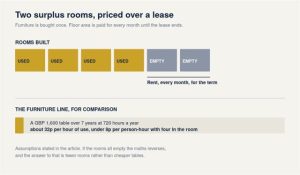
Surplus rooms are a rent commitment for the length of the lease. The furniture line is a single purchase.
Replacement cycles are the cost nobody budgets
The expense that appears nowhere in a refurbishment budget is the second purchase.
Contract furniture is tested against published standards. ANSI/BIFMA X5.1, an American standard widely used as a specification point for commercial furniture sold into the UK, puts a tilt mechanism through 300,000 cycles under a 240 lb load and a caster and base assembly through 100,000 cycles including passes over an obstacle. Furniture built to domestic specification is not tested against anything comparable.
In a meeting room the consequences are mundane and expensive. Edge banding lifts. Cable ports crack. A leg mechanism fails and the whole table is scrap because the part was never stocked. You buy again in year three at year-three prices, plus disposal, plus the day the room is out of service.
A finance function modelling a seven-year life on an item that will realistically last three has understated the cost by roughly the price of the item. This is the same failure pattern that shows up in budgeting for IT consulting and managed services, where the visible purchase price sits in the budget and the recurring commitment behind it does not.
Ask the capital allowances question before the order goes in
Refurbishment spending may attract capital allowances, and the Annual Investment Allowance is set at £1 million per accounting period for sole traders, partnerships and limited companies alike, according to GOV.UK.
The part worth attention is that a fit-out is not treated as one homogeneous purchase. GOV.UK’s guidance defines integral features as a specific category, covering lifts, heating and air conditioning systems, hot and cold water systems and electrical systems including lighting. Fixtures are addressed separately. Loose furniture is not enumerated alongside either group.
The practical consequence is that “we will get the allowances anyway” is an assumption rather than a plan. The answer depends on the specific items, how they are installed, and how the business is structured, so it is a question for your accountant before the order is placed rather than at the year end. Businesses that ask early sometimes find the split between fixed and loose items is worth structuring around.
Where the counter-argument holds
There is a reasonable case on the other side and it applies to any business that does not know what its space will look like in eighteen months.
If you are pre-Series A, on a two-year lease, or growing at a rate that makes every floor plan provisional, furniture designed to last a decade is an option you will not exercise. Cheap and replaceable is the right answer, and the room count discipline above matters more in that situation, not less.
The argument for durable furniture is an argument for stability. Where the stability is not there, do not pay for it. Where it is, the seven-year model is the one to defend, and defending it starts with refusing to sign off a plan for six rooms when the diary supports four.
This article is general information rather than tax or financial advice. Confirm your own position with a qualified adviser.