

Scan tool for diesel trucks: Powerful efficiency
Sponsored content. This article was supplied by a third party and Business Money has been paid to publish it.
Optimizing bulk material transport with advanced scanning technology
The evolution of payload measurement in fleet logistics
 Optimizing the transport of bulk materials is a critical factor for profitability and efficiency across numerous industries, from mining to construction. Every truckload represents a significant investment, and ensuring each one is perfectly loaded can prevent costly overloads, maximize revenue, and reduce wear and tear on equipment.
However, traditional methods often fall short, leading to guesswork, delays, and lost opportunities. This is where advanced scanning technology steps in, offering a transformative approach to payload management.

We will explore how these innovative solutions are revolutionizing fleet logistics. We will delve into the evolution of payload measurement, examine key technologies like laser-based volumetric scanning systems, and discuss how they overcome common industry challenges. For heavy-duty operations, especially in industries relying on precise volumetric measurements, solutions for Diesel truck load scanning are becoming indispensable.

Join us as we uncover how these tools enhance efficiency, reduce costs, and drive data-driven decision-making in bulk material transport.
For decades, the measurement of payloads in bulk material transport relied heavily on rudimentary and often inaccurate methods. Visual estimation, while quick, was notoriously unreliable, leading to frequent underloading (lost revenue) or overloading (fines, safety hazards, and accelerated equipment wear). Static weigh scales, a more precise alternative, introduced significant bottlenecks into operations. Trucks had to stop, often unhitch, and wait their turn on the scale, adding considerable time and complexity to each cycle. These traditional approaches, while serving their purpose in an era of less stringent regulations and lower operational costs, are no longer sufficient for the demands of modern fleet logistics in July 2026.
The imperative for greater accuracy, efficiency, and safety has been the primary driver behind the evolution of payload measurement. As industries became more competitive and margins tightened, the financial implications of even slight inaccuracies in bulk materials transport became magnified. Every ton of material represents revenue, and ensuring that each truck carries its optimal, legal, and safe payload is paramount. This shift has led to the widespread adoption of advanced volumetric scanning technologies.
Volumetric scanning offers a superior alternative, particularly for bulk materials where density can vary significantly. Unlike traditional scales that measure gross weight, volumetric scanners precisely determine the volume of material. By applying known or estimated density factors, these systems can then provide a highly accurate payload analysis. This level of detail is crucial for materials like aggregates, sand, coal, or waste, where moisture content or compaction can alter density without changing the visual volume. This precision directly translates into enhanced haulage efficiency. Fleets can ensure trucks are loaded to their maximum legal capacity without exceeding safety limits, optimizing resource utilization, reducing the number of trips required, and ultimately lowering operational costs per ton moved.
The integration of technology has been key to enabling this evolution. Modern systems are no longer just measuring devices; they are intelligent tools that provide real-time data, allowing for immediate adjustments to loading processes. This data-driven approach to payload management extends beyond simply knowing the weight or volume of a load. It encompasses a comprehensive understanding of how efficiently a fleet is operating, identifying opportunities for improvement in loading practices, route optimization, and overall logistics planning. The financial benefits are substantial: avoiding costly overloading fines, maximizing revenue per trip, optimizing fuel consumption by eliminating dead weight or inefficient loads, and extending the lifespan of valuable heavy equipment. This continuous pursuit of optimization underscores the critical role that advanced payload measurement plays in the strategic management of modern bulk material fleets.
Key technologies powering industrial load scanning
The leap from traditional payload measurement to sophisticated industrial load scanning has been facilitated by advancements in sensor technology and data processing. At the heart of these modern systems lies the ability to create precise digital representations of truck beds and their contents, providing unparalleled insights into loading operations.
Laser-based volumetric scanning systems
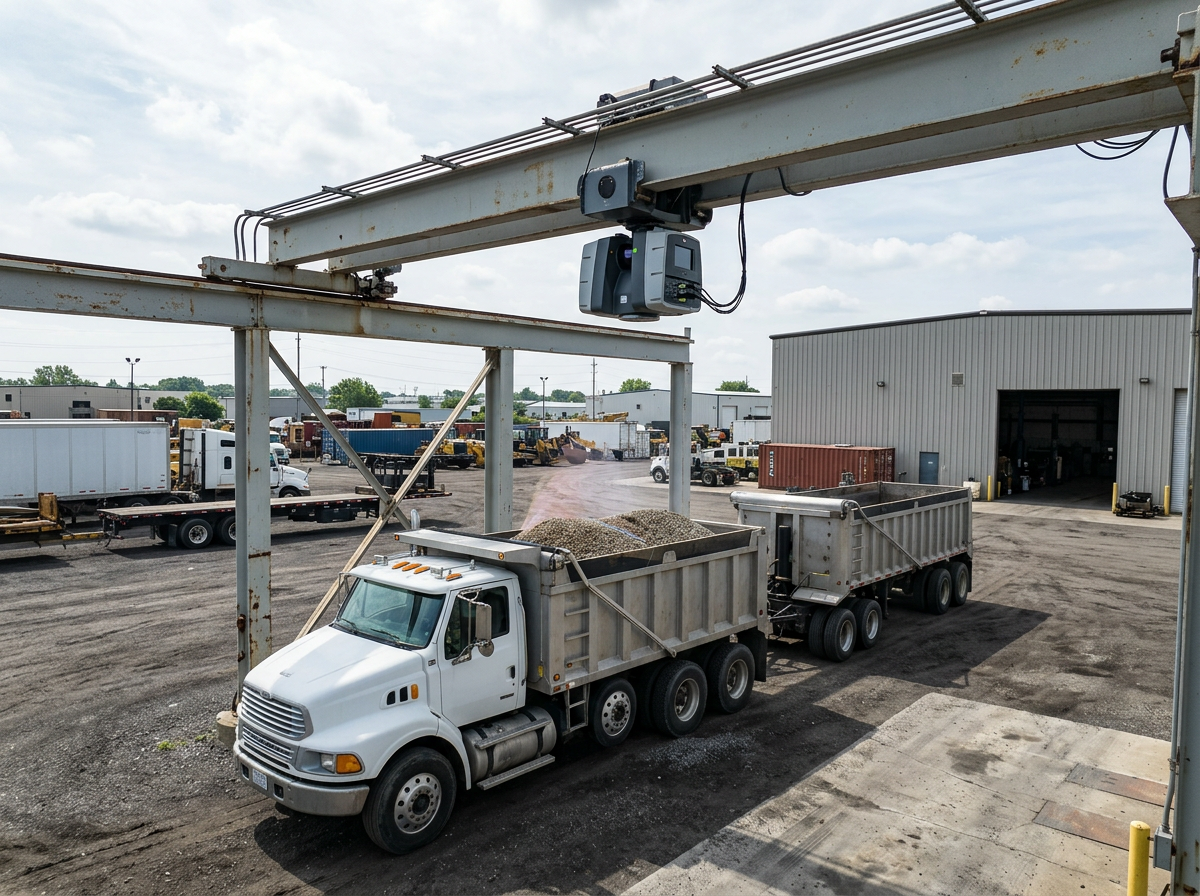
The cornerstone of modern industrial load scanning is the laser-based volumetric scanning system, primarily utilizing LIDAR (Light Detection and Ranging) technology. These systems operate by emitting rapid pulses of laser light and measuring the time it takes for these pulses to return after reflecting off surfaces. By collecting millions of these data points, the scanner constructs an incredibly detailed and accurate three-dimensional map of the truck bed and the material within it.
The process of volume calculation is precise and systematic. First, the empty truck bed is scanned to establish a baseline, creating a digital “template” of its internal dimensions. This empty scan accounts for any permanent fixtures, wear, or unique characteristics of that specific vehicle. Once loaded, the truck passes under the scanner again. The system then captures a new 3D map of the loaded bed. The magic happens in the software: by digitally subtracting the empty volume from the loaded volume, the system determines the exact volume of the material being transported.
A critical advantage of this volumetric approach is its ability to handle materials with varying densities. While the scanner measures volume, operators can input or dynamically apply density factors (e.g., for different types of aggregates, coal, or soil) to convert the measured volume into an estimated weight. This provides a more comprehensive and nuanced payload analysis than traditional weigh scales, which only measure total mass and cannot account for the variability of bulk materials. The accuracy and speed of these LIDAR-based systems are remarkable, often completing a scan in mere seconds as a truck drives through, far surpassing the time and potential for human error associated with manual inspections or static scales. Furthermore, these systems provide real-time data, allowing for immediate feedback to loader operators to adjust loading practices on the fly, ensuring optimal and compliant loads every time.
Integrating industrial load scanning with fleet management
The true power of industrial load scanning systems is unlocked through their seamless integration with broader fleet management ecosystems. The data generated by these scanners is not an isolated piece of information; it’s a vital input that enriches an organization’s entire logistics and operational intelligence.
This integration is typically achieved through API (Application Programming Interface) connections, allowing the scanning systems to communicate directly with existing fleet management software, Enterprise Resource Planning (ERP) systems, and dispatch platforms. This means that as a truck is scanned, its precise load volume and estimated weight can be automatically transmitted and recorded against its trip manifest, driver, material type, and destination.
The benefits of incorporating this telemetry data are profound. Fleet managers gain a holistic view of their operations, tracking not just load volumes and weights, but also cycle times, truck movements, and overall operational efficiency metrics. This data can be used to identify bottlenecks, optimize routes, and fine-tune loading procedures. For instance, if a specific loading zone consistently produces underloaded trucks, the data immediately highlights this inefficiency, prompting corrective action.
Automated ticket generation is another significant advantage. With scan data automatically populating delivery tickets, invoices, and compliance reports, the administrative burden is drastically reduced. This eliminates manual data entry errors, accelerates billing cycles, and ensures that all documentation is accurate and consistent with the actual payload. The integration transforms raw scan data into actionable intelligence, enabling better planning, more efficient resource allocation, and a proactive approach to fleet management. It creates a robust, data-driven environment where every load contributes to a clearer understanding of operational performance and profitability.
Overcoming common challenges in bulk material transport
Bulk material transport is fraught with challenges that can erode profitability, compromise safety, and increase operational costs. From inefficient loading practices to premature equipment wear, these issues demand sophisticated solutions. Industrial load scanning systems provide the precision and data necessary to mitigate these pervasive problems effectively.
Eliminating carry-back and spillage
Two of the most insidious problems in bulk material transport are carry-back and spillage. Carry-back refers to material that remains in the truck bed after unloading, effectively becoming “dead weight” that is transported unnecessarily. This not only wastes fuel and reduces the capacity for the next load but also leads to inaccurate inventory counts and potentially higher disposal costs if the material is waste. Spillage, on the other hand, occurs when material falls off the truck during transport due to overloading or uneven distribution. This creates safety hazards on roads and worksites, necessitates costly cleanup operations, results in material loss, and can lead to environmental compliance issues and fines.
Industrial load scanning systems directly address both these problems through their precise measurement capabilities. By performing an empty bed calibration—scanning the truck after it has supposedly unloaded—the system can accurately detect any residual carry-back. This ensures that trucks are genuinely empty before they are reloaded, preventing the transport of dead weight and ensuring that each new load calculation is based on an accurate tare volume. The data can also be used to identify issues with unloading equipment or procedures.
Furthermore, the real-time feedback provided by these scanners during the loading process is critical in preventing spillage. Loader operators can see the exact volume and distribution of material in the truck bed, allowing them to load to optimal capacity without overfilling or creating hazardous, uneven loads. This precise control reduces the likelihood of material falling off during transit, enhancing site safety, minimizing material loss, reducing cleanup costs, and helping to maintain environmental compliance. The ability to quantify and eliminate carry-back and spillage translates into significant cost savings and operational efficiencies.
Optimizing asset lifecycle and reducing wear
The heavy-duty trucks used in bulk material transport represent substantial capital investments. Their operational lifespan and maintenance costs are heavily influenced by how they are loaded and operated. Improper loading—particularly overloading or uneven weight distribution—is a major culprit behind accelerated wear and tear, leading to increased suspension stress, premature tire wear, and higher fuel consumption. These factors collectively drive up the total cost of ownership (TCO) and can lead to unexpected downtime, which is often far more expensive than the repair itself.
Precise load scanning systems play a pivotal role in optimizing the asset lifecycle by ensuring that every load is optimal and balanced. By providing accurate volumetric and estimated weight data in real-time, these systems empower loader operators to distribute weight evenly across the truck’s axles. This balanced loading significantly reduces localized stress on suspension components, chassis, and tires. When loads are consistently within legal and manufacturer-recommended limits, the structural integrity of the vehicle is maintained for longer, delaying the onset of fatigue-related failures.
The benefits extend to fuel efficiency as well. Overloading forces the engine to work harder, consuming more fuel per mile. Transporting carry-back also means burning fuel to move unproductive weight. By eliminating these inefficiencies, load scanning contributes to a noticeable reduction in fuel consumption. Moreover, by reducing the stress on critical components, maintenance intervals can be extended, and the frequency of costly repairs due to premature wear is diminished. The result is an extended vehicle lifespan, lower maintenance costs, improved fuel economy, and crucially, safer operation due to better vehicle stability and control. Industrial load scanning transforms loading from a potential source of damage into a strategic process that preserves asset value and maximizes operational uptime.
Frequently asked questions about industrial load scanning
What is industrial load scanning and how does it work?
Industrial load scanning is a sophisticated technology designed to accurately measure the volume of bulk materials loaded into transport vehicles, such as heavy-duty diesel trucks. It typically employs advanced sensors, most commonly laser (LIDAR) technology, to create a precise three-dimensional digital model of the truck’s cargo area. The process generally involves two scans: first, an “empty” scan of the truck bed to establish a baseline volume, and second, a “loaded” scan after the material has been placed. By subtracting the empty volume from the loaded volume, the system accurately calculates the net volume of the material. This volumetric data can then be converted into an estimated weight by applying known or calculated density factors for the specific material, providing comprehensive payload information in real-time.
How does industrial load scanning compare to traditional truck scales?
Industrial load scanning offers several distinct advantages over traditional static truck scales, though both have their place in logistics. Scales measure the direct weight of a vehicle and its contents, requiring the truck to stop completely and often queue, which can introduce significant delays and bottlenecks into operations. Load scanning, conversely, measures volume and can often do so “in-motion” or with only a brief pause, greatly increasing throughput and efficiency. For bulk materials where density can vary (e.g., due to moisture content or compaction), volumetric scanning followed by a density conversion can provide a more accurate representation of the actual material transported than a simple gross weight measurement. Additionally, scanning systems can detect carry-back (material left in the truck bed after unloading) and provide detailed load distribution analysis, capabilities that traditional scales lack. They are also less susceptible to environmental factors like mud or debris affecting scale accuracy.
Which industries benefit most from industrial load scanning systems?
Industries that deal extensively with the transport of bulk, loose, or variable-density materials stand to benefit most significantly from industrial load scanning systems. This includes, but is not limited to:
- Mining: For precise measurement of ore, overburden, and aggregates.
- Construction: For tracking sand, gravel, asphalt, and demolition debris.
- Aggregates and quarries: Ensuring accurate loading of crushed stone, sand, and other raw materials.
- Waste management: Measuring volumes of municipal waste, recycling, and hazardous materials.
- Agriculture: For crops, feed, and fertilizers.
- Forestry: Measuring wood chips, logs, and biomass.
- Port operations: For efficient loading and unloading of bulk cargo onto trucks. Essentially, any operation where maximizing payload, ensuring compliance, reducing operational costs, and gaining real-time insights into material movement is critical will find immense value in these advanced scanning solutions.
Conclusion
The landscape of bulk material transport has undergone a profound transformation, moving from an era of approximation to one of precision. The adoption of advanced scanning technology, particularly laser-based volumetric systems, has been a cornerstone of this evolution. We have seen how these innovative solutions deliver substantial efficiency gains by ensuring optimal loading, eliminating costly carry-back, and preventing hazardous spillage. The real-time data provided by these systems empowers fleet managers and operators to make informed decisions, transforming logistics from guesswork into a data-driven science.
Beyond the immediate operational improvements, the strategic advantages are clear: significant cost reductions through optimized fuel consumption, extended asset lifecycles due to reduced wear and tear, and enhanced safety for both personnel and the public. Environmental compliance is also strengthened as accurate loading minimizes waste and spillage. As we look towards the future of transport, the integration of smart technologies like industrial load scanning will only become more critical. It represents an investment not just in equipment, but in a more optimized, sustainable, and profitable future for the entire bulk material transport industry. The journey towards truly intelligent logistics is well underway, and advanced scanning technology is leading the charge.