

Packaging strategies in marketing
Sponsored content. This article was supplied by a third party and Business Money has been paid to publish it.

Photo by cottonbro studio
Packaging is no longer simply a protective layer placed around a product. In modern marketing, it can influence how customers recognise a brand, understand a product, compare alternatives, and remember their purchasing experience. From the material and structure to the colours and printed messaging, packaging communicates information before a customer has even used the product.
An effective packaging strategy connects these physical elements with broader marketing objectives. Businesses need to consider their target audience, product positioning, sales environment, functionality, and customer expectations when deciding how packaging should look and perform. When these factors are aligned, packaging can become a practical extension of the brand’s marketing strategy.
Build packaging around brand identity
A strong packaging strategy begins with a clear understanding of the brand. Packaging should reflect the qualities a business wants customers to associate with its products, whether those qualities are premium quality, simplicity, convenience, creativity, sustainability, or affordability.
Colours, typography, logos, imagery, materials, and structural formats can all contribute to brand recognition. Consistency across different products is particularly useful because customers can begin to associate recurring visual elements with the same company. However, consistency does not mean every product needs to look identical. Packaging can maintain shared brand characteristics while allowing individual products to have their own identity.
Material selection can also influence perception. A carefully chosen paperboard, kraft, corrugated, or specialty material can support the intended positioning when its appearance and performance are appropriate for the product. The objective is to make the physical package reinforce the message communicated through other marketing channels.
Understand the target customer
Packaging decisions should be based on the people who will ultimately interact with the product. Customer expectations can vary significantly depending on age, lifestyle, purchasing habits, product category, and buying environment. Understanding these factors helps businesses create packaging that is relevant rather than simply visually attractive.
Functionality is an important part of customer-focused packaging. Customers may value easy opening, convenient carrying, secure closures, simple storage, or clear product information. A package that solves a practical problem can strengthen the customer’s perception of the product and brand.
The purchasing environment should also influence the strategy. Retail packaging needs to compete for attention on shelves, while e-commerce packaging needs to withstand transportation and still provide a positive delivery experience. Packaging should therefore be designed around the complete customer journey rather than a single moment of purchase.
Use packaging to differentiate the product
In competitive markets, customers are often presented with numerous products offering similar features. Packaging can help establish distinction through structure, graphics, colour, proportions, materials, and finishing. Effective differentiation does not necessarily require an unusual or complicated package; even a clear visual system or useful structural feature can make a product easier to recognise.
Structural formats can provide both marketing and functional benefits. For example, customized gable boxes can combine branded presentation with an integrated carrying handle, making them relevant to products or promotional applications where portability is part of the customer experience. Their structure can also provide a distinctive presentation compared with conventional packaging formats.
Differentiation works best when it has a clear purpose. A distinctive design should help customers identify the product, understand its value, or interact with it more conveniently. When visual appeal and functionality support each other, packaging has a stronger opportunity to stand out without becoming unnecessarily elaborate.
Make the customer experience part of the strategy
Packaging continues to influence customers after they have made their purchasing decision. Opening the package, removing the product, handling the contents, and storing the packaging can all form part of the overall brand experience. Businesses that consider these interactions can create packaging that feels intentional rather than purely functional.
The unboxing experience has become especially relevant for products purchased online or received as gifts. Secure product placement, logical opening mechanisms, attractive presentation, and easy handling can contribute to customer satisfaction. However, an effective experience does not require excessive materials or complicated construction.
Packaging can also extend customer interaction beyond the initial purchase. Practical or reusable packaging may continue to serve a purpose after the product has been removed, while distinctive presentation can encourage customers to photograph or share their experience. These effects can complement broader marketing activities and contribute to brand visibility.
Measure packaging performance and commercial value
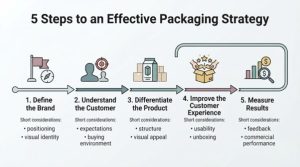 Packaging should be evaluated as a business and marketing investment rather than solely as a creative exercise. Businesses can examine customer feedback, sales performance, product recognition, repeat purchasing, returns, product damage, and other relevant indicators to understand whether packaging changes are achieving their intended objectives.
Testing different packaging concepts can provide useful evidence before committing to a large-scale change. Businesses may compare alternative designs, evaluate customer reactions, test messaging, or introduce a new format within a limited product range. This reduces reliance on assumptions and allows packaging decisions to be refined based on actual responses.
Cost is another important consideration. A more sophisticated package may be worthwhile if it improves protection, strengthens brand recognition, enhances customer experience, or creates meaningful differentiation. At the same time, unnecessary features can increase production and distribution costs without providing an equivalent benefit. The strongest packaging strategy balances marketing impact with practical and commercial requirements.
Packaging strategies in marketing are most effective when they connect brand identity, customer expectations, differentiation, experience, and measurable business outcomes. The package should not simply look attractive; it should communicate the right message, perform its practical function, and support the way customers interact with the product.
When businesses approach packaging as part of the wider marketing strategy, even functional packaging decisions can contribute to stronger brand recognition and customer relationships. The result is packaging that works not only as product protection, but also as a consistent and purposeful part of the brand experience.