

The cool economy: How energy efficiency became big business
Sponsored content. This article was supplied by a third party and Business Money has been paid to publish it.
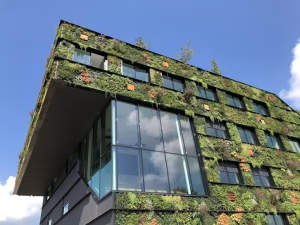
Credit: Unsplash
When Taylor Swift sang about a cruel summer, we doubt she was sounding off about climate change. Suffice to say, summers are about to get more intense, hotter, and, shall we say, cruel.
Big corporations are realizing that going green makes good business sense. The new power move isn’t driving a Tesla but trimming your energy bill. Efficiency has become sexy. Profitable, even. And in today’s climate (pun intended), cutting carbon is the smartest investment in town.
The age of energy efficiency
We’ve entered what the World Bank is calling the “energy efficiency era,” a period where growth and sustainability can coexist.
Industries are no longer guilt-tripped into hugging the planet. It’s about rethinking how we all power it. Efficiency is now a key driver of profit, competitiveness, and resilience. Companies know that every wasted watt is money leaking out the window.
According to ABB’s latest research, energy efficiency has become the decisive factor when businesses choose electric motors. Why? Because efficient systems don’t save power, they save profit margins.
Factories are getting smarter. So are data centers and bakeries. Everyone’s obsessed with squeezing more from less. It’s like corporate weight loss, trimming the energy fat for a leaner, cleaner bottom line.
The cool revolution
Energy efficiency isn’t fancy solar panels or eco lighting. It’s the invisible stuff that keeps the world running smoothly and coolly.
Take a thermal break, for example. These thin conductive materials, which stop heat transfer between steel connections or aluminum parts, are integrated into modern building design. They keep the hot side hot and the cool side cool.
Fabreeka explains that the best thermal break materials act as thermal bridging, helping prevent heat loss, reduce condensation, and cut down on energy costs in big construction projects.
They’re not flashy, but they make buildings and by extension, entire cities, far more energy-efficient.
Green is the new black
Gone are the days when sustainability sat at the kids’ table. It’s now front and center in boardrooms and investment portfolios.
A few decades ago, the Carbon Trust made the business case loud and clear: energy efficiency improves performance, reduces costs, and boosts brand reputation. It’s the triple win that no CEO can ignore.
Even Bain & Company, the folks that turn spreadsheets into gospel, are preaching the same message: energy efficiency can no longer be ignored. Their research shows businesses that actively manage energy performance are faster, smarter, and more resilient in a shaky economy.
And investors? They’re eating it up. Sustainable funds are now outperforming traditional ones. Being energy-efficient is economical. As the saying goes, money talks, and right now it’s saying, “Use less power.”
Numbers don’t lie
ABB’s 2025 report revealed that the number of businesses investing in energy efficiency jumped 7% from 2022.
According to Energy Digital, companies like Siemens and Honeywell are pioneering new technologies that make factories, offices, and homes smarter. These giants turn efficiency into a competitive edge.
Meanwhile, scientists believe that we can’t efficiency-our-way-out of the climate crisis entirely. Yet, they also admit that it’s the easiest win we have right now. It’s immediate, measurable, and profitable.
The power of pop culture
Climate talk used to bore people to tears. Today, it’s trending. Energy efficiency is the new avocado toast; it’s everywhere.
Podcasts are buzzing about carbon footprints. TikTokers are flexing their low-energy homes like status symbols. And the most skeptical politicians are realizing that “saving money and jobs” polls better than “saving the ice caps.”
Here’s the truth: no one wants to argue about climate change anymore. They want their bills lower, their air cooler, and their conscience clear.
The business of being smarter
If you haven’t noticed by now, energy efficiency is a strategy. When Bain & Company crunched the numbers, they found that the most energy-efficient businesses were also the most resilient to market shocks.
The World Bank argues that investing in energy efficiency is one of the fastest ways to reduce emissions while creating jobs. Think electricians, retrofitting crews, engineers, and auditors. These are all green jobs that pay well.
Meanwhile, ABB’s electric motor data shows that more efficient systems can cut global electricity consumption by 10%. This is basically the same as taking every car in America off the road.
Now is the time to act rather than bury our heads in the sand. Climate change is here, and it’s saying loud and clear that denial is no longer an option. It’s a chance for businesses to step up and take the lead.
Efficiency isn’t solely about saving money. It’s saving time. And maybe, just maybe, it’s saving us.