

The ROI behind well-planned commercial outdoor spaces
Sponsored content. This article was supplied by a third party and Business Money has been paid to publish it.

Photo by Reggie B on Unsplash
In the modern commercial real estate landscape, the utilization of square footage has evolved far beyond interior walls. Business owners, developers, and property managers increasingly recognize that the exterior environment is a powerful, underutilized asset. Whether it is an open-air dining patio for a restaurant, a rooftop lounge for a boutique hotel, or a green courtyard for a corporate office, well-planned commercial outdoor spaces are proving to be substantial revenue drivers.
This shift is propelled by a fundamental change in consumer and employee behavior; people actively seek out environments offering fresh air, natural light, and a connection to nature. Consequently, investing in high-quality exterior infrastructure is no longer viewed merely as an aesthetic luxury; it is a strategic financial move. This article explores the tangible Return on Investment (ROI) behind well-planned commercial outdoor spaces, demonstrating how thoughtful exterior design directly translates into increased commercial vitality, elevated property values, and sustained business growth.
Design, functionality, and local context
Achieving these high returns requires more than just placing generic furniture outside. A lucrative commercial outdoor space demands meticulous planning, durable material selection, and professional execution. The design must be tailored to the local climate to ensure multi-season utility. In regions with distinct seasonal shifts, integrating heating elements, custom shade structures, and robust drainage systems extends the usable lifecycle of the space. To navigate these complexities, developers frequently collaborate with regional experts who understand local zoning laws and climate demands. Engaging professional deck builders in Cincinnati allows local businesses to construct resilient outdoor platforms that withstand regional weather extremes while adhering to commercial building codes, ensuring capital expenditures result in permanent assets.
Boosting commercial vitality and foot traffic
To understand the financial impact of outdoor environments, one must analyze how they influence consumer behavior. An attractive, functional outdoor area acts as a visual magnet, drawing in foot traffic that might otherwise overlook a business. When consumers occupy an outdoor space, it creates a sense of vibrancy that naturally signals popularity to onlookers, driving further engagement.
This economic phenomenon is backed by urban planning research. For instance, a study on urban commercial environments published by the National Institutes of Health demonstrates that the spatial configuration of open spaces plays a critical role in market performance. The findings reveal that convex and scatter-occupying spontaneous spaces have the most significant positive impact, increasing commercial vitality by an average of 22.4% and 16.8%, respectively. This increase translates to higher customer retention, extended dwell times, and greater transaction volumes. When an outdoor layout is planned effectively, it optimizes patron movement, allowing businesses to capture a larger market share and maximize revenue potential.
Maximizing property value and rental income
Let’s look at how outdoor upgrades affect the underlying numbers:
- Attracting High-Profile Tenants: Premium outdoor amenities allow landlords to command a distinct advantage in a competitive leasing market.
- Commanding Rental Premiums: Businesses are willing to pay more for properties that feature expansive decks, covered pergolas, and functional landscaping that enhance their brand image.
- Optimizing Capitalization Rates: Transforming underutilized concrete lots into premium exterior retreats fundamentally improves long-term valuation metrics.
The long-term financial ramifications of these upgrades are profound. Research compiled in an academic economic report available highlights that strategic investments in public and commercial spatial enhancements deliver dramatic fiscal rewards. The analysis notes that a substantial increase in cash flow and the successful attraction of high-profile tenants can boost gross income by up to 82% and overall property value by up to 84%.
The human element and operational efficiency
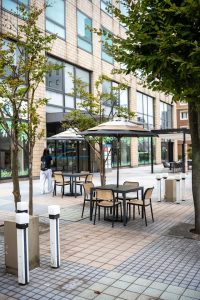
Photo by Kouji Tsuru on Unsplash
The ROI of outdoor spaces also extends into the corporate sector, where the focus shifts to employee productivity and retention. Modern workforce strategies emphasize biophilic design – the practice of connecting building occupants with natural elements. Providing employees with access to well-designed outdoor break areas or open-air workspaces has been shown to reduce workplace stress, combat mental fatigue, and boost cognitive function. Higher productivity and lower turnover rates contribute directly to an enterprise’s bottom line by reducing recruitment costs.
From an operational standpoint, outdoor spaces offer a cost-effective method for expanding capacity. Building a traditional indoor expansion requires extensive structural renovations, HVAC integration, and drywall installation, carrying a steep price tag per square foot. In contrast, developing an outdoor deck or patio achieves a similar increase in usable footprint at a fraction of the cost, providing a much faster path to profitability.
The financial justification for investing in commercial outdoor spaces is clear and multifaceted. Whether the goal is to increase restaurant seating capacity, elevate retail foot traffic, command higher lease rates, or foster a productive corporate environment, the outdoor arena represents an unparalleled opportunity. When executed with the right design principles and professional craftsmanship, a well-planned commercial outdoor space ceases to be a mere expense and becomes an enduring engine for financial return.