

Transitioning to scalable card processing infrastructure strategies
Sponsored content. This article was supplied by a third party and Business Money has been paid to publish it.
 Payment downtime during peak sales events destroys revenue in minutes. For engineering and payments leaders in 2026, resilient payment processing infrastructure is not an IT project — it is a direct lever on conversion rates and global market expansion.
Key Takeaway: Scalable payment infrastructure connects technical architecture to business outcomes — higher authorization rates, faster market entry, and protected revenue at peak load.
What is payment infrastructure and why does it matter?
Payment infrastructure is the backbone connecting a business to the global financial system — gateways, processors, APIs, and settlement rails that authorize, clear, and settle every transaction. Legacy systems accumulate technical debt in payments and crack under volume. Modern stacks treat it as a dynamic layer that adapts to demand.
Modernizing delivers three measurable outcomes:
- Faster market expansion — Multi-currency support cuts time to enter new geographies from months to weeks.
- Lower technical debt — Cloud-native architecture replaces brittle custom integrations with maintainable components.
- Higher authorization rates — Intelligent routing improves approval rates on cross-border transactions.
Scaling payments is a growth decision with direct revenue impact, not just an infrastructure upgrade.
Core components of a modern payment ecosystem
A global payment system is a coordinated stack of specialized components. Understanding each role at scale clarifies where bottlenecks form and where investment pays off.
| Component | Function at scale |
| Payment gateways | Encrypt and transmit transaction data to the processor |
| Payment processors | Execute authorization between gateway and issuing bank |
| Acquiring banks | Hold the merchant account; connection quality affects approval rates and FX costs |
| Payment APIs | Connect business logic to infrastructure; enable orchestration and faster integration |
| Settlement rails | Move funds post-authorization; rail selection affects speed, cost, and FX handling |
The interaction between layers — not just the layers themselves — determines whether the ecosystem holds under load or collapses during a traffic spike.
The lifecycle of a high-volume transaction
Every payment travels through three sequential stages. At high-volume transaction processing, each stage becomes a potential bottleneck that throttles conversion rates.
- Authorization — The gateway routes the transaction to the processor and issuing bank. Single-threaded routing causes bottlenecks; response times above 2–3 seconds measurably increase cart abandonment.
- Clearing — The issuing bank confirms and earmarks the funds. Mismatched data fields or timeout errors produce false declines — invisible to the merchant but real lost revenue.
- Settlement — The acquiring bank credits the merchant account. Rail selection determines whether funds arrive in hours or days, with direct impact on working capital.
Eliminating bottlenecks at authorization delivers the highest conversion impact — it is where milliseconds separate completed from abandoned purchases.
Architectural best practices for scaling payments
On-premise payment stacks overprovision for average load and still fail at peak. Modern payment orchestration runs on elastic, distributed infrastructure that scales with real demand.
Key Takeaway: Moving to cloud-native payment infrastructure is the single most impactful architectural decision a payments team can make in 2026.
Leverage cloud-native auto-scaling and load balancing
During a Black Friday spike, auto-scaling spins up additional compute in seconds without manual intervention. Load balancing distributes transactions across multiple nodes, eliminating single points of failure. Cloud-native payments environments respond to actual demand curves automatically and maintain sub-second authorization response times regardless of volume.
Ensure geographic redundancy and failover
Geographic redundancy runs infrastructure across multiple regional data centers. When one node fails, automatic failover switches traffic in seconds. Without it, a localized outage produces a full checkout blackout — typically 20–40 minutes of lost revenue while engineers reroute manually. Global payment systems cannot treat redundancy as optional.
Implement payment orchestration and smart routing
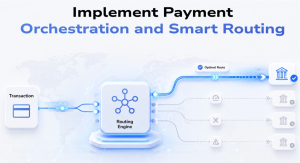
Payment orchestration routes each transaction in real time to the acquirer most likely to approve it at the lowest cost. This goes beyond static routing rules — the engine adapts to live performance data across connections.
Smart transaction routing delivers three direct benefits:
- Higher approval rates — Routing around underperforming acquirers reduces false declines on legitimate transactions.
- Lower cross-border fees — Directing payments through local acquiring banks in the destination currency cuts FX conversion costs.
- Built-in failover — When a primary acquirer times out, the layer retries through an alternate route in milliseconds.
Payment orchestration is the control plane that makes distributed infrastructure measurable for finance teams.
Overcoming B2B payment infrastructure challenges
B2B payment flows carry complexities that consumer architectures handle poorly: high transaction values, bulk invoice processing, and Days Sales Outstanding (DSO) that directly affects working capital.
Automated reconciliation through payment APIs eliminates manual matching — freeing finance teams from the technical debt in payments that compounds every month-end.
Modern B2B payment infrastructure connects to ERP systems via API, mapping every payment to the correct invoice or workflow automatically. API-driven bulk processing handles high-volume invoice batches in a single operation rather than sequential manual entry.
Scalable vs. legacy payment systems: Key differences
Legacy systems hinder global expansion through accumulated friction — slower integrations, missed markets, and per-transaction costs that compound at scale.
| Feature | Legacy systems | Scalable infrastructure |
| Integration speed | Weeks to months | Days via payment APIs |
| Cross-border | Limited currency support, high FX costs | Native multi-currency with smart routing |
| Uptime under load | Degrades at traffic peaks | Auto-scales consistently |
| Architecture | On-premise or partial cloud | Fully cloud-native with geo-redundancy |
| Compliance updates | Manual, slow | Automated, provider-managed |
Every new market entry on a legacy foundation costs more than it should, and each integration adds technical debt to the next.
Security and compliance at scale
 Security must scale in lockstep with payment infrastructure — without adding latency to authorization speed.
Three non-negotiable protection layers in any high-volume payment stack:
- PCI-DSS Compliance — Mandates storage, transmission, and processing of cardholder data; requires automated scanning and segmented network architecture across every system that touches card data.
- Tokenization — Replaces card numbers with non-sensitive tokens at capture, ensuring raw data never enters merchant infrastructure and significantly reducing PCI-DSS scope.
- Automated AML/KYC Monitoring — Real-time screening for suspicious patterns and sanctions exposure; at high volumes, manual AML processes break down and automation is the only viable model.
Embedding these controls at the infrastructure level ensures compliance scales automatically and never becomes a bottleneck during growth.
TODA Pay builds payment infrastructure for global scale
TODA Pay holds a Canadian MSB (Money Services Business) license — the federal regulatory credential underpinning its compliant cross-border payment operations across North American and global corridors. Combined with PCI-DSS compliance, payment orchestration, and multi-currency support, TODA Pay delivers the payment processing infrastructure that high-volume B2B operations need in 2026.
Explore Card Payment Solutions to see how TODA Pay handles high-volume, cross-border card processing at scale.