

What is the role of artificial intelligence in optimizing SaaS operations?
Sponsored content. This article was supplied by a third party and Business Money has been paid to publish it.
If you’re in SaaS, chances are AI has already crept into your world. Maybe you’re about to test a new tool that claims to save hours, or scrolled past yet another AI “debate” on Reddit. It could be that the manager has just asked you to do more with less.
And it can all happen on the same day.
The truth is, AI is starting to reshape how SaaS really works. It’s not about replacing people but about making operations leaner, smarter, and easier to scale. And the companies that learn how to use it well are already reaping huge profits.
So the real question isn’t if AI belongs in SaaS. The question is how AI optimizes SaaS operations in ways that drive efficiency and open the door to smarter growth.
Key benefits of AI for SaaS businesses

Image via McKinsey
We’ll discuss the role of AI in optimizing SaaS operations in a jiff, but first, let’s understand what your business stands to gain.
There’s a reason, or several, why AI adoption has increased to 78% in 2024, up from 55% in 2023.
Here are the benefits of using AI in your SaaS business:
- Smarter decision-making with clear data
- Faster workflows with less manual work
- Accurate financial records and reports
- Clearer insights into customer needs and behavior
- Easier scalability without extra costs
- Real-time monitoring to spot security risks early
- More reliable forecasts
- Clearer visibility into overall performance
The role of AI in optimizing SaaS operations
Here are the various aspects in which AI helps improve SaaS operations.
1. Streamlining revenue recognition and financial compliance
For SaaS companies, revenue recognition is absolutely important, but it can get messy fast. Think of a customer who upgrades mid-cycle, then pauses, then restarts. How do you log that without creating a financial mess?
Subscriptions, renewals, upgrades, and usage-based pricing can be a maze. And if you get it wrong, your financial reports lose credibility.
AI automatically tracks revenue from every subscription, renewal, and upsell, so you’re not stuck reconciling numbers at the end of the month. For SaaS business owners, Younium and other revenue recognition software use AI to ensure compliance with standards like ASC 606 and IFRS, without the manual headaches.
On top of that, AI can spot unusual billing spikes. Say a customer gets charged twice because of a system glitch. AI flags it before it snowballs.
2. Sales strategies and training
Let’s be honest: selling SaaS products isn’t easy. Competition is fierce, and what worked last year may flop today. AI makes training more precise by analyzing call transcripts, deal outcomes, and sales performance.
Instead of generic “everyone gets the same training” sessions, your reps get personalized coaching. Weak in closing? Struggle with handling objections? AI highlights that and suggests fixes. As a Flow State Sales expert says, a well-trained sales team can achieve better results if it gets better sales training from expert sales trainers.
It even learns from your top performers and builds training programs around their habits. That means instead of lagging behind market shifts, your team adapts quickly.
3. Improving customer communication
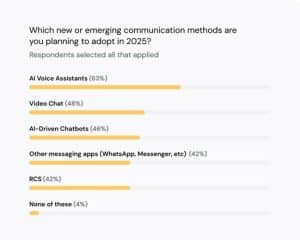
Image via Sinch
We’ve all had that experience of waiting days for a support reply. In SaaS, that wait can cost you a customer. That’s why effective customer communication can make or break your SaaS business.
Nevertheless, managing email threads, tickets, and chats can quickly overwhelm your team. AI sorts incoming messages, flags urgent ones, and even drafts context-based responses. That means faster replies, fewer bottlenecks, and more consistent communication.
Imagine a customer stuck during onboarding. AI keeps that ticket from getting buried under a pile of routine billing questions.
Timetoreply stresses that quick responses are non-negotiable now. And with 95% of SaaS leaders planning to use AI in different communication channels, staying behind isn’t an option.
4. Personalizing customer onboarding
First impressions count. If onboarding feels clunky, customers drop off before they even sign up and see your SaaS product’s value.
AI can help make this process far more effective, something 73% of business leaders agree on.
It analyzes how a customer interacts with your product and tailors the steps accordingly. Instead of a generic walkthrough, they get a guided path that makes sense for them. A finance manager gets guided toward reporting features, while a developer is shown integrations first.
Customers hit their “aha moment” faster, feel supported from day one, and are more likely to stick around.
5. Predicting customer churn
Here’s a nightmare: you realize a major account has gone silent only after they cancel. Churn is the silent revenue killer. Lost customers mean lost revenue, higher acquisition costs, and a shaky growth plan.
AI tracks login frequency, feature use, and even delayed payments. If engagement starts dropping, it waves a red flag. For example, if a customer who usually logs in daily suddenly skips a week, AI alerts your team.
This gives you a chance to step in, maybe with a call, support check-in, or discount. Over time, AI learns which signals are the strongest predictors. That’s how AI optimizes SaaS operations by protecting your revenue before it slips away.
6. Forecasting cash flow and subscription growth
Forecasting with spreadsheets only goes so far. They can’t keep up with shifting markets and customer behavior.
AI clears the view, combining billing data, product usage, renewal trends, and market shifts to project cash flow and growth. For instance, it might show that users on your mid-tier plan often upgrade after six months, signaling upsell potential.
These insights go way beyond tracking numbers. They help spot growth opportunities (like upselling) and catch cash flow risks before they hit, so you can plan growth confidently.
7. Enhancing cybersecurity and monitoring
If your SaaS platform was hacked overnight, that could instantly evaporate customer trust. Recovering from that kind of damage is financially and reputationally expensive.
AI minimizes that risk by watching logins, data access, and user activity 24/7. It also learns what “normal” usage looks like for your platform and spots anomalies faster than your team could. For instance, a sudden surge in failed logins or unusual file downloads won’t go unnoticed.
It can also automatically trigger alerts or even block suspicious activity in real time, reducing response time from hours to seconds. Plus, it keeps airtight audit logs without adding extra manual work.
8. Optimizing pricing
The last, but definitely not the least, role of AI in optimizing SaaS operations is choosing the right pricing structure. Pricing can make or break your SaaS growth. Too high, you scare customers away, and too low, you leave money on the table.
AI studies how customers use your product, what features they value most, and how competitors are pricing similar offers. For example, it might show that people are willing to pay extra for faster support, while add-ons like storage barely move the needle.
Those insights can help you experiment with new pricing models and predict how they’ll affect revenue and churn. AI can also highlight which pricing tiers attract your stickiest long-term customers.
Wrapping up
The role of AI in optimizing SaaS operations is no longer a side discussion. It’s now clear that AI is indeed playing an integral part in running SaaS businesses.
So, the question is: where can AI make the biggest impact in your SaaS operations right now? The industry moves quickly, and hesitation can cost growth. If you’re ready to level up, now’s the time to put AI to work.