

When the fingerprint goes to court: What judges actually need to accept algorithmic evidence
Sponsored content. This article was supplied by a third party and Business Money has been paid to publish it.
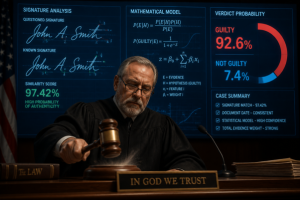 Picture a copyright attorney placing a printout on the courtroom table. It shows a waveform comparison, a percentage similarity score, a timestamp, and the name of a software system nobody in the room has heard of. The attorney announces that the defendant’s uploaded film used protected footage. The opposing counsel asks who built the algorithm, how it was trained, what its error rate is, and whether any peer-reviewed publication has validated its methodology. The judge looks up and asks a simpler question: why should I trust this at all?
That courtroom moment is no longer hypothetical. A video fingerprint — the compact mathematical signature extracted from a piece of media and used to establish a match between a protected work and an allegedly infringing copy — is appearing with increasing regularity as a documentary exhibit in both copyright and criminal proceedings. Fingerprinting video for enforcement purposes has become standard practice across platforms and rights-management pipelines, but the standards a private detection system must meet to flag a pirate stream and the standards it must meet to survive evidentiary challenge in federal court are entirely different conversations. Understanding the gap between those two conversations requires some time in the weeds of American evidence law, a look at how equivalent frameworks handle the same problem outside the United States, and an honest accounting of where video fingerprinting’s best-developed systems still fall short of what courts expect.
What Daubert actually demands
The starting point for any discussion of scientific or technical evidence in American federal courts is a 1993 Supreme Court decision, Daubert v. Merrell Dow Pharmaceuticals, which replaced a looser prior standard and charged trial judges with a specific gatekeeping responsibility: to assess, before any expert testimony or scientifically-derived evidence reaches a jury, whether the underlying methodology is sound enough to be trusted. The Daubert standard is based on that 1993 ruling and is used to assess the reliability and validity of evidence such as computer logs, digital analyses, or other types of digital data, with several factors the court considers: whether the technique has been empirically tested in real-world conditions; whether it has been subjected to peer review and publication; whether its known or potential error rate has been established; and whether it has achieved general acceptance in the relevant scientific community.
None of those criteria is satisfied merely by the fact that a system produces a confident-looking match report. Software that has been deployed commercially across hundreds of platforms is not automatically peer-reviewed. A match confidence score is not a disclosed error rate. The name recognition of a vendor in the anti-piracy industry is not the same as general acceptance in the forensic video analysis community. Each of these distinctions has become a point of contention as algorithmic evidence from content-recognition systems works its way into formal litigation.
Daubert applies in federal courts and in many state courts that have adopted it. Some states still operate under the older Frye standard, which requires only that a technique have achieved general acceptance in its relevant scientific community — a simpler test, but one that can still produce unexpected friction when the “relevant scientific community” is defined more narrowly than the proponent expected.
The Frye problem: Whose community counts?
The Frye question — which community’s acceptance matters? — turned out to be central in one of the most instructive recent cases involving AI-processed video in a courtroom. In State of Washington v. Puloka, a 2024 criminal trial in King County Superior Court, defense attorneys sought to introduce a version of surveillance footage that had been processed through a commercial AI upscaling tool to improve its clarity. The original video was already in evidence; the enhanced version was meant to make crucial details more legible.
The court refused to admit it. The Topaz Video AI enhancement tools, which use machine-learning algorithms, were found to have not been peer-reviewed by the forensic video analysis community, to be not reproducible by that community, and to not be accepted generally in that community. Crucially, the court rejected the defense’s argument that the “video production community” — which does use and accept such tools — was the appropriate reference group. The forensic video analysis community, the court found, was the relevant one, and that community had issued warnings about using AI enhancement tools for evidentiary purposes rather than endorsements.
The deeper finding was more unsettling. The court determined that the enhanced video did not show with integrity what actually happened but instead used opaque methods to represent what the AI model thought should be shown, and that there existed a significant risk of a time-consuming trial within a trial about the non-peer-reviewed process the AI model used. Topaz Labs itself, the developer of the software used, stated in public communications that it strongly recommends against using its technology for forensic or legal applications. The expert who produced the enhanced video was a commercial video editor with no forensic training.
The Puloka ruling is important for video fingerprinting not because fingerprinting and AI enhancement are the same thing — they aren’t — but because it illustrates precisely how courts define the line between a tool that is commercially effective and a tool that is legally credible. Being widely used in industry is not the same as being validated for evidential purposes. The forensic video analysis community is a specific, organized field with established best practices, peer-reviewed literature, and certification standards. Matching to that community’s requirements is a threshold, not a suggestion.
The black box problem and the right to cross-examine
The foundational concern courts have expressed about algorithmic evidence generally — and which applies directly to fingerprint video systems built on machine learning — is the black box problem. If a human expert witness relies on conclusions produced by an AI system that the witness cannot explain, the opposing party has no meaningful ability to cross-examine the decision itself. The expert witness cannot explain the conclusions reached by such an AI system. Defense counsel cannot meaningfully challenge a result without the ability to ask questions about the decisions made by the system. This concern was articulated directly in a National Academy of Sciences publication examining forensic evidence standards, and it has been echoed in law review scholarship and in the reports of federal judicial committees studying how to address algorithmic proof.
The right to confront evidence against you — embedded in the Sixth Amendment in criminal proceedings — implicitly demands some level of transparency about how that evidence was produced. A match report that says “similarity: 94.7%” from a system whose training data, threshold choices, and error characteristics are proprietary tells a court very little it can evaluate. The precision of the number creates the illusion of rigor. The inability to verify what that number means in practice, or how often the system produces that score for non-matching content, is a fundamental gap that numeric confidence cannot paper over.
AI analytical outputs — including what video fingerprinting systems generate — require Daubert expert testimony gatekeeping, with error rate disclosure being essential. They are also subject to Federal Rule of Evidence 403 balancing given the risk of juror deference to numeric outputs. That last concern is real: a jury shown a chart comparing two waveforms with a high match score tends to treat the percentage as more authoritative than it may be. The FRE 403 danger of misleading the jury is heightened, not reduced, by false numeric precision.
What video fingerprinting systems can and cannot prove
This is where the specific capabilities of video fingerprinting matter to the legal analysis. A Content ID match tells you two files share a fingerprint. It does not tell you who created the original, who owns it, or whether the use was licensed. A Content ID claim is not the same as a court ruling — it is an automated platform action based on a match to a rights holder’s reference and ownership data. That distinction, articulated clearly in guidance for copyright practitioners, maps directly onto what a fingerprint match can and cannot establish in litigation.
What a match can establish, if the methodology is properly documented and the expert who testifies about it is credentialed and transparent: that two pieces of media share distinctive structural characteristics that make it unlikely they are unrelated. What it cannot establish on its own: that the rights holder who registered the reference file actually owns the copyright in the work it represents; that the alleged infringer had access to the protected work; or that the use was not licensed, permitted, or protected under a fair use or equivalent defense.
The evidentiary presentation of a fingerprint match therefore typically requires two distinct tracks. The first is technical: establishing that the fingerprinting methodology is valid, that the comparison was performed correctly, that the system’s error rates are known and acceptable, and that the output is what it purports to be. The second is legal: connecting the match to ownership, demonstrating the chain of custody from protected work to reference file to matched content, and addressing any defenses the other side raises about the nature of the use.
Courts scrutinize fingerprint evidence for scientific validity, error rates, and the qualifications of the analyst. Expert witnesses who can authenticate the process are often essential: attorneys retain specialists in digital forensics who can explain methodology, tool validation, and the significance of the match report in plain language. The best video fingerprinting software vendors — including Audible Magic, Vobile, Pex, and platform-native systems — differ significantly in how much of this documentation they provide and how accessible it is to legal teams building an evidentiary record. The best video fingerprinting software for enforcement purposes and the best video fingerprinting software for litigation support are not necessarily the same product evaluated on the same criteria.
The emerging federal framework
Courts were improvising at the intersection of AI and evidence law through most of the 2020s, applying existing rules as best they could. As of 2025, that improvisation became the subject of formal rulemaking. The Federal Judicial Conference’s Advisory Committee on Evidence Rules voted in May 2025 to seek public comment on a proposed Rule 707, which would require federal courts to apply Rule 702’s standards — the standards that govern expert testimony — to machine-generated evidence, treating algorithmic outputs with the same rigor as human expert conclusions.
On August 1, 2025, Louisiana became the first state to establish a framework for addressing AI-generated evidence. Rule 707 was released for public comment in August 2025, with a comment period extending through February 2026. Critics noted that the proposed rule applies only to evidence the proponent acknowledges was created by AI, leaving contested authenticity situations — deepfakes, disputed AI-generated content — without a clear procedural framework. Nevertheless, the rulemaking marks the first formal federal effort to adapt evidence law to machine outputs, and its eventual adoption, in whatever final form, will reshape how video fingerprint evidence is presented and challenged.
International comparisons: How courts outside the US handle it
The United States is not the only jurisdiction grappling with this question. In the United Kingdom, the equivalent of Daubert gatekeeping is performed through the admissibility standards set out in the Criminal Practice Directions and through the court’s inherent authority to exclude unreliable evidence. Expert witnesses in England and Wales must meet obligations of independence and transparency set out in Civil Procedure Rule 35 and the equivalent criminal provisions, and courts have increasingly required digital forensics experts to document not just their conclusions but their methodology, the tools they used, and the limitations of those tools. The absence of peer review for a particular software system is a recognized basis for challenging reliability in UK proceedings.
Across the European Union, the Digital Services Act and the existing e-Evidence framework create a setting in which evidence generated by automated content recognition systems must be traceable to specific technical processes that can be documented, audited, and challenged. The Court of Justice of the EU has emphasized that automated decisions affecting rights require transparency and human review capacity as baseline conditions — principles that, while developed in the administrative and regulatory context, are increasingly shaping what courts in member states expect when algorithmic outputs appear as evidence.
What practitioners actually need
For legal teams preparing to present fingerprint video evidence or challenge it, the practical checklist that emerges from Daubert, Frye, and the emerging federal framework converges on a few consistent demands. The methodology must be documented: not just the output, but the process that produced it, including the algorithm’s architecture, the training data if machine learning was involved, the threshold settings applied, and the validation studies that support those settings. The error rate must be known and disclosed: a system that produces one false positive in ten thousand comparisons presents a very different evidentiary picture than one that has never been tested against a representative population. The expert who testifies about the results must have relevant qualifications: a forensic video analyst rather than a commercial video editor, a data scientist with published work on the specific recognition method rather than a sales engineer from the vendor. And the chain of custody from the protected reference material to the match report must be airtight.
When a party presenting fingerprinting video evidence cannot satisfy these requirements — because the software vendor treats its algorithm as a trade secret, or because the expert lacks credentials recognized by the forensic community, or because the error rate was never measured — the match report is vulnerable. Some vendors and software tools have invested in this documentation; others have not. Choosing among the best video fingerprinting software options requires asking not just whether the system is accurate in testing, but whether it produces output that is legally defensible — documentation that a court can evaluate rather than an opaque score a jury will simply accept.
The score is not the verdict
Courts have been admitting expert fingerprint evidence in criminal and civil proceedings for over a century, and they have developed a framework for doing so that prizes transparency, testability, and the defendant’s opportunity to challenge the method, not just the conclusion. Digital fingerprinting of video operates in a world shaped by that history but complicated by the speed at which algorithmic tools have been deployed for commercial purposes before the legal infrastructure caught up with them.
The match report on the courtroom table is not wrong because algorithms are untrustworthy. It faces scrutiny because the standards that make evidence reliable in a legal context — peer review, disclosed error rates, credentialed testimony, reproducible methods, an adversary’s right to probe — were not designed around systems built to process millions of comparisons per day as private enforcement tools. Those systems serve their purpose efficiently. Translating that efficiency into courtroom credibility is a separate engineering problem, one that the evidence rules committees and forensic video analysts and software vendors are all, slowly, beginning to work on together. The score says 94.7 percent. The judge wants to know what that means, who says so, and how they know.